
脂多糖通过Toll样受体4-核因子-κB信号通路和成肌细胞衍生的肿瘤坏死因子-α抑制C2C12成肌细胞的肌源性分化。
Lipopolysaccharide inhibits myogenic differentiation of C2C12 myoblasts through the Toll-like receptor 4-nuclear factor-κB signaling pathway and myoblast-derived tumor necrosis factor-α.
作者信息
Ono Yuko, Sakamoto Kazuho
机构信息
Department of Pharmacology, School of Medicine, Fukushima Medical University, Fukushima, Japan.
Emergency and Critical Care Medical Center, Fukushima Medical University Hospital, Fukushima, Japan.
出版信息
PLoS One. 2017 Jul 24;12(7):e0182040. doi: 10.1371/journal.pone.0182040. eCollection 2017.
BACKGROUND
Circulating lipopolysaccharide (LPS) concentrations are often elevated in patients with sepsis or with various endogenous diseases that are associated with metabolic endotoxemia. Involuntary loss of skeletal muscle, termed muscle wasting, is commonly observed in these conditions, suggesting that circulating LPS might play an essential role in its development. Although impairment of muscle regeneration is an important determinant of skeletal muscle wasting, it is unclear whether LPS affects this process and, if so, by what mechanism. Here, we used the C2C12 myoblast cell line to investigate the effects of LPS on myogenesis.
METHODS
C2C12 myoblasts were grown to 80% confluence and induced to differentiate in the absence or presence of LPS (0.1 or 1 μg/mL); TAK-242 (1 μM), a specific inhibitor of Toll-like receptor 4 (TLR4) signaling; and a tumor necrosis factor (TNF)-α neutralizing antibody (5 μg/mL). Expression of a skeletal muscle differentiation marker (myosin heavy chain II), two essential myogenic regulatory factors (myogenin and MyoD), and a muscle negative regulatory factor (myostatin) was analyzed by western blotting. Nuclear factor-κB (NF-κB) DNA-binding activity was measured using an enzyme-linked immunosorbent assay.
RESULTS
LPS dose-dependently and significantly decreased the formation of multinucleated myotubes and the expression of myosin heavy chain II, myogenin, and MyoD, and increased NF-κB DNA-binding activity and myostatin expression. The inhibitory effect of LPS on myogenic differentiation was reversible, suggesting that it was not caused by nonspecific toxicity. Both TAK-242 and anti-TNF-α reduced the LPS-induced increase in NF-κB DNA-binding activity, downregulation of myogenic regulatory factors, and upregulation of myostatin, thereby partially rescuing the impairment of myogenesis.
CONCLUSIONS
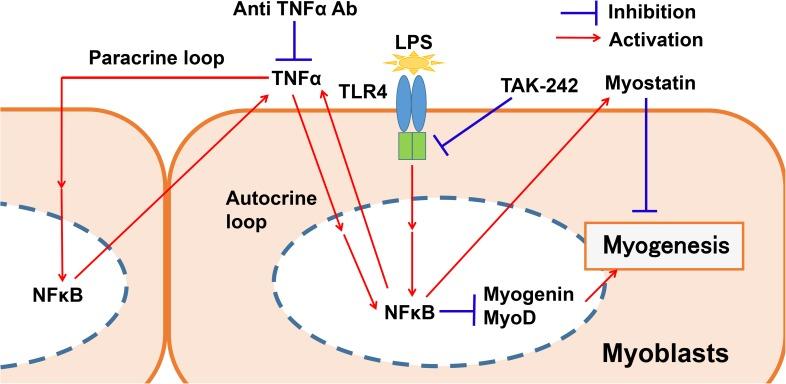
Our data suggest that LPS inhibits myogenic differentiation via a TLR4-NF-κB-dependent pathway and an autocrine/paracrine TNF-α-induced pathway. These pathways may be involved in the development of muscle wasting caused by sepsis or metabolic endotoxemia.
背景
脓毒症患者或患有与代谢性内毒素血症相关的各种内源性疾病的患者,其循环中的脂多糖(LPS)浓度通常会升高。在这些情况下,经常会观察到骨骼肌的非自愿性丧失,即肌肉萎缩,这表明循环中的LPS可能在其发展过程中起重要作用。虽然肌肉再生受损是骨骼肌萎缩的一个重要决定因素,但尚不清楚LPS是否会影响这一过程,如果会,其作用机制是什么。在此,我们使用C2C12成肌细胞系来研究LPS对肌生成的影响。
方法
将C2C12成肌细胞培养至80%汇合度,然后在不存在或存在LPS(0.1或1μg/mL)、TAK-242(1μM,一种Toll样受体4(TLR4)信号通路的特异性抑制剂)和肿瘤坏死因子(TNF)-α中和抗体(5μg/mL)的情况下诱导其分化。通过蛋白质印迹法分析骨骼肌分化标志物(肌球蛋白重链II)、两种重要的肌源性调节因子(肌细胞生成素和MyoD)以及一种肌肉负调节因子(肌肉生长抑制素)的表达。使用酶联免疫吸附测定法测量核因子-κB(NF-κB)的DNA结合活性。
结果
LPS呈剂量依赖性地显著减少多核肌管的形成以及肌球蛋白重链II、肌细胞生成素和MyoD的表达,并增加NF-κB的DNA结合活性和肌肉生长抑制素的表达。LPS对肌源性分化的抑制作用是可逆的,这表明它不是由非特异性毒性引起的。TAK-242和抗TNF-α均可降低LPS诱导的NF-κB DNA结合活性增加、肌源性调节因子的下调以及肌肉生长抑制素的上调,从而部分挽救肌生成的损伤。
结论
我们的数据表明,LPS通过TLR4-NF-κB依赖性途径和自分泌/旁分泌TNF-α诱导的途径抑制肌源性分化。这些途径可能参与了脓毒症或代谢性内毒素血症所致肌肉萎缩的发生发展。


 Zotero 插件