Division of Endocrinology and Bone and Mineral Unit, Oregon Health & Science University, Portland, OR, USA.
Division of Endocrinology, University of Colorado, 12801 E. 17th Ave. Mail Stop 8106, Aurora, CO, 80045, USA.
Osteoporos Int. 2017 Nov;28(11):3205-3213. doi: 10.1007/s00198-017-4162-5. Epub 2017 Jul 26.
The osteocyte's role in orchestrating diurnal variations in bone turnover markers (BTMs) is unclear. We identified no rhythm in serum sclerostin (osteocyte protein). These results suggest that serum sclerostin can be measured at any time of day and the osteocyte does not direct the rhythmicity of other BTMs in men.
The osteocyte exerts important effects on bone remodeling, but its rhythmicity and effect on the rhythms of other bone cells are not fully characterized. The purpose of this study was to determine if serum sclerostin displays rhythmicity over a 24-h interval, similar to that of other bone biomarkers.
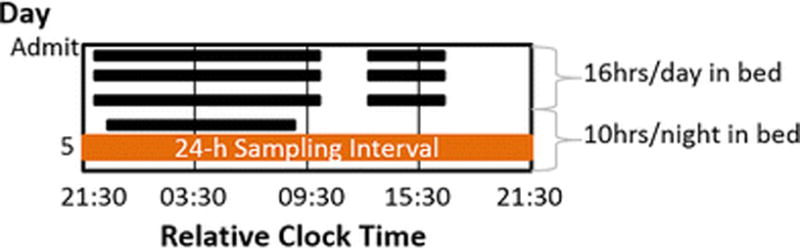
Serum sclerostin, FGF-23, CTX, and P1NP were measured every 2 h over a 24-h interval in ten healthy men aged 20-65 years. Maximum likelihood estimates of the parameters in a repeated measures model were used to determine if these biomarkers displayed a diurnal, sinusoidal rhythm.
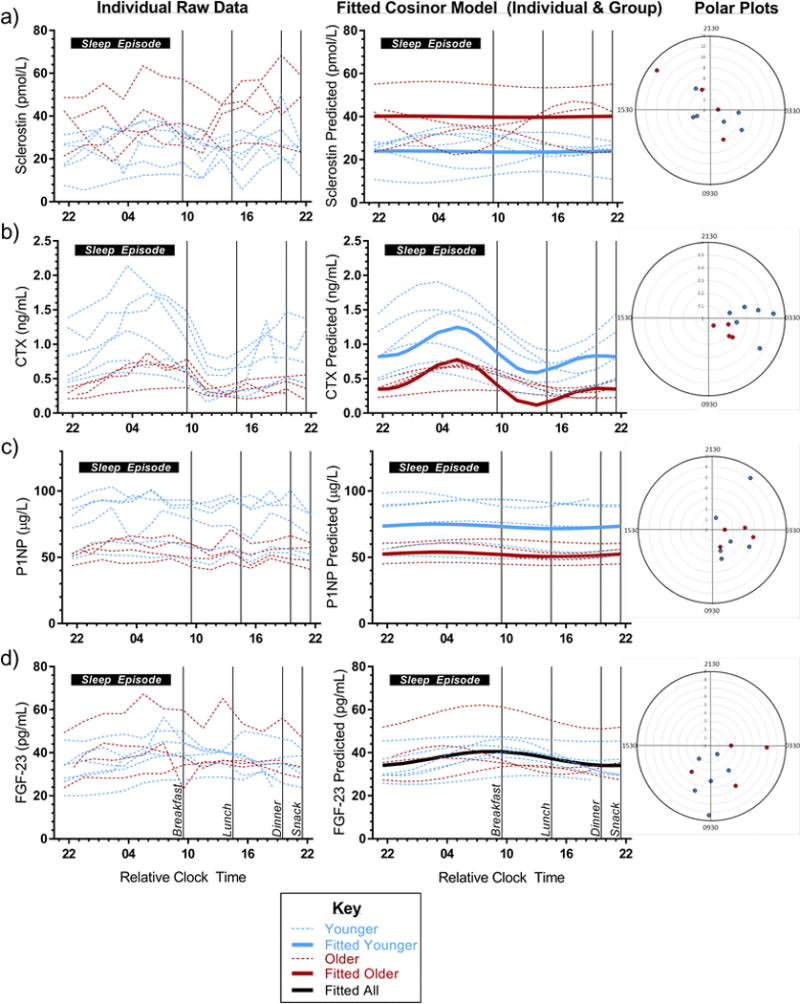
No discernible 24-h rhythm was identified for sclerostin (p = 0.99) or P1NP (p = 0.65). CTX rhythmicity was confirmed (p < 0.001), peaking at 05:30 (range 01:30-07:30). FGF-23 levels were also rhythmic (p < 0.001), but time of peak was variable (range 02:30-11:30). The only significant association identified between these four bone biomarkers was for CTX and P1NP mean 24-h metabolite levels (r = 0.65, p = 0.04).
Sclerostin levels do not appear to be rhythmic in men. This suggests that in contrast to CTX, serum sclerostin could be measured at any time of day. The 24-h profiles of FGF-23 suggest that a component of osteocyte function is rhythmic, but its timing is variable. Our results do not support the hypothesis that osteocytes direct the rhythmicity of other bone turnover markers (CTX), at least not via a sclerostin-mediated mechanism.
成骨细胞在调节骨转换标志物(BTM)的日周期变化中起重要作用,但成骨细胞的节律性及其对其他骨细胞节律性的影响尚未完全阐明。本研究旨在确定血清硬化素是否存在 24 小时的节律性,类似于其他骨生物标志物。
在 24 小时内,每 2 小时测量 10 名 20-65 岁健康男性的血清硬化素、FGF-23、CTX 和 P1NP。采用重复测量模型的最大似然估计来确定这些生物标志物是否存在昼夜、正弦节律。
未发现硬化素(p=0.99)或 P1NP(p=0.65)存在 24 小时节律。CTX 节律性得到确认(p<0.001),峰值出现在 05:30(范围 01:30-07:30)。FGF-23 水平也呈节律性(p<0.001),但峰值时间不同(范围 02:30-11:30)。这四种骨生物标志物之间唯一有显著关联的是 CTX 和 P1NP 的 24 小时代谢物水平(r=0.65,p=0.04)。
男性硬化素水平似乎没有节律性。这表明,与 CTX 不同,血清硬化素可以在一天中的任何时间测量。FGF-23 的 24 小时谱表明,成骨细胞功能的一个组成部分是有节律的,但时间是可变的。我们的结果不支持成骨细胞指导其他骨转换标志物(CTX)节律性的假说,至少不是通过硬化素介导的机制。