Mitchell Claire, Bowen Audrey, Tyson Sarah, Conroy Paul
Division of Neuroscience and Experimental Psychology, Faculty of Biology, Medicine and Health, University of Manchester MAHSC, Manchester, UK.
Central Manchester University Hospitals NHS Foundation Trust, MAHSC, Manchester, UK.
Pilot Feasibility Stud. 2017 Jul 20;4:25. doi: 10.1186/s40814-017-0169-0. eCollection 2018.
Dysarthria, a disordered speech production resulting from neuro-muscular impairment, is a common symptom after stroke. It causes significant problems for patients' speech intelligibility, communication, psychological well-being, social engagement and stroke recovery. Rehabilitation for dysarthria is variable in quality, intensity and duration, which may be, in part, due to the lack of good quality evidence. An online therapy programme, ReaDySpeech, has the potential to improve quality, intensity and duration of speech rehabilitation and was considered in a proof-of-concept study to be acceptable to speech and language therapists and patients which warranted further evaluation. The present study aims to examine the feasibility of running a trial using the ReaDySpeech intervention.
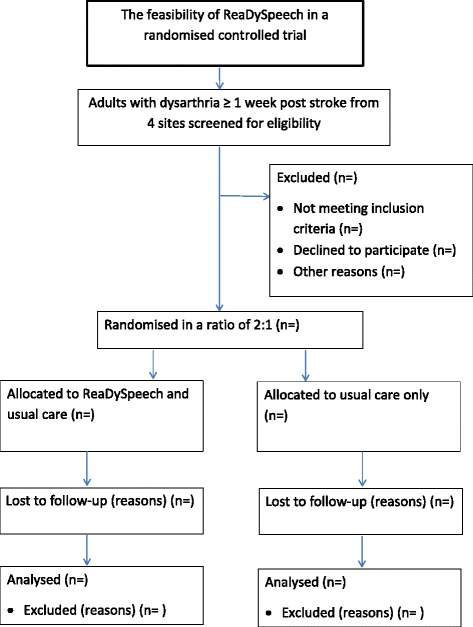
METHODS/DESIGN: A feasibility, randomised controlled trial, will recruit a minimum of 36 people with post-stroke dysarthria who are more than 1 week post stroke. Participants will be externally randomised in a 2:1 ratio to receive either ReaDySpeech and usual care (24 participants) or usual care only (12 participants). This study is single blind with the researcher carrying out the baseline and outcome measures while blinded to treatment allocation. The primary objective is to assess the feasibility of conducting a larger Phase III trial. The specific objectives are to determine the following: recruitment rate and reasons for non-recruitment; loss of participants to follow-up; acceptability of randomisation; adherence to the intervention; delivery of ReaDySpeech and content; acceptability of outcome measures; success of blinding strategies; defining 'usual' care; and the implications of the intervention for the patient/family/carer.
This study will involve a regional, multi-centre, randomised controlled feasibility trial of a complex intervention in order to evaluate whether a Phase III randomised controlled trial is feasible.
Current Controlled Trials, ISRCTN84996500.
构音障碍是一种由神经肌肉损伤导致的言语产生障碍,是中风后的常见症状。它给患者的言语清晰度、沟通能力、心理健康、社交参与度及中风恢复带来了严重问题。构音障碍的康复在质量、强度和持续时间方面存在差异,部分原因可能是缺乏高质量的证据。一个在线治疗项目ReaDySpeech有潜力提高言语康复的质量、强度和持续时间,并且在一项概念验证研究中被认为言语治疗师和患者均可接受,值得进一步评估。本研究旨在检验使用ReaDySpeech干预进行试验的可行性。
方法/设计:一项可行性随机对照试验将招募至少36名中风后构音障碍且中风后超过1周的患者。参与者将按2:1的比例被外部随机分组,分别接受ReaDySpeech加常规护理(24名参与者)或仅接受常规护理(12名参与者)。本研究为单盲试验,研究人员在对治疗分配不知情的情况下进行基线和结果测量。主要目的是评估开展更大规模的III期试验的可行性。具体目标包括确定以下内容:招募率和未招募的原因;失访的参与者;随机分组的可接受性;对干预的依从性;ReaDySpeech的实施及内容;结果测量的可接受性;盲法策略的成功性;定义“常规”护理;以及干预对患者/家庭/照顾者的影响。
本研究将涉及一项针对复杂干预措施的区域性、多中心随机对照可行性试验,以评估III期随机对照试验是否可行。
国际标准随机对照试验编号,ISRCTN84996500。