Patiño-Ruiz Miyer, Ganea Constanța, Fendler Klaus, Călinescu Octavian
Department of Biophysical Chemistry, Max Planck Institute of Biophysics, Frankfurt am Main, Germany.
Department of Biophysics, "Carol Davila" University of Medicine and Pharmacy, Bucharest, Romania.
PLoS One. 2017 Jul 27;12(7):e0182293. doi: 10.1371/journal.pone.0182293. eCollection 2017.
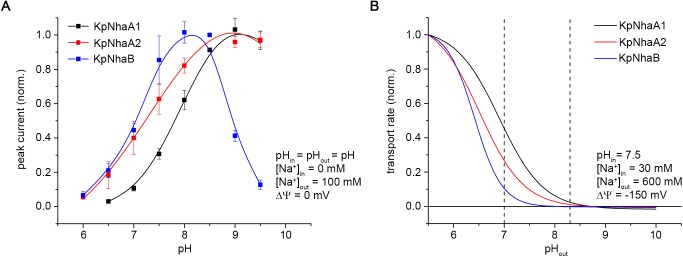
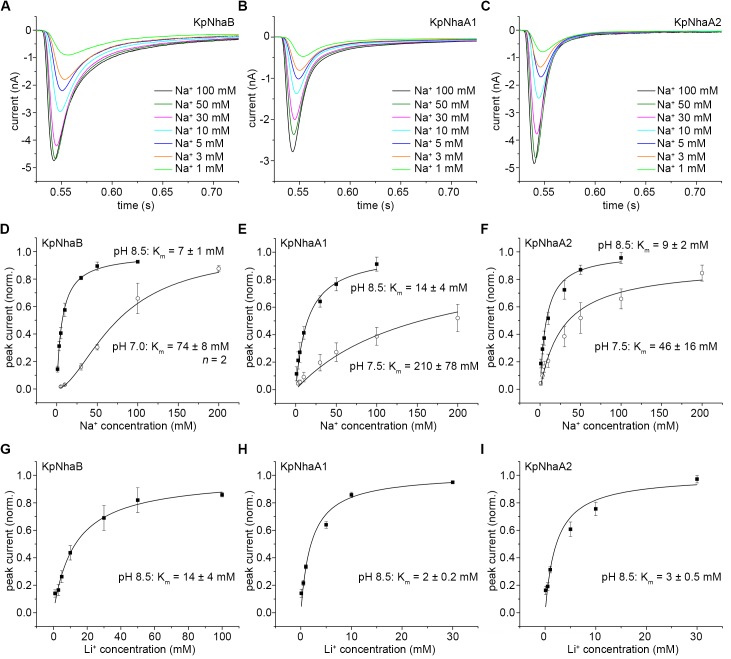
Na+/H+ exchange is essential for survival of all organisms, having a role in the regulation of the intracellular Na+ concentration, pH and cell volume. Furthermore, Na+/H+ exchangers were shown to be involved in the virulence of the bacterium Yersinia pestis, indicating they might be potential targets for novel antibiotic treatments. The model system for Na+/H+ exchangers is the NhaA transporter from Escherichia coli, EcNhaA. Therefore, the general transport mechanism of NhaA exchangers is currently well characterized. However, much less is known about NhaB exchangers, with only a limited number of studies available. The pathogen Klebsiella pneumoniae, which is a major source of nosocomial infection, possesses three electrogenic Na+/H+ exchangers, KpNhaA1, KpNhaA2 and KpNhaB, none of which have been previously investigated. Our aim in this study was to functionally characterize KpNhaB using solid supported membrane-based electrophysiology as the main investigation technique, and thus provide the first electrophysiological investigation of an NhaB Na+/H+ exchanger. We found that NhaB can be described by the same competition-based mechanism that was shown to be valid for electrogenic NhaA and NapA, and for electroneutral NhaP Na+/H+ exchangers. For comparison we also characterized the activity of KpNhaA1 and KpNhaA2 and found that the three exchangers have complementary activity profiles, which is likely a survival advantage for K. pneumoniae when faced with environments of different salinity and pH. This underlines their importance as potential antibiotic drug targets.
钠氢交换对所有生物体的生存至关重要,在调节细胞内钠浓度、pH值和细胞体积方面发挥作用。此外,钠氢交换体已被证明与鼠疫耶尔森菌的毒力有关,这表明它们可能是新型抗生素治疗的潜在靶点。钠氢交换体的模型系统是来自大肠杆菌的NhaA转运体,即EcNhaA。因此,NhaA交换体的一般转运机制目前已得到充分表征。然而,人们对NhaB交换体的了解要少得多,相关研究数量有限。病原菌肺炎克雷伯菌是医院感染的主要来源,它拥有三种生电钠氢交换体,即KpNhaA1、KpNhaA2和KpNhaB,此前均未被研究过。我们在本研究中的目的是使用基于固体支持膜的电生理学作为主要研究技术,对KpNhaB进行功能表征,从而首次对NhaB钠氢交换体进行电生理学研究。我们发现,NhaB可以用与已证明对生电NhaA和NapA以及电中性NhaP钠氢交换体有效的基于竞争的机制来描述。为了进行比较,我们还表征了KpNhaA1和KpNhaA2的活性,发现这三种交换体具有互补的活性谱,这可能是肺炎克雷伯菌在面对不同盐度和pH值环境时的生存优势。这突出了它们作为潜在抗生素药物靶点的重要性。