
基于腺相关病毒 9 型的基因疗法部分改善了 Leigh 综合征小鼠模型的临床表型。
AAV9-based gene therapy partially ameliorates the clinical phenotype of a mouse model of Leigh syndrome.
作者信息
Di Meo I, Marchet S, Lamperti C, Zeviani M, Viscomi C
机构信息
IRCCS Foundation Neurological Institute 'C. Besta', Milan, Italy.
University of Cambridge/Medical Research Council, Mitochondrial Biology Unit, Wellcome Trust/MRC Building, Hills Road, Cambridge, CB2 0XY, UK.
出版信息
Gene Ther. 2017 Oct;24(10):661-667. doi: 10.1038/gt.2017.53. Epub 2017 Jul 27.
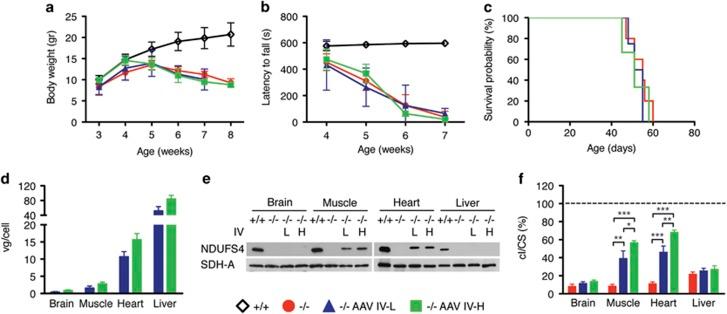
Leigh syndrome (LS) is the most common infantile mitochondrial encephalopathy. No treatment is currently available for this condition. Mice lacking Ndufs4, encoding NADH: ubiquinone oxidoreductase iron-sulfur protein 4 (NDUFS4) recapitulates the main findings of complex I (cI)-related LS, including severe multisystemic cI deficiency and progressive neurodegeneration. In order to develop a gene therapy approach for LS, we used here an AAV2/9 vector carrying the human NDUFS4 coding sequence (hNDUFS4). We administered AAV2/9-hNDUFS4 by intravenous (IV) and/or intracerebroventricular (ICV) routes to either newborn or young Ndufs4 mice. We found that IV administration alone was only able to correct the cI deficiency in peripheral organs, whereas ICV administration partially corrected the deficiency in the brain. However, both treatments failed to improve the clinical phenotype or to prolong the lifespan of Ndufs4 mice. In contrast, combined IV and ICV treatments resulted, along with increased cI activity, in the amelioration of the rotarod performance and in a significant prolongation of the lifespan. Our results indicate that extraneurological organs have an important role in LS pathogenesis and provide an insight into current limitations of adeno-associated virus (AAV)-mediated gene therapy in multisystem disorders. These findings warrant future investigations to develop new vectors able to efficiently target multiple organs.
Leigh综合征(LS)是最常见的婴儿线粒体脑病。目前尚无针对这种疾病的治疗方法。缺乏编码NADH:泛醌氧化还原酶铁硫蛋白4(NDUFS4)的Ndufs4的小鼠重现了与复合物I(cI)相关的LS的主要发现,包括严重的多系统cI缺乏和进行性神经退行性变。为了开发针对LS的基因治疗方法,我们在此使用携带人NDUFS4编码序列(hNDUFS4)的AAV2/9载体。我们通过静脉内(IV)和/或脑室内(ICV)途径将AAV2/9-hNDUFS4给予新生或年轻的Ndufs4小鼠。我们发现,仅静脉内给药只能纠正外周器官中的cI缺乏,而脑室内给药只能部分纠正脑中的缺乏。然而,两种治疗均未能改善临床表型或延长Ndufs4小鼠的寿命。相比之下,静脉内和脑室内联合治疗除了增加cI活性外,还改善了转棒试验表现并显著延长了寿命。我们的结果表明,神经外器官在LS发病机制中具有重要作用,并为腺相关病毒(AAV)介导的基因治疗在多系统疾病中的当前局限性提供了见解。这些发现值得未来开展研究以开发能够有效靶向多个器官的新载体。




 Zotero 插件