Beamish Christine A, Zhang Linhao, Szlapinski Sandra K, Strutt Brenda J, Hill David J
Department of Physiology and Pharmacology, Western University, London, ON, Canada.
Children's Health Research Institute, London, ON, Canada.
PLoS One. 2017 Jul 28;12(7):e0182256. doi: 10.1371/journal.pone.0182256. eCollection 2017.
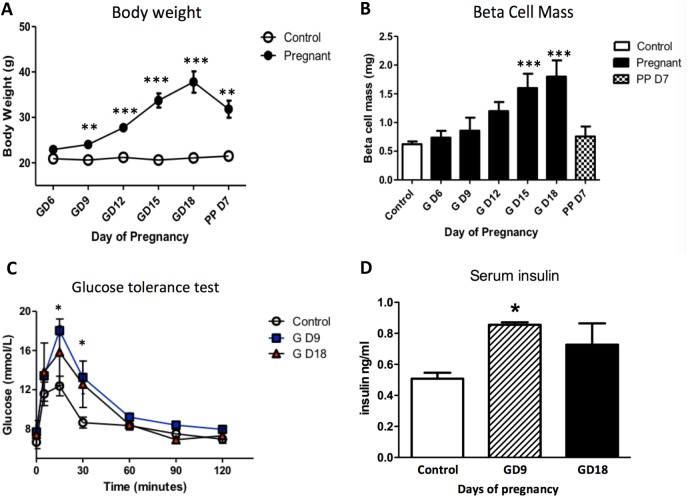
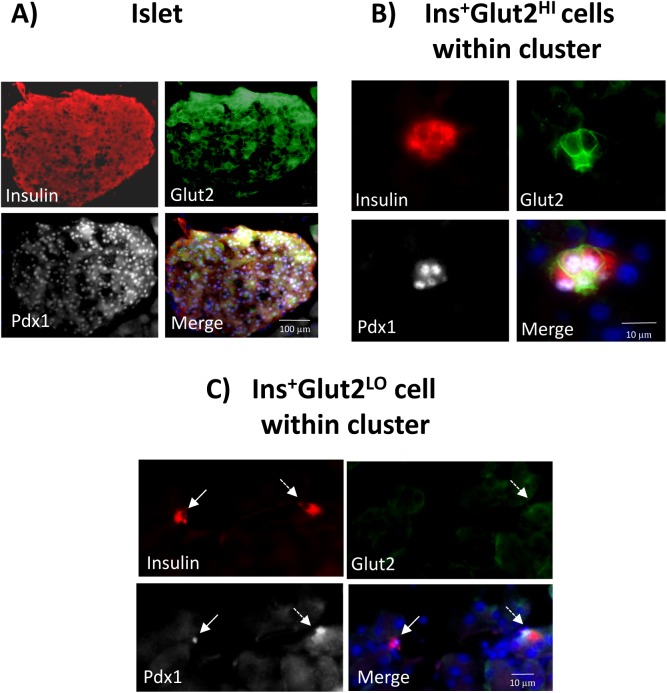
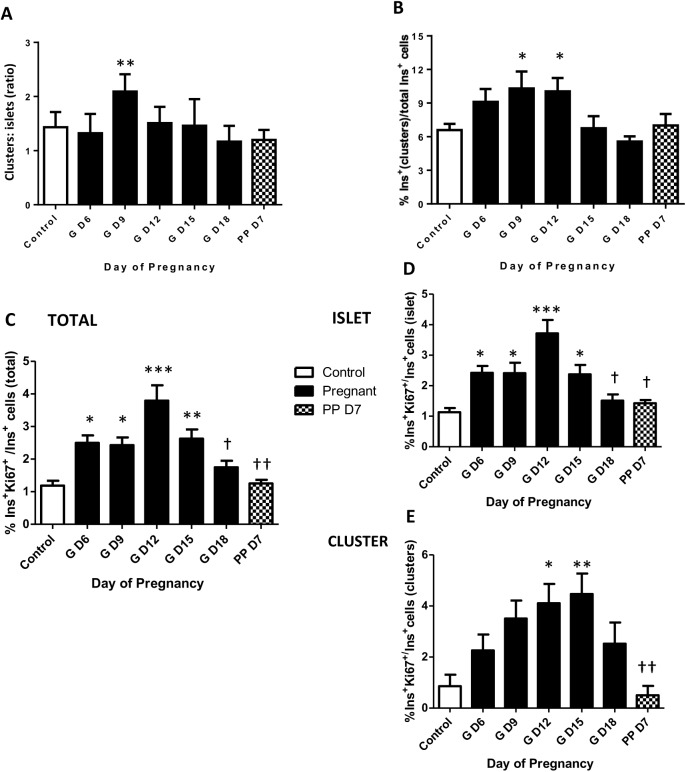
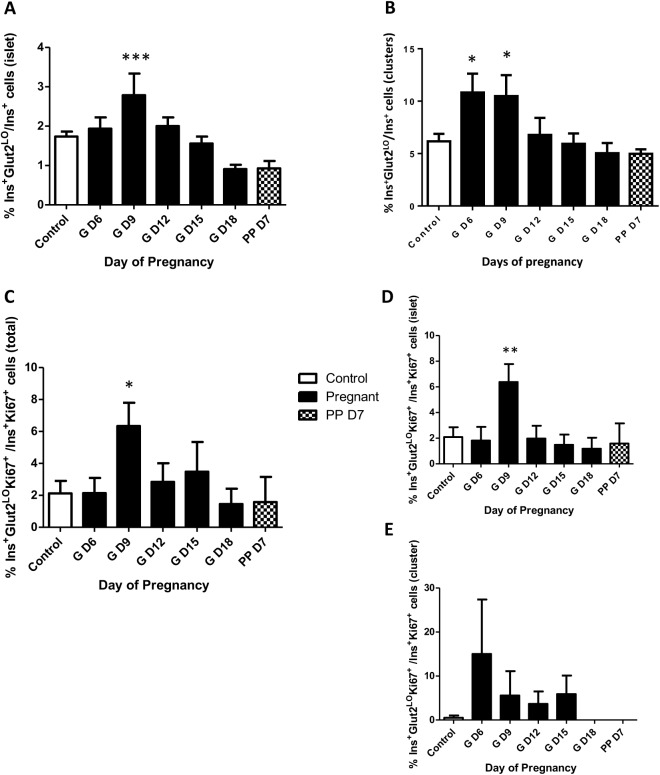
A compensatory increase in β-cell mass occurs during pregnancy to counter the associated insulin resistance, and a failure in adaptation is thought to contribute to gestational diabetes. Insulin-expressing but glucose-transporter-2-low (Ins+Glut2LO) progenitor cells are present in mouse and human pancreas, being predominantly located in extra-islet β-cell clusters, and contribute to the regeneration of the endocrine pancreas following induced ablation. We therefore sought to investigate the contribution of Ins+Glut2LO cells to β-cell mass expansion during pregnancy. Female C57Bl/6 mice were time mated and pancreata were collected at gestational days (GD) 6, 9, 12, 15, and 18, and postpartum D7 (n = 4/time-point) and compared to control (non-pregnant) animals. Beta cell mass, location, proliferation (Ki67+), and proportion of Ins+Glut2LO cells were measured using immunohistochemistry and bright field or confocal microscopy. Beta cell mass tripled by GD18 and β-cell proliferation peaked at GD12 in islets (≥6 β-cells) and small β-cell clusters (1-5 β-cells). The proportion and fraction of Ins+Glut2LO cells undergoing proliferation increased significantly at GD9 in both islets and clusters, preceding the increase in β-cell mass and proliferation, and their proliferation within clusters persisted until GD15. The overall number of clusters increased significantly at GD9. Quantitative PCR showed a significant increase in Pdx1 presence at GD9 vs. GD18 or control pancreas, and Pdx1 was visualized by immunohistochemistry within both Ins+Glut2LO and Ins+Glut2HI cells within clusters. These results indicate that Ins+Glut2LO cells are likely to contribute to β-cell mass expansion during pregnancy.
孕期会出现β细胞量的代偿性增加,以应对相关的胰岛素抵抗,而适应性失败被认为是导致妊娠期糖尿病的原因之一。表达胰岛素但葡萄糖转运蛋白2含量低(Ins+Glut2LO)的祖细胞存在于小鼠和人类胰腺中,主要位于胰岛外β细胞簇中,并在诱导消融后有助于内分泌胰腺的再生。因此,我们试图研究Ins+Glut2LO细胞在孕期对β细胞量增加的贡献。对雌性C57Bl/6小鼠进行定时交配,并在妊娠第6、9、12、15和18天以及产后第7天收集胰腺(每个时间点n = 4),并与对照(未怀孕)动物进行比较。使用免疫组织化学和明场或共聚焦显微镜测量β细胞量、位置、增殖(Ki67+)以及Ins+Glut2LO细胞的比例。到妊娠第18天β细胞量增加了两倍,胰岛(≥6个β细胞)和小β细胞簇(1 - 5个β细胞)中的β细胞增殖在妊娠第12天达到峰值。在胰岛和细胞簇中,Ins+Glut2LO细胞增殖的比例和分数在妊娠第9天显著增加,早于β细胞量和增殖的增加,并且它们在细胞簇内的增殖持续到妊娠第15天。细胞簇的总数在妊娠第9天显著增加。定量PCR显示,与妊娠第18天或对照胰腺相比,妊娠第9天Pdx1的表达显著增加,并且通过免疫组织化学在细胞簇内的Ins+Glut2LO和Ins+Glut2HI细胞中均观察到Pdx1。这些结果表明,Ins+Glut2LO细胞可能在孕期对β细胞量的增加有贡献。