Alves Geraldo da Silva, Pereira Monalessa Fábia, Bride Lais de Lima, Nunes Ana Paula Ferreira, Schuenck Ricardo Pinto
Universidade Federal de Espírito Santo, Centro de Ciências da Saúde, Departamento de Patologia, Vitória, ES, Brazil.
Universidade Federal de Espírito Santo, Centro de Ciências da Saúde, Departamento de Patologia, Vitória, ES, Brazil.
Braz J Infect Dis. 2017 Nov-Dec;21(6):656-659. doi: 10.1016/j.bjid.2017.07.001. Epub 2017 Jul 29.
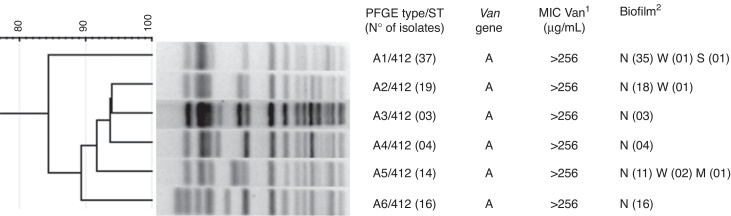
Vancomycin-resistant Enterococcus faecium (VREfm) has emerged as an important global nosocomial pathogen, and this trend is associated with the spread of high-risk clones. Here, we determined the genetic and phenotypic features of 93 VREfm isolates that were obtained from patients in 13 hospitals in Vitória, Espírito Santo, Brazil, during 2012-2013. All the isolates were vancomycin-resistant and harbored the vanA gene. Only 6 (6.5%) of the VREfm isolates showed the ability to form biofilm. The 93 isolates analyzed belong to a single pulsed-field gel electrophoresis lineage and presented six subtypes. MLST genotyping showed that all VREfm belonged to ST412 (the high-risk clone, hospital-adapted). The present study describes the dissemination of ST412 clone in the local hospitals. The clonal spread of these ST412 isolates in the area we analyzed as well as other hospitals in southeastern Brazil supports the importance of identifying and controlling the presence of these microorganisms in health care-related services.
耐万古霉素屎肠球菌(VREfm)已成为一种重要的全球医院病原体,这种趋势与高风险克隆的传播有关。在此,我们确定了2012年至2013年期间从巴西圣埃斯皮里图州维多利亚市13家医院的患者中分离出的93株VREfm菌株的遗传和表型特征。所有分离株均对万古霉素耐药,并携带vanA基因。只有6株(6.5%)VREfm分离株显示出形成生物膜的能力。分析的93株分离株属于单一的脉冲场凝胶电泳谱系,并呈现出六个亚型。多位点序列分型(MLST)基因分型显示,所有VREfm均属于ST412(高风险克隆,医院适应性)。本研究描述了ST412克隆在当地医院的传播情况。这些ST412分离株在我们分析的地区以及巴西东南部其他医院的克隆传播支持了在医疗相关服务中识别和控制这些微生物存在的重要性。