Zhou Juan, Zhang Wen-Wen, Wu San-Gang, He Zhen-Yu, Sun Jia-Yuan, Wang Yan, Chen Qiong-Hua
Department of Obstetrics and Gynecology, The First Affiliated Hospital of Xiamen University, Xiamen.
Department of Radiation Oncology, Sun Yat-sen University Cancer Center, State Key Laboratory of Oncology in South China, Collaborative Innovation Center of Cancer Medicine, Guangzhou.
Cancer Manag Res. 2017 Jul 18;9:315-322. doi: 10.2147/CMAR.S141335. eCollection 2017.
The prognostic impact of the number of examined lymph nodes (ELNs) in different histological subtypes of cervical cancer remains unclear. We aimed to assess the impact of the number of ELNs in stage IA2-IIA cervical cancer with different histological subtypes.
Data of patients with stage IA2-IIA squamous cell carcinoma (SCC) and adenocarcinoma (AC) of the uterine cervix between 1988 and 2013 were retrieved from the Surveillance, Epidemiology, and End Results program. Univariate and multivariate Cox regression analyses were performed to analyze the effect of number of ELNs on cause-specific survival (CSS) and overall survival (OS).
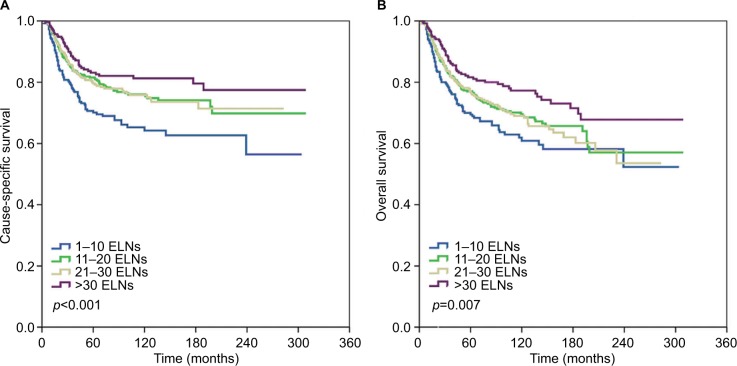
The final data set identified 11,830 patients including 7,920 (66.9%) women with SCC and 3,910 (33.1%) with AC. The median number of ELNs was 19. The multivariate analysis indicated that the number of ELNs was an independent prognostic factor influencing CSS and OS, both as a continuous or a categorical variable. Patients with a higher number of ELNs had better survival outcomes. In SCC subtype, the number of ELNs was also the independent prognostic factor of CSS and OS in node-positive patients, but not in patients with node-negative disease. In AC patients, ELN count was not an independent predictor of CSS and OS regardless of lymph node status.
The number of ELNs is an independent prognostic factor in patients with stage IA2-IIB cervical cancer. A higher number of ELNs is associated with better survival outcomes, especially in the node-positive SCC subtype.
在宫颈癌的不同组织学亚型中,检查的淋巴结数量(ELNs)对预后的影响尚不清楚。我们旨在评估不同组织学亚型的IA2-IIA期宫颈癌中ELNs数量的影响。
从监测、流行病学和最终结果计划中检索1988年至2013年间IA2-IIA期子宫颈鳞状细胞癌(SCC)和腺癌(AC)患者的数据。进行单因素和多因素Cox回归分析,以分析ELNs数量对特定病因生存率(CSS)和总生存率(OS)的影响。
最终数据集确定了11830例患者,其中7920例(66.9%)为SCC女性患者,3910例(33.1%)为AC患者。ELNs的中位数为19。多因素分析表明,ELNs数量是影响CSS和OS的独立预后因素,无论是作为连续变量还是分类变量。ELNs数量较多的患者生存结局更好。在SCC亚型中,ELNs数量也是淋巴结阳性患者CSS和OS的独立预后因素,但在淋巴结阴性患者中不是。在AC患者中,无论淋巴结状态如何,ELN计数都不是CSS和OS的独立预测因素。
ELNs数量是IA2-IIB期宫颈癌患者的独立预后因素。ELNs数量较多与更好的生存结局相关,尤其是在淋巴结阳性的SCC亚型中。