Brenner Hermann, Chen Hongda
Division of Clinical Epidemiology and Aging Research, German Cancer Research Center (DKFZ).
Division of Preventive Oncology, German Cancer Research Center (DKFZ) and National Center for Tumor Diseases (NCT).
Clin Epidemiol. 2017 Jul 13;9:377-384. doi: 10.2147/CLEP.S136565. eCollection 2017.
A multitarget stool DNA test (MSDT) that showed higher sensitivity but lower specificity than a fecal immunochemical test (FIT) for hemoglobin in one recent study from the US and Canada, is increasingly used for colorectal cancer (CRC) screening, despite its ~20-fold higher costs compared to FITs. We aimed to assess diagnostic performance of a quantitative FIT in an independent study among participants of screening colonoscopy and to compare it with the previously reported performance of MSDT.
A total of 3494 participants, aged 50-84 years, who underwent screening colonoscopy in private gastroenterological practices in Germany, and who provided a stool sample before colonoscopy to be evaluated by a commercially available quantitative FIT (FOB Gold) were included. Diagnostic performance (sensitivity, specificity) for detecting CRC or advanced precancerous lesions (APCLs) was evaluated by comparison of test results with findings at screening colonoscopy. In addition to the original cutoff, we used an adjusted cutoff yielding the same specificity as reported for the MSDT to enhance comparability.
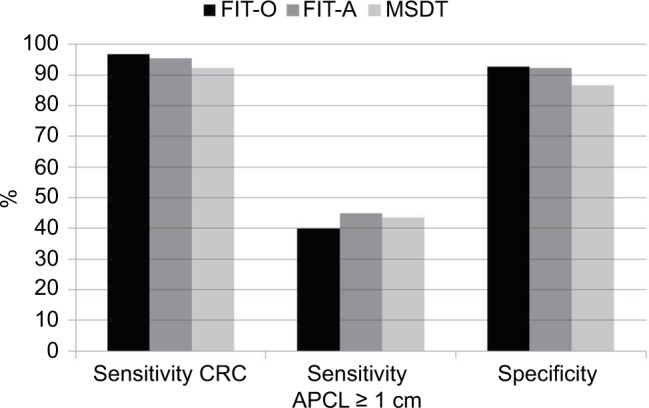
The most advanced finding at colonoscopy was CRC and APCL in 30 (0.86%) and 359 (10.3%) cases, respectively. At a cutoff yielding the same specificity as reported for MSDT (86.6%), the sensitivities (95% CI) of the FIT for detecting CRC and APCL >1 cm were 96.7% (82.8-99.9%) and 54.3% (48.3-60.3%), respectively. These sensitivities are higher than those reported for MSDT (92.3% and 43.6%, =0.66 and 0.003, respectively).
In this large screening population, FIT showed equivalent or better diagnostic performance in comparison to reported performance of MSDT.
在美国和加拿大最近的一项研究中,一种多靶点粪便DNA检测(MSDT)对血红蛋白的检测灵敏度高于粪便免疫化学检测(FIT),但特异性较低。尽管其成本比FIT高约20倍,但仍越来越多地用于结直肠癌(CRC)筛查。我们旨在通过一项独立研究评估定量FIT在结肠镜筛查参与者中的诊断性能,并将其与先前报道的MSDT性能进行比较。
共有3494名年龄在50 - 84岁之间的参与者,他们在德国的私人胃肠病诊所接受了结肠镜筛查,并在结肠镜检查前提供了粪便样本,以便通过市售的定量FIT(FOB Gold)进行评估。通过将检测结果与结肠镜筛查结果进行比较,评估检测CRC或高级癌前病变(APCL)的诊断性能(灵敏度、特异性)。除了原始临界值外,我们还使用了一个调整后的临界值,其特异性与MSDT报道的相同,以提高可比性。
结肠镜检查中最严重的发现分别为30例(0.86%)CRC和359例(10.3%)APCL。在与MSDT报道的相同特异性(86.6%)的临界值下,FIT检测CRC和>1 cm的APCL的灵敏度(95% CI)分别为96.7%(82.8 - 99.9%)和54.3%(48.3 - 60.3%)。这些灵敏度高于MSDT报道的灵敏度(分别为92.3%和43.6%,P = 0.66和0.003)。
在这个大型筛查人群中,FIT与报道的MSDT性能相比,显示出同等或更好的诊断性能。