Laboratory for Biomolecular Simulation Research, Center for Integrative Proteomics Research, and Department of Chemistry & Chemical Biology, Rutgers University, 174 Frelinghuysen Road, Piscataway, NJ, 08854-8076, USA.
Angew Chem Int Ed Engl. 2017 Oct 16;56(43):13392-13395. doi: 10.1002/anie.201705608. Epub 2017 Sep 8.
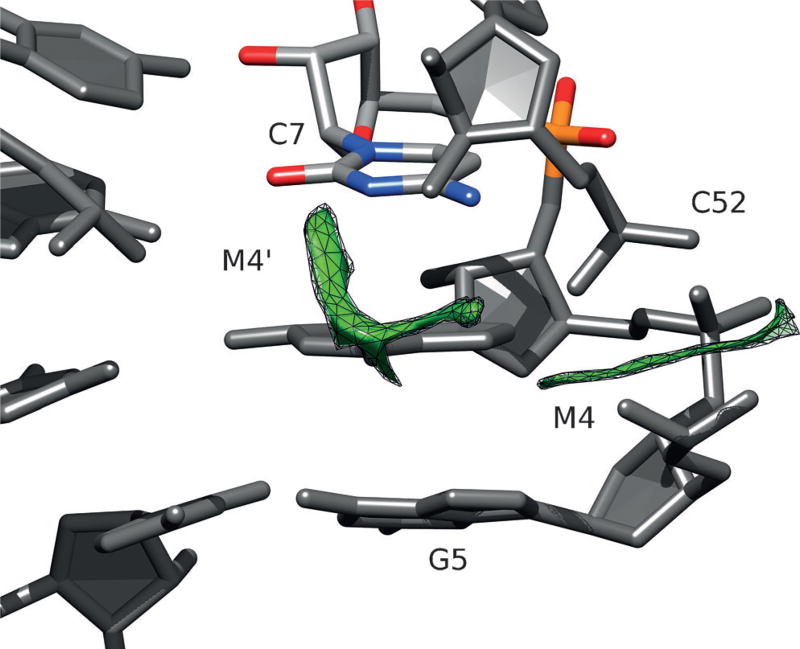
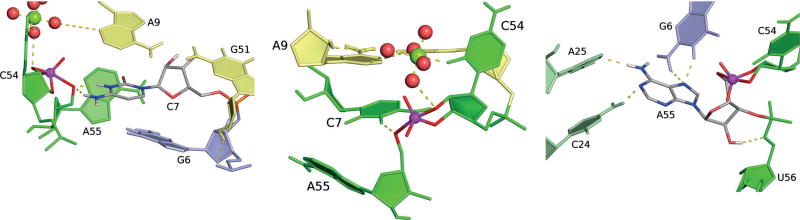
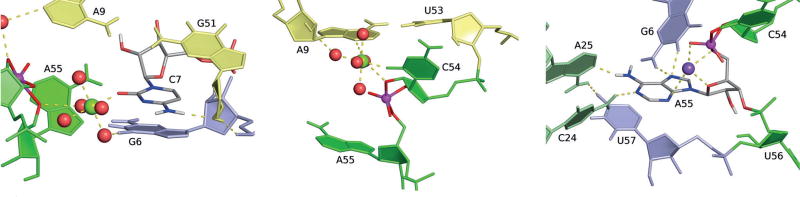
Recently, a crystal structure has been reported of a new catalytic RNA, the TS ribozyme, that has been identified through comparative genomics and is believed to be a metalloribozyme having novel mechanistic features. Although this data provides invaluable structural information, analysis suggests a conformational change is required to arrive at a catalytically relevant state. We report results of molecular simulations that predict a spontaneous local rearrangement of the active site, leading to solution structures consistent with available functional data and providing competing mechanistic hypotheses that can be experimentally tested. The two competing hypotheses differ in the proposed identity of the catalytic general acid: either a water molecule coordinating a Mg ion bound at the Watson-Crick edge of residue C7, or the N3 position of residue C7 itself.
最近,通过比较基因组学,发现了一种新型催化 RNA,即 TS 核酶的晶体结构,据信它是一种具有新颖机制特征的金属核酶。尽管这些数据提供了宝贵的结构信息,但分析表明需要进行构象变化才能达到催化相关状态。我们报告了分子模拟的结果,这些结果预测了活性位点的自发局部重排,导致与可用功能数据一致的溶液结构,并提供了可以通过实验测试的竞争性机制假说。这两个竞争性假说在提议的催化通用酸的身份上有所不同:要么是配位结合在残基 C7 的沃森-克里克边缘的 Mg 离子的水分子,要么是残基 C7 自身的 N3 位置。