Bang Ji Seok, Kim Gi Beom, Kwon Bo Sang, Song Mi Kyung, An Hyo Soon, Song Young Whan, Bae Eun Jung, Noh Chung Il
Department of Pediatrics, Seoul National University Children's Hospital, Seoul, Korea.
Department of Pediatrics, Sejong General Hospital, Bucheon, Korea.
Korean Circ J. 2017 Jul;47(4):516-522. doi: 10.4070/kcj.2016.0163. Epub 2017 Jul 27.
Some patients with Kawasaki disease (KD) develop large coronary aneurysms and subsequent coronary stenosis or obstruction, leading to ischemic heart disease. This study examined the long-term outcomes of patients with KD complicated by large coronary aneurysms.
The medical records of 71 patients (53 men and 18 women) diagnosed with large coronary aneurysms (diameter ≥6 mm) between December 1986 and December 2013 were retrospectively reviewed from our institutional database.
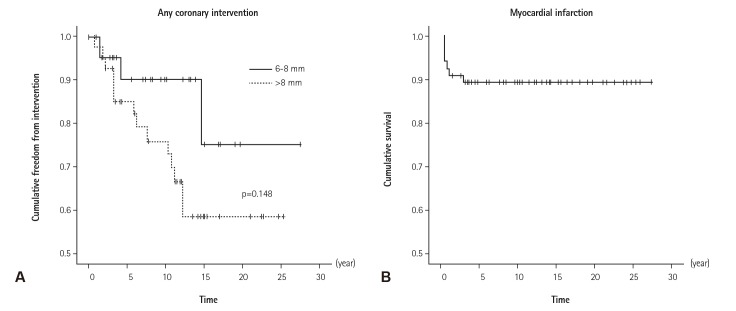
The mean age at onset was 4.6±3.3 years, and the mean follow-up duration was 12.5±6.9 years. Maximum coronary artery internal diameter ranged from 6.1 to 25 mm. Giant coronary aneurysms occurred in 48 patients and coronary aneurysms 6-8 mm in diameter developed in 23 patients. Coronary stenosis and/or complete occlusion occurred in 30 patients (42.3%). Catheter and/or surgical interventions (mean: 1.5 interventions, range: 1-5 interventions) were performed in 20 patients (28.2%), 9 months to 18 years after KD onset, resulting in 33.7% cumulative coronary intervention rates at 20 years after onset. There were no differences in cumulative coronary intervention rates between two coronary aneurysm groups (6-8 mm vs. ≥8 mm). Myocardial infarction occurred in 7 patients with a giant aneurysm and there was one death.
Long-term survival of patients with KD complicated by large coronary aneurysm was good even though 28.2% of patients underwent multiple catheter or surgical interventions. Careful follow-up is also necessary in KD patients with coronary aneurysms 6-8 mm in diameter, such as those with giant aneurysms.
部分川崎病(KD)患者会出现大型冠状动脉瘤,随后发生冠状动脉狭窄或阻塞,进而导致缺血性心脏病。本研究调查了合并大型冠状动脉瘤的KD患者的长期预后情况。
回顾性分析了我院机构数据库中1986年12月至2013年12月期间诊断为大型冠状动脉瘤(直径≥6 mm)的71例患者(53例男性和18例女性)的病历。
发病时的平均年龄为4.6±3.3岁,平均随访时间为12.5±6.9年。冠状动脉最大内径范围为6.1至25 mm。48例患者出现巨大冠状动脉瘤,23例患者出现直径6 - 8 mm的冠状动脉瘤。30例患者(42.3%)发生冠状动脉狭窄和/或完全闭塞。20例患者(28.2%)在KD发病后9个月至18年接受了导管和/或手术干预(平均:1.5次干预,范围:1 - 5次干预),发病20年后累计冠状动脉干预率为33.7%。两个冠状动脉瘤组(6 - 8 mm与≥8 mm)的累计冠状动脉干预率无差异。7例巨大动脉瘤患者发生心肌梗死,1例死亡。
合并大型冠状动脉瘤的KD患者长期生存率良好,尽管28.2%的患者接受了多次导管或手术干预。对于直径6 - 8 mm的冠状动脉瘤KD患者,如巨大动脉瘤患者,也需要进行仔细的随访。