Gerace Claudio, Montorsi Francesco, Tambaro Rosa, Cartenì Giacomo, De Luca Stefano, Tucci Marcello, Martorana Giuseppe, Basso Umberto, Cardosi Leonardo, Teruzzi Cristina
Temas s.r.l.-QuintilesIMS, Integrated Market Access Department.
Department of Urology, IRCCS Ospedale San Raffaele, Milano, Italy.
Clinicoecon Outcomes Res. 2017 Jul 24;9:433-442. doi: 10.2147/CEOR.S135065. eCollection 2017.
Urothelial bladder cancer (UBC) is the ninth most common cancer worldwide. In Italy, the prevalence of the disease is approximately 10%, making it the fourth most prevalent cancer in the country. The increase in prevalence requires continuous surveillance and care, resulting in a significant burden on Italian National Health Service, making any improvement to the strategy for diagnosing and treating this disease important to the medical and scientific community. The aim of this study was to evaluate the UBC cost of illness in the Italian context, collecting the total costs of the disease.
An economic analysis was carried out in the context of the National Health Service, using data collected from six centers, in order to evaluate direct costs in terms of outpatient, inpatient, and emergency care; pharmaceuticals and follow-up procedures; and indirect costs in terms of productivity losses. Data were collected through aggregated form reports, focusing on patients with an existing diagnosis of UBC who were treated in the last year. The Italian Association of Medical Oncology (AIOM) guidelines were used to identify diagnostic and therapeutic procedures. Statistical analysis was conducted to explore variations among centers.
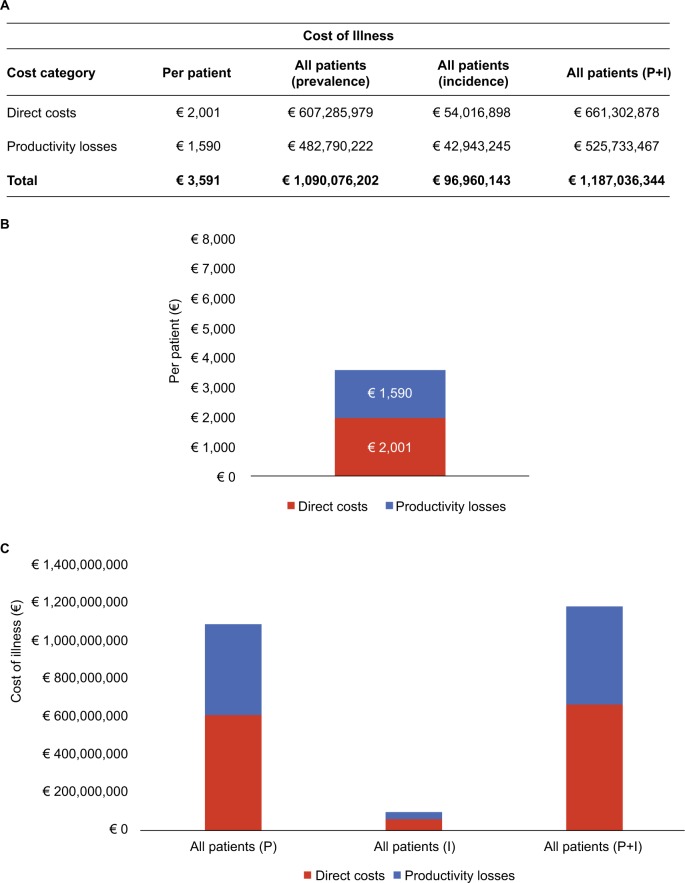
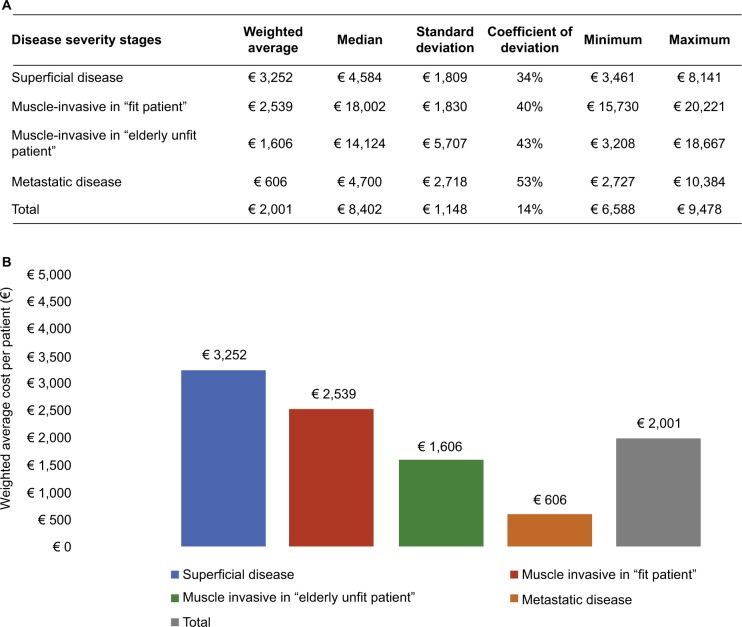
The weighted mean total annual cost per patient was € 3,591, where the cost for superficial disease was € 3,252 and that for metastatic disease was € 606. The analysis confirmed a proportional relation between disease severity and disability grade. The UBC cost of illness, considering prevalence and incidence data coming from the 2016 AIOM/Italian Association of Cancer Registries report, was € 1,187,036,344. Indirect costs accounted to 44%, represented by estimated productivity losses.
Our analysis represents the first economic study of UBC in the Italian context, as well as the first real-life evidence of the current therapeutic algorithm. This study opens the possibility for further analysis on the indirect cost components that represent a great burden for the society, especially for those in the severest stages of the disease with high disability grades.
尿路上皮膀胱癌(UBC)是全球第九大常见癌症。在意大利,该疾病的患病率约为10%,使其成为该国第四大常见癌症。患病率的上升需要持续的监测和护理,给意大利国家医疗服务体系带来了巨大负担,因此对该疾病诊断和治疗策略的任何改进对医学界和科学界都很重要。本研究的目的是在意大利背景下评估UBC的疾病成本,收集该疾病的总成本。
在国家医疗服务体系背景下进行了一项经济分析,使用从六个中心收集的数据,以评估门诊、住院和急诊护理方面的直接成本;药品和后续程序;以及生产力损失方面的间接成本。数据通过汇总报告收集,重点关注去年接受治疗的现有UBC诊断患者。使用意大利医学肿瘤学会(AIOM)指南来确定诊断和治疗程序。进行了统计分析以探索各中心之间的差异。
每位患者的加权平均年度总成本为3591欧元,其中浅表疾病的成本为3252欧元,转移性疾病的成本为606欧元。分析证实了疾病严重程度与残疾等级之间的比例关系。考虑到来自2016年AIOM/意大利癌症登记协会报告的患病率和发病率数据,UBC的疾病成本为1187036344欧元。间接成本占44%,以估计的生产力损失为代表。
我们的分析是意大利背景下对UBC的首次经济研究,也是当前治疗算法的首个实际证据。这项研究为进一步分析间接成本组成部分开辟了可能性,这些间接成本对社会造成了巨大负担,尤其是对于那些处于疾病最严重阶段且残疾等级高的患者。