Gao Xing-Hui, Zhang Shuang-Shuang, Chen Hao, Wang Yu-Hui, Yuan Chun-Hui, Wang Fu-Bing
Department of Laboratory Medicine, Zhongnan Hospital of Wuhan UniversityWuhan, China.
Department of Dermatology, Shanghai Dermatology Hospital, Tongji UniversityShanghai, China.
Front Physiol. 2017 Jul 18;8:480. doi: 10.3389/fphys.2017.00480. eCollection 2017.
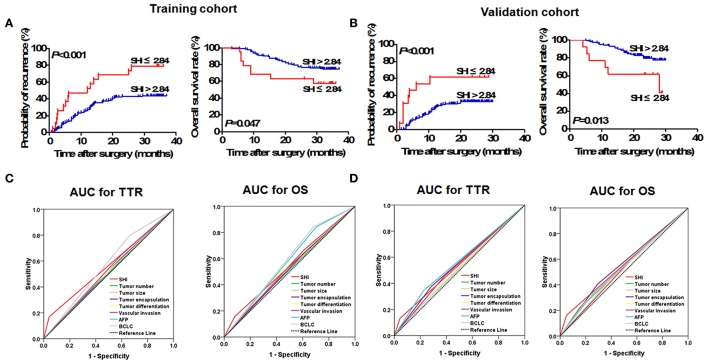
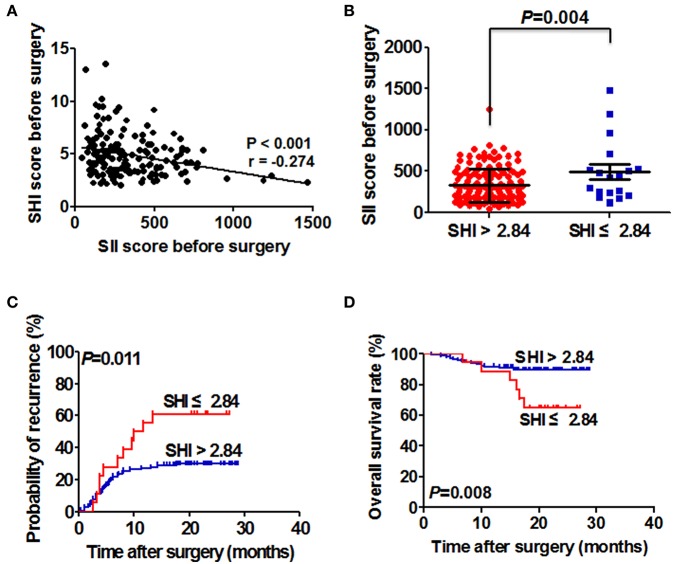
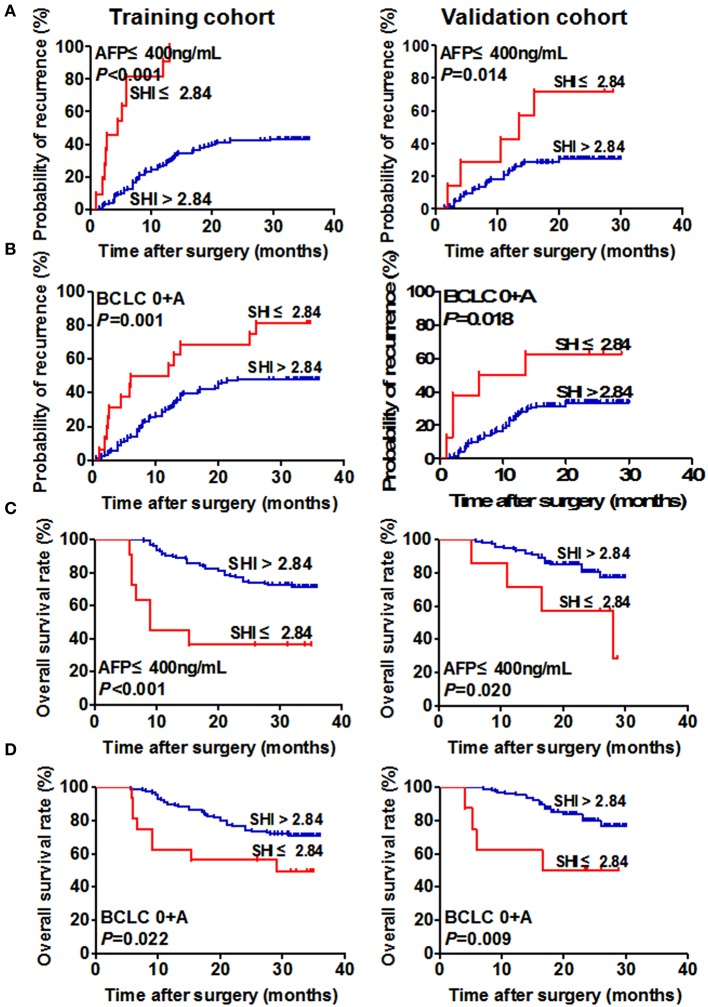
We have developed a systemic hepatic-damage index (SHI) based on serum total cholesterol (TC) and high density lipoprotein levels (HDL) and determined its prognostic significance in hepatocellular carcinoma (HCC) patients undergoing resection. The SHI was analyzed in the training cohort of 188 HCC patients and in the validation cohort of 177 HCC patients. The systemic immune-inflammation index (SII) scores in the validation cohorts were also measured. Area under the receiver operating characteristic curve (AUC) was used to explore the prediction accuracy in HCC patients. An optimal cutoff point for the SHI of 2.84 stratified the HCC patients into high SHI (>2.84) and low SHI (≤2.84) groups in the training cohort. Univariate and multivariate analyses revealed the SHI was an independent predictor for overall survival and relapse-free survival, and prognostic for patients with negative α-fetoprotein and Barcelona Clinic Liver Cancer stage 0+A. The AUCs of the SHI for survival and recurrence were higher than other conventional clinical indices. Low SHI significantly correlated with vascular invasion. The SII scores were significantly higher in patients with low SHI compared with those with high SHI. HCC patients in SHI ≤ 2.84 group had shorter recurrence time and lower survival rate than HCC patients in SHI > 2.84 group. The SHI was a potential biomarker for assessing HCC prognosis, and improving SHI level in HCC patients may be a promising therapeutic strategy decision. The poor outcome in HCC patients with low SHI scores might increase SII scores, increasing the possibility of recurrence and metastasis.
我们基于血清总胆固醇(TC)和高密度脂蛋白水平(HDL)制定了一种系统性肝损伤指数(SHI),并确定了其在接受肝切除的肝细胞癌(HCC)患者中的预后意义。在188例HCC患者的训练队列和177例HCC患者的验证队列中分析了SHI。还测量了验证队列中的全身免疫炎症指数(SII)评分。采用受试者操作特征曲线下面积(AUC)来探索HCC患者的预测准确性。在训练队列中,SHI的最佳截断点为2.84,可将HCC患者分为高SHI(>2.84)和低SHI(≤2.84)组。单因素和多因素分析显示,SHI是总生存和无复发生存的独立预测因子,对甲胎蛋白阴性和巴塞罗那临床肝癌分期0+A的患者具有预后意义。SHI在生存和复发方面的AUC高于其他传统临床指标。低SHI与血管侵犯显著相关。低SHI患者的SII评分显著高于高SHI患者。SHI≤2.84组的HCC患者比SHI>2.84组的HCC患者复发时间更短,生存率更低。SHI是评估HCC预后的潜在生物标志物,提高HCC患者的SHI水平可能是一种有前景的治疗策略决策。SHI评分低的HCC患者预后较差可能会增加SII评分,增加复发和转移的可能性。