Muleke Everlyne M'mbone, Fan Lianxue, Wang Yan, Xu Liang, Zhu Xianwen, Zhang Wei, Cao Yang, Karanja Benard K, Liu Liwang
National Key Laboratory of Crop Genetics and Germplasm Enhancement, Key Laboratory of Horticultural Crop Biology and Genetic Improvement (East China) of MOA, College of Horticulture, Nanjing Agricultural UniversityNanjing, China.
Department of Plant Sciences, North Dakota State UniversityFargo, ND, United States.
Front Plant Sci. 2017 Jul 19;8:1243. doi: 10.3389/fpls.2017.01243. eCollection 2017.
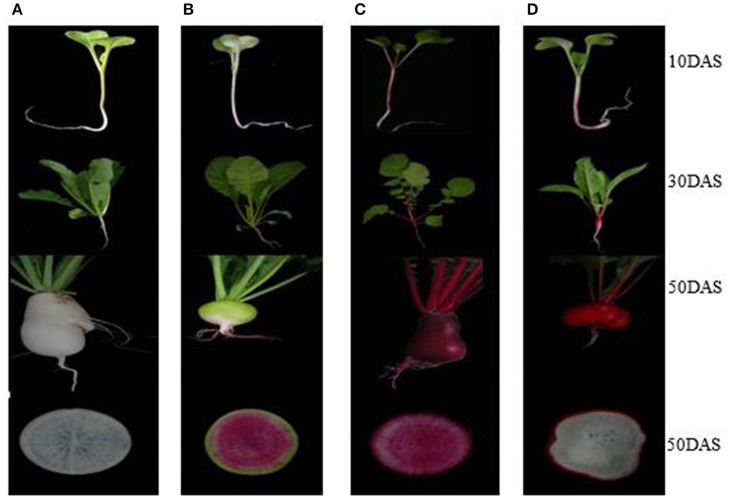
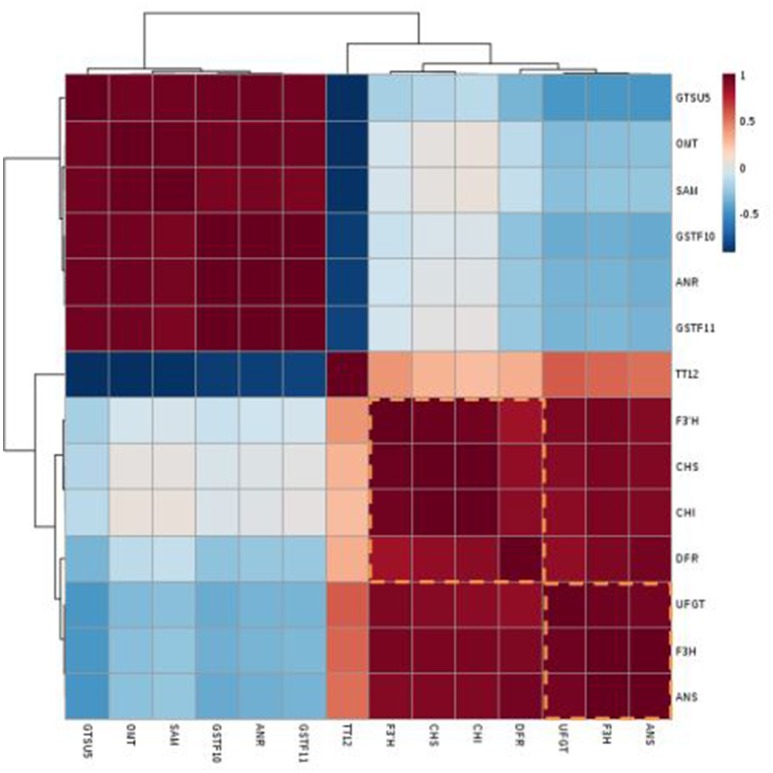
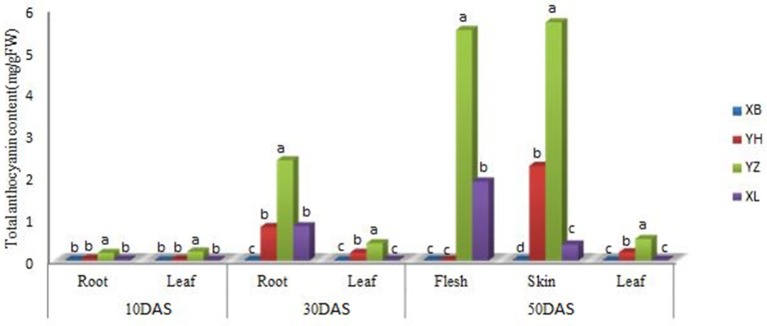
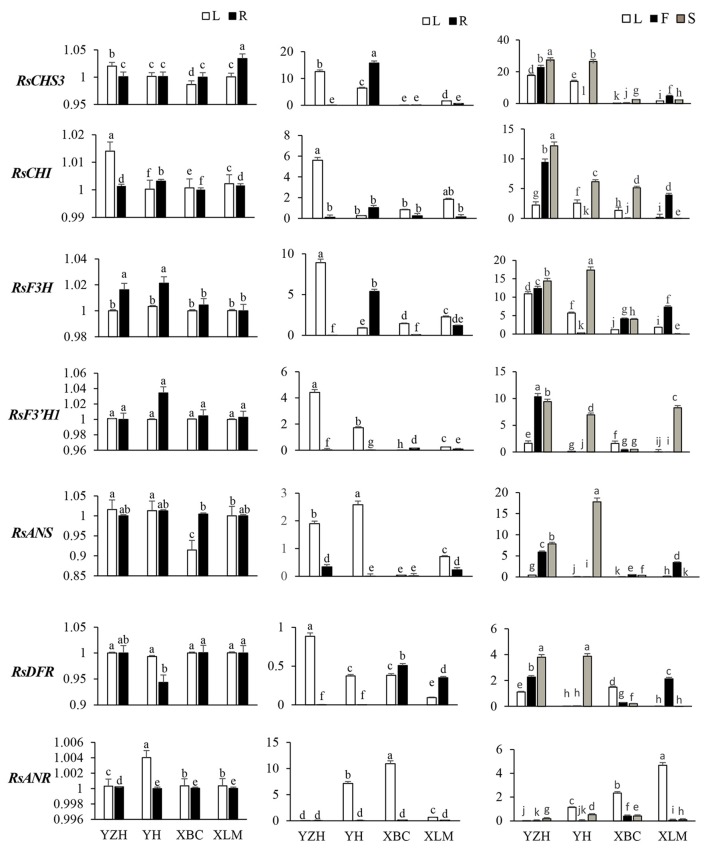
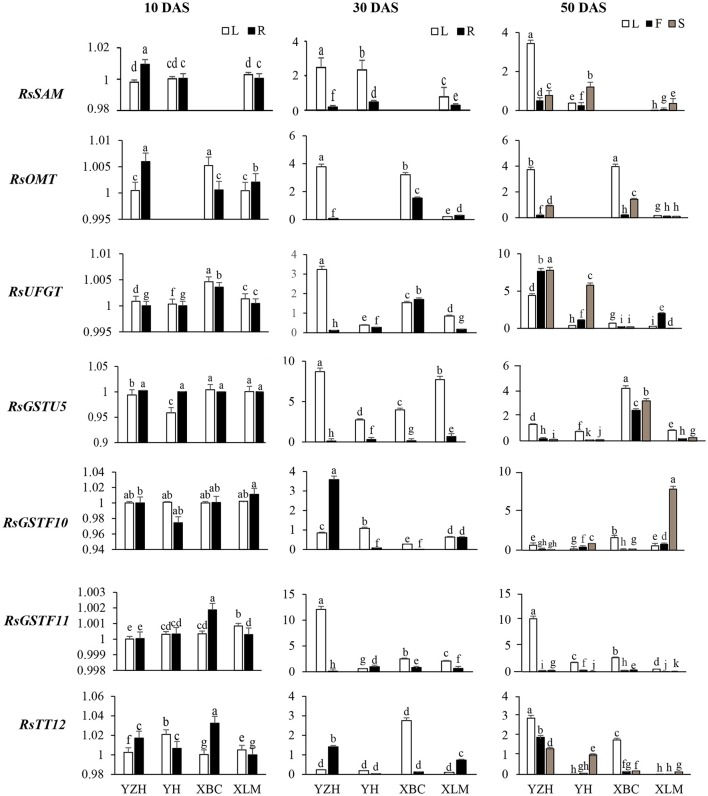
Anthocyanins are natural pigments that have important functions in plant growth and development. Radish taproots are rich in anthocyanins which confer different taproot colors and are potentially beneficial to human health. The crop differentially accumulates anthocyanin during various stages of growth, yet molecular mechanisms underlying this differential anthocyanin accumulation remains unknown. In the present study, transcriptome analysis was used to concisely identify putative genes involved in anthocyanin biosynthesis in radish. Spatial-temporal transcript expressions were then profiled in four color variant radish cultivars. From the total transcript sequences obtained through illumina sequencing, 102 assembled unigenes, and 20 candidate genes were identified to be involved in anthocyanin biosynthesis. Fifteen genomic sequences were isolated and sequenced from radish taproot. The length of these sequences was between 900 and 1,579 bp, and the unigene coverage to all of the corresponding cloned sequences was more than 93%. Gene structure analysis revealed that ' is intronless and anthocyanin biosynthesis genes (ABGs) bear asymmetrical exons, except . Anthocyanin accumulation showed a gradual increase in the leaf of the red radish and the taproot of colored cultivars during development, with a rapid increase at 30 days after sowing (DAS), and the highest content at maturity. Spatial-temporal transcriptional analysis of 14 genes revealed detectable expressions of 12 ABGs in various tissues at different growth levels. The investigation of anthocyanin accumulation and gene expression in four color variant radish cultivars, at different stages of development, indicated that total anthocyanin correlated with transcript levels of ABGs, particularly and '. Our results suggest that these candidate genes play key roles in phenotypic and spatial-temporal anthocyanin accumulation in radish through coordinated regulation and the major control point in anthocyanin biosynthesis in radish is . The present findings lend invaluable insights into anthocyanin biosynthesis and may facilitate genetic manipulation for enhanced anthocyanin content in radish.
花青素是在植物生长发育过程中具有重要功能的天然色素。萝卜主根富含花青素,赋予主根不同颜色,且可能对人体健康有益。该作物在生长的各个阶段花青素积累存在差异,然而这种花青素差异积累的分子机制仍不清楚。在本研究中,利用转录组分析来简明地鉴定参与萝卜花青素生物合成的假定基因。然后在四个颜色变异的萝卜品种中分析时空转录表达。通过Illumina测序获得的总转录序列中,鉴定出102个组装的单基因和20个参与花青素生物合成的候选基因。从萝卜主根中分离并测序了15个基因组序列。这些序列长度在900至1579 bp之间,所有相应克隆序列的单基因覆盖率超过93%。基因结构分析表明,除了 外, 没有内含子,花青素生物合成基因(ABGs)具有不对称外显子。在发育过程中,红萝卜叶片和有色品种主根中的花青素积累呈逐渐增加趋势,在播种后30天(DAS)迅速增加,成熟期含量最高。对14个基因的时空转录分析表明,12个ABGs在不同生长阶段的各种组织中都有可检测到的表达。对四个颜色变异萝卜品种在不同发育阶段的花青素积累和基因表达的研究表明,总花青素与ABGs的转录水平相关,特别是 和 。我们的结果表明,这些候选基因通过协同调控在萝卜花青素的表型和时空积累中起关键作用,萝卜花青素生物合成的主要控制点是 。本研究结果为花青素生物合成提供了宝贵的见解,并可能有助于通过基因操作提高萝卜中的花青素含量。