Gay-des-Combes Justine Marie, Sanz Carrillo Clara, Robroek Bjorn Jozef Maria, Jassey Vincent Eric Jules, Mills Robert Thomas Edmund, Arif Muhammad Saleem, Falquet Leia, Frossard Emmanuel, Buttler Alexandre
ECOS Laboratory École Polytechnique Fédérale de Lausanne Lausanne Switzerland.
Swiss Federal Institute for Forest Snow and Landscape Research Lausanne Switzerland.
Ecol Evol. 2017 Jun 12;7(14):5378-5388. doi: 10.1002/ece3.3104. eCollection 2017 Jul.
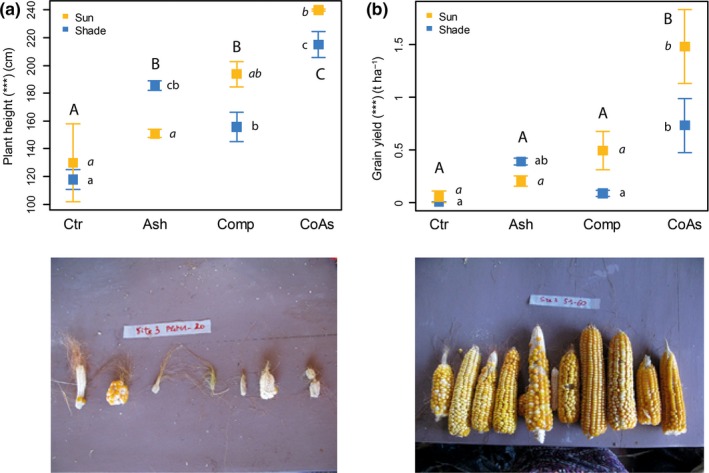
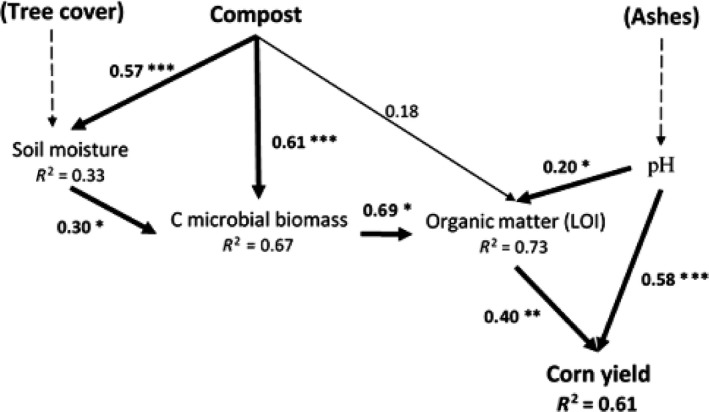
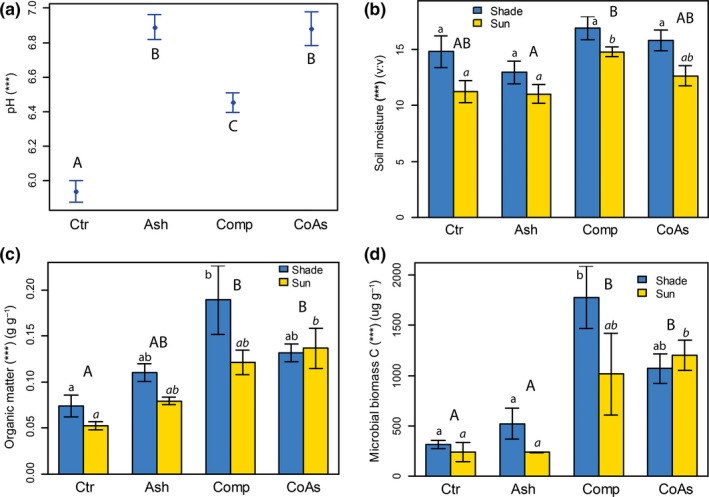
In many tropical regions, slash-and-burn agriculture is considered as a driver of deforestation; the forest is converted into agricultural land by cutting and burning the trees. However, the fields are abandoned after few years because of yield decrease and weed invasion. Consequently, new surfaces are regularly cleared from the primary forest. We propose a reclamation strategy for abandoned fields allowing and sustaining re-cultivation. In the dry region of south-western Madagascar, we tested, according to a split-plot design, an alternative selective slash-and-burn cultivation technique coupled with compost amendment on 30-year-old abandoned fields. Corn plants ( L.) were grown on four different types of soil amendments: no amendment (control), compost, ashes (as in traditional slash-and-burn cultivation), and compost + ashes additions. Furthermore, two tree cover treatments were applied: 0% tree cover (as in traditional slash-and-burn cultivation) and 50% tree cover (selective slash-and-burn). Both corn growth and soil fertility parameters were monitored during the growing season 2015 up to final harvest. The amendment compost + ashes strongly increased corn yield, which was multiplied by 4-5 in comparison with ashes or compost alone, reaching 1.5 t/ha compared to 0.25 and 0.35 t/ha for ashes and compost, respectively. On control plots, yield was negligible as expected on these degraded soils. Structural equation modeling evidenced that compost and ashes were complementary fertilizing pathways promoting soil fertility through positive effects on soil moisture, pH, organic matter, and microbial activity. Concerning the tree cover treatment, yield was reduced on shaded plots (50% tree cover) compared to sunny plots (0% tree cover) for all soil amendments, except ashes. To conclude, our results provide empirical evidence on the potential of recultivating tropical degraded soils with compost and ashes. This would help mitigating deforestation of the primary forest by increasing lifespan of agricultural lands.
在许多热带地区,刀耕火种农业被视为森林砍伐的一个驱动因素;通过砍伐和焚烧树木,森林被转化为农业用地。然而,由于产量下降和杂草入侵,这些田地几年后就被废弃了。因此,新的土地不断从原始森林中被开垦出来。我们提出了一种针对废弃田地的开垦策略,以允许并维持重新耕种。在马达加斯加西南部的干旱地区,我们根据裂区设计,在有30年历史的废弃田地上测试了一种替代性的选择性刀耕火种种植技术,并添加了堆肥改良剂。玉米植株(L.)种植在四种不同类型的土壤改良剂上:不添加改良剂(对照)、堆肥、灰烬(如传统刀耕火种种植那样)以及添加堆肥 + 灰烬。此外,还应用了两种树木覆盖处理方式:0%树木覆盖(如传统刀耕火种种植那样)和50%树木覆盖(选择性刀耕火种)。在2015年生长季直至最终收获期间,对玉米生长和土壤肥力参数进行了监测。添加堆肥 + 灰烬的改良剂显著提高了玉米产量,与单独使用灰烬或堆肥相比,产量增加了4至5倍,达到1.5吨/公顷,而单独使用灰烬和堆肥时分别为0.25吨/公顷和0.35吨/公顷。在对照地块上,正如在这些退化土壤上预期的那样,产量可以忽略不计。结构方程模型表明,堆肥和灰烬是互补的施肥途径,通过对土壤湿度、pH值、有机质和微生物活性产生积极影响来促进土壤肥力。关于树木覆盖处理,除了灰烬处理外,对于所有土壤改良剂,在遮荫地块(50%树木覆盖)上的产量都低于阳光充足的地块(0%树木覆盖)。总之,我们的结果为用堆肥和灰烬重新开垦热带退化土壤的潜力提供了实证依据。这将有助于通过延长农业用地的使用寿命来减轻原始森林的砍伐。