Burgio Kevin R, Carlson Colin J, Tingley Morgan W
Department of Ecology and Evolutionary Biology University of Connecticut Storrs CT USA.
Department of Environmental Science, Policy and Management University of California Berkeley CA USA.
Ecol Evol. 2017 Jun 12;7(14):5467-5475. doi: 10.1002/ece3.3135. eCollection 2017 Jul.
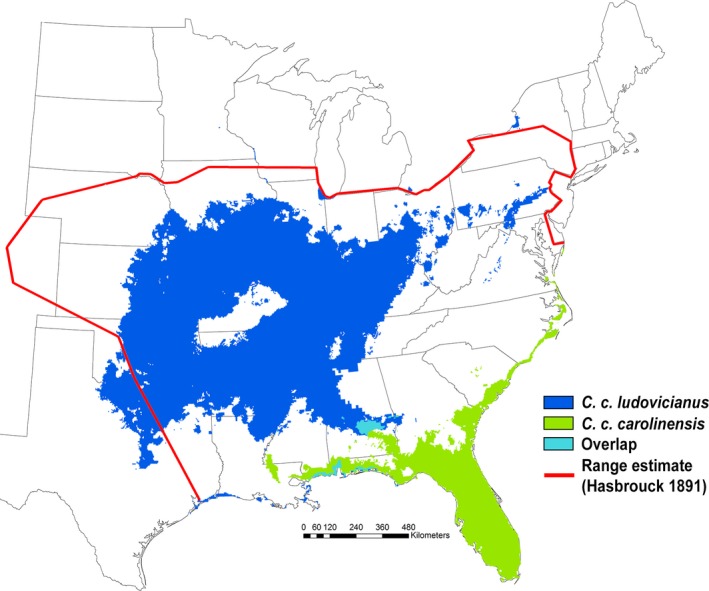
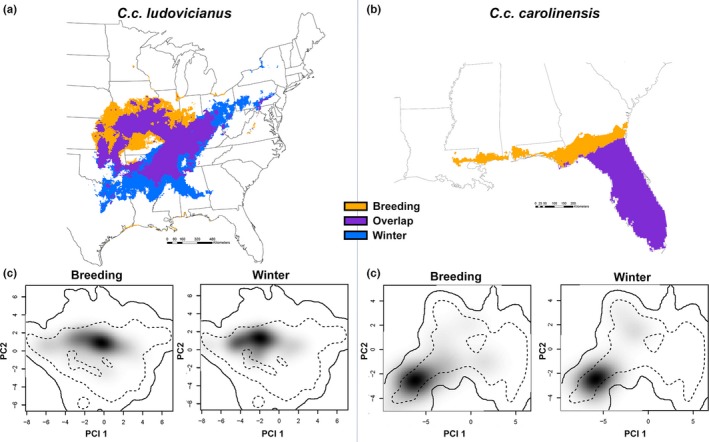
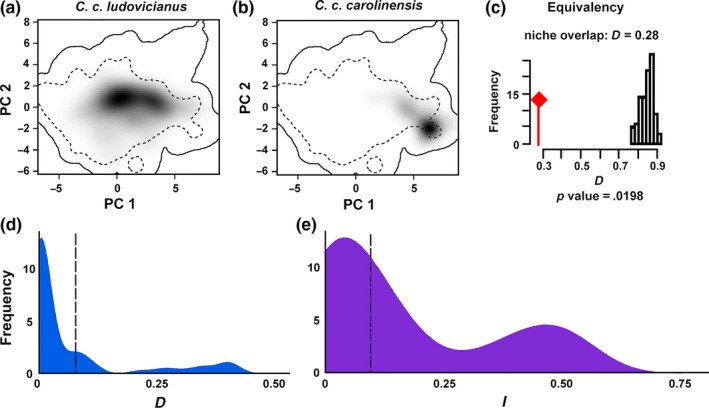
The study of the ecology and natural history of species has traditionally ceased when a species goes extinct, despite the benefit to current and future generations of potential findings. We used the extinct Carolina parakeet as a case study to develop a framework investigating the distributional limits, subspecific variation, and migratory habits of this species as a means to recover important information about recently extinct species. We united historical accounts with museum collections to develop an exhaustive, comprehensive database of every known occurrence of this once iconic species. With these data, we combined species distribution models and ordinal niche comparisons to confront multiple conjectured hypotheses about the parakeet's ecology with empirical data on where and when this species occurred. Our results demonstrate that the Carolina parakeet's range was likely much smaller than previously believed, that the eastern and western subspecies occupied different climatic niches with broad geographical separation, and that the western subspecies was likely a seasonal migrant while the eastern subspecies was not. This study highlights the novelty and importance of collecting occurrence data from published observations on extinct species, providing a starting point for future investigations of the factors that drove the Carolina parakeet to extinction. Moreover, the recovery of lost autecological knowledge could benefit the conservation of other parrot species currently in decline and would be crucial to the success of potential de-extinction efforts for the Carolina parakeet.
传统上,当一个物种灭绝时,对其生态和自然史的研究就会停止,尽管这对当代和后代可能的研究发现有益。我们以已灭绝的卡罗莱纳鹦鹉为例,开发了一个框架,通过研究该物种的分布范围、亚种变异和迁徙习性,来恢复有关最近灭绝物种的重要信息。我们将历史记录与博物馆藏品相结合,建立了一个详尽、全面的数据库,涵盖了这个曾经具有代表性的物种的每一个已知出现地点。利用这些数据,我们结合了物种分布模型和有序生态位比较,用该物种出现的地点和时间的实证数据来验证关于卡罗莱纳鹦鹉生态的多个推测假设。我们的研究结果表明,卡罗莱纳鹦鹉的分布范围可能比之前认为的要小得多,东部和西部亚种占据不同的气候生态位,地理分隔广泛,西部亚种可能是季节性迁徙物种,而东部亚种不是。这项研究凸显了从已发表的关于灭绝物种的观察中收集出现数据的新颖性和重要性,为未来研究导致卡罗莱纳鹦鹉灭绝的因素提供了一个起点。此外,恢复已失传的个体生态学知识可能有益于目前数量正在减少的其他鹦鹉物种的保护,并且对于卡罗莱纳鹦鹉潜在的复活努力的成功至关重要。