
肺移植中早发性闭塞性细支气管炎综合征和限制性同种异体移植综合征的多变量预测模型的开发。
Development of a Multivariate Prediction Model for Early-Onset Bronchiolitis Obliterans Syndrome and Restrictive Allograft Syndrome in Lung Transplantation.
作者信息
Koutsokera Angela, Royer Pierre J, Antonietti Jean P, Fritz Andreas, Benden Christian, Aubert John D, Tissot Adrien, Botturi Karine, Roux Antoine, Reynaud-Gaubert Martine L, Kessler Romain, Dromer Claire, Mussot Sacha, Mal Hervé, Mornex Jean-François, Guillemain Romain, Knoop Christiane, Dahan Marcel, Soccal Paola M, Claustre Johanna, Sage Edouard, Gomez Carine, Magnan Antoine, Pison Christophe, Nicod Laurent P
机构信息
Division of Pulmonary Medicine, Centre Hospitalier Universitaire Vaudois (CHUV), University of Lausanne, Lausanne, Switzerland.
Institut du thorax, INSERM UMR 1087/CNRS UMR 6291, CHU de Nantes, Université de Nantes, Nantes, France.
出版信息
Front Med (Lausanne). 2017 Jul 17;4:109. doi: 10.3389/fmed.2017.00109. eCollection 2017.
BACKGROUND
Chronic lung allograft dysfunction and its main phenotypes, bronchiolitis obliterans syndrome (BOS) and restrictive allograft syndrome (RAS), are major causes of mortality after lung transplantation (LT). RAS and early-onset BOS, developing within 3 years after LT, are associated with particularly inferior clinical outcomes. Prediction models for early-onset BOS and RAS have not been previously described.
METHODS
LT recipients of the French and Swiss transplant cohorts were eligible for inclusion in the SysCLAD cohort if they were alive with at least 2 years of follow-up but less than 3 years, or if they died or were retransplanted at any time less than 3 years. These patients were assessed for early-onset BOS, RAS, or stable allograft function by an adjudication committee. Baseline characteristics, data on surgery, immunosuppression, and year-1 follow-up were collected. Prediction models for BOS and RAS were developed using multivariate logistic regression and multivariate multinomial analysis.
RESULTS
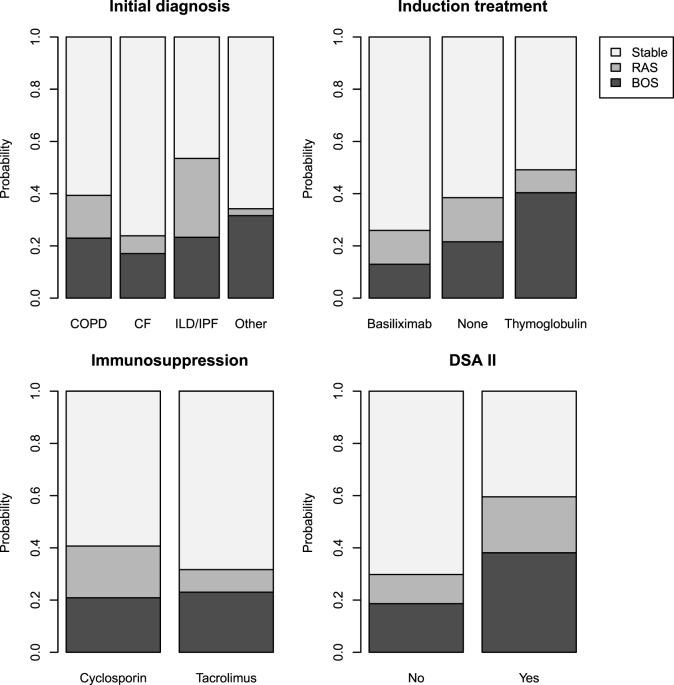
Among patients fulfilling the eligibility criteria, we identified 149 stable, 51 BOS, and 30 RAS subjects. The best prediction model for early-onset BOS and RAS included the underlying diagnosis, induction treatment, immunosuppression, and year-1 class II donor-specific antibodies (DSAs). Within this model, class II DSAs were associated with BOS and RAS, whereas pre-LT diagnoses of interstitial lung disease and chronic obstructive pulmonary disease were associated with RAS.
CONCLUSION
Although these findings need further validation, results indicate that specific baseline and year-1 parameters may serve as predictors of BOS or RAS by 3 years post-LT. Their identification may allow intervention or guide risk stratification, aiming for an individualized patient management approach.
背景
慢性肺移植功能障碍及其主要表型,闭塞性细支气管炎综合征(BOS)和限制性移植综合征(RAS),是肺移植(LT)后死亡的主要原因。RAS和LT后3年内发生的早发性BOS与特别差的临床结果相关。早发性BOS和RAS的预测模型此前尚未见报道。
方法
法国和瑞士移植队列的LT受者若存活且随访至少2年但少于3年,或在少于3年的任何时间死亡或再次移植,则有资格纳入SysCLAD队列。由一个判定委员会对这些患者进行早发性BOS、RAS或移植肺功能稳定的评估。收集基线特征、手术、免疫抑制及1年随访的数据。使用多变量逻辑回归和多变量多项式分析建立BOS和RAS的预测模型。
结果
在符合纳入标准的患者中,我们确定了149例移植肺功能稳定、51例BOS和30例RAS患者。早发性BOS和RAS的最佳预测模型包括潜在诊断、诱导治疗、免疫抑制及1年时的II类供者特异性抗体(DSA)。在该模型中,II类DSA与BOS和RAS相关,而LT前诊断为间质性肺疾病和慢性阻塞性肺疾病与RAS相关。
结论
尽管这些发现需要进一步验证,但结果表明特定的基线和1年时的参数可能作为LT后3年时BOS或RAS的预测指标。对它们的识别可能有助于进行干预或指导风险分层,以实现个体化的患者管理方法。


 Zotero 插件