Li Jianping, Zhao Mingxi, Liu Yongsheng, Chai Nan, Ye Fang, Qin Hailong, Cheng Laifei, Zhang Litong
Science and Technology on Thermostructural Composite Materials Laboratory, Northwestern Polytechnical University, Xi'an 710072, China.
State Key Laboratory of Solidification Processing, Northwestern Polytechnical University, Xi'an 710072, China.
Materials (Basel). 2017 Jun 15;10(6):655. doi: 10.3390/ma10060655.
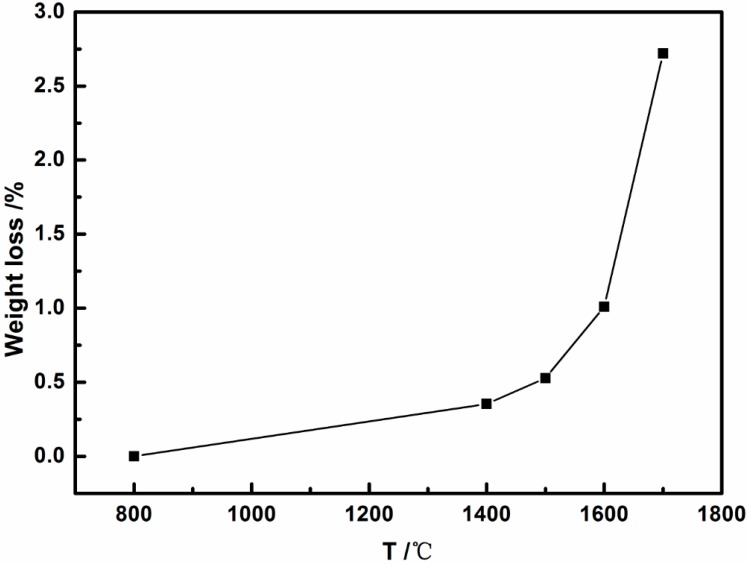
SiBCN ceramics were introduced into porous Si₃N₄ ceramics via a low-pressure chemical vapor deposition and infiltration (LPCVD/CVI) technique, and then the composite ceramics were heat-treated from 1400 °C to 1700 °C in a N₂ atmosphere. The effects of annealing temperatures on microstructure, phase evolution, dielectric properties of SiBCN ceramics were investigated. The results revealed that α-Si₃N₄ and free carbon were separated below 1700 °C, and then SiC grains formed in the SiBCN ceramic matrix after annealing at 1700 °C through a phase-reaction between free carbon and α-Si₃N₄. The average dielectric loss of composites increased from 0 to 0.03 due to the formation of dispersive SiC grains and the increase of grain boundaries.
通过低压化学气相沉积和渗透(LPCVD/CVI)技术将SiBCN陶瓷引入多孔Si₃N₄陶瓷中,然后在N₂气氛中将复合陶瓷在1400℃至1700℃下进行热处理。研究了退火温度对SiBCN陶瓷微观结构、相演变和介电性能的影响。结果表明,α-Si₃N₄和游离碳在1700℃以下分离,然后在1700℃退火后,通过游离碳与α-Si₃N₄之间的相反应在SiBCN陶瓷基体中形成SiC晶粒。由于分散的SiC晶粒的形成和晶界的增加,复合材料的平均介电损耗从0增加到0.03。