Luo Beibei, Huang Feng, Liu Yanli, Liang Yiying, Wei Zhe, Ke Honghong, Zeng Zhiyu, Huang Weiqiang, He Yan
Department of Geriatric Cardiology, The First Affiliated Hospital of Guangxi Medical UniversityNanning, China.
Department of Cardiology, Institute of Cardiovascular Diseases, The First Affiliated Hospital of Guangxi Medical UniversityNanning, China.
Front Physiol. 2017 Jul 25;8:519. doi: 10.3389/fphys.2017.00519. eCollection 2017.
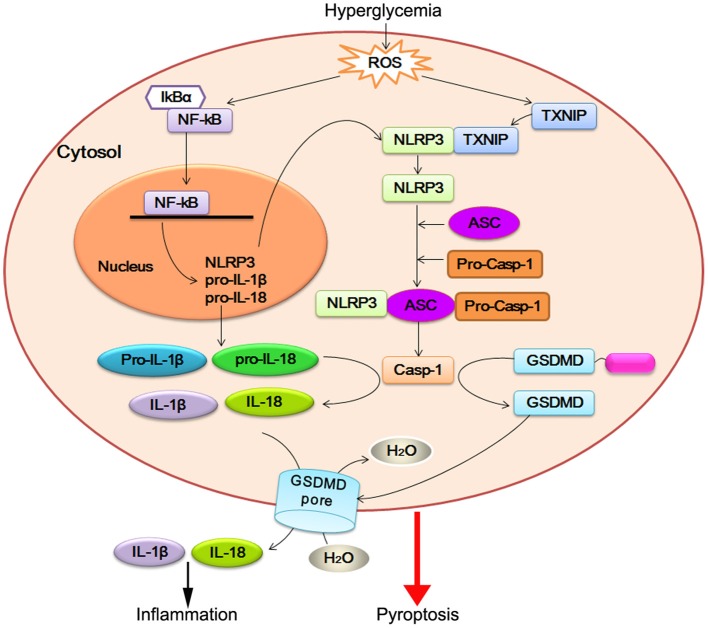
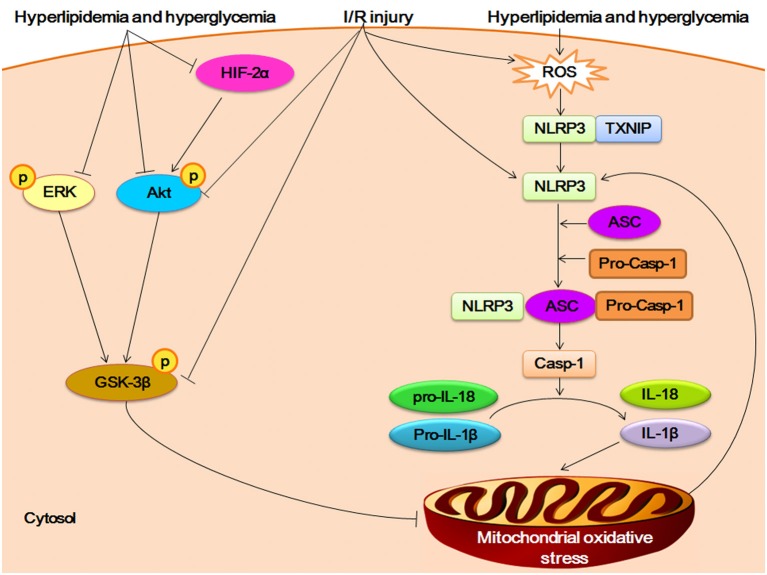
Diabetic cardiomyopathy (DCM), a common consequence of longstanding diabetes mellitus, is initiated by death of cardiomyocyte. Hyperglycemia-induced reactive oxygen species (ROS) overproduction is a major contributor of the chronic low-grade inflammation that characterizes as the DCM. ROS may promote the activation of nucleotide-binding oligomerization domain like receptor (NLR) pyrin domain containing 3 (NLRP3) inflammasome, a novel regulator of inflammation and cell death, by nuclear factor-kB (NF-κB) and thioredoxin interacting/inhibiting protein (TXNIP). NLRP3 inflammasome regulates the death of cardiomyocyte and activation of fibroblast in DCM, which is involved in the structural and functional disorder of DCM. However, comprehensive understanding of molecular mechanisms linking NLRP3 inflammasome and disorder of cardiomyocyte and fibroblast in DCM is lacking. Here, we review the molecular mechanism(s) of NLRP3 inflammasome activation in response to hyperglycemia in DCM.
糖尿病性心肌病(DCM)是长期糖尿病的常见并发症,由心肌细胞死亡引发。高血糖诱导的活性氧(ROS)过量产生是慢性低度炎症的主要促成因素,这种炎症是DCM的特征。ROS可能通过核因子-κB(NF-κB)和硫氧还蛋白相互作用/抑制蛋白(TXNIP)促进含吡咯结构域的核苷酸结合寡聚化结构域样受体(NLR)家族的NLRP3炎性小体的激活,NLRP3炎性小体是炎症和细胞死亡的新型调节因子。NLRP3炎性小体调节DCM中心肌细胞的死亡和成纤维细胞的激活,这与DCM的结构和功能紊乱有关。然而,目前缺乏对连接NLRP3炎性小体与DCM中心肌细胞和成纤维细胞紊乱的分子机制的全面了解。在此,我们综述了DCM中NLRP3炎性小体对高血糖反应的激活分子机制。