Neurology Service and Geriatrics Research, Education, and Clinical Center, Veterans Affairs Ann Arbor Health System, Ann Arbor, MI 48105.
Department of Neurology, University of Michigan, Ann Arbor, MI 48109.
eNeuro. 2017 Aug 7;4(4). doi: 10.1523/ENEURO.0178-17.2017. eCollection 2017 Jul-Aug.
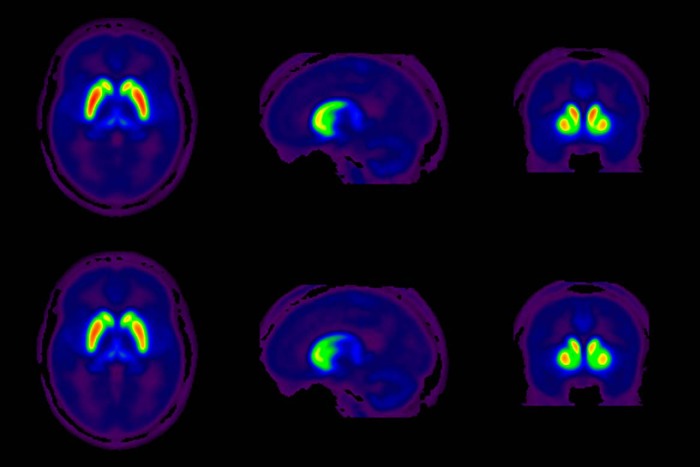
Considerable prior work suggests basal ganglia dysfunction in Tourette syndrome (TS). Analysis of a small number of postmortem specimens suggests deficits of some striatal interneuron populations, including striatal cholinergic interneurons. To assess the integrity of striatal cholinergic interneurons in TS, we used [F]FEOBV positron emission tomography (PET) to quantify striatal vesicular acetylcholine transporter (VAChT) expression, a measure of cholinergic terminal density, in human TS and control subjects. We found no evidence of striatal cholinergic deficits. Discrepant imaging and postmortem analysis results may reflect agonal or postmortem changes, medication effects, or significant disease heterogeneity.
大量先前的研究表明,基底神经节功能障碍与妥瑞氏综合征(TS)有关。对少数尸检标本的分析表明,包括纹状体内胆硷能中间神经元在内的一些纹状体中间神经元群体存在缺陷。为了评估 TS 患者纹状体内胆硷能中间神经元的完整性,我们使用[F]FEOBV 正电子发射断层扫描(PET)来定量测定纹状体内囊泡乙酰胆硷转运体(VAChT)的表达,这是一种胆碱能终末密度的测量方法,对 TS 患者和对照组进行了研究。我们没有发现纹状体内胆硷能缺陷的证据。不一致的影像学和尸检分析结果可能反映了濒死期或死后的变化、药物的影响,或疾病的显著异质性。