Division of Pharmaceutical Analysis, Office of Testing and Research, Office of Pharmaceutical Quality, Center for Drug Evaluation and Research, Food and Drug Administration, Silver Spring, Maryland, 20993, USA.
Division of Pharmaceutical Analysis, Office of Testing and Research, Office of Pharmaceutical Quality, Center for Drug Evaluation and Research, Food and Drug Administration, St. Louis, Missouri, USA.
AAPS J. 2017 Nov;19(6):1760-1766. doi: 10.1208/s12248-017-0127-z. Epub 2017 Aug 8.
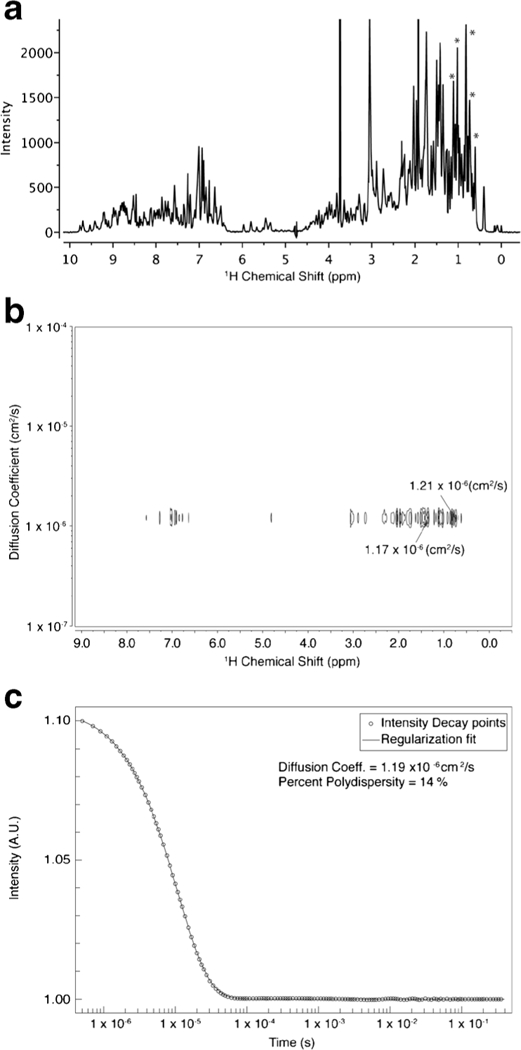
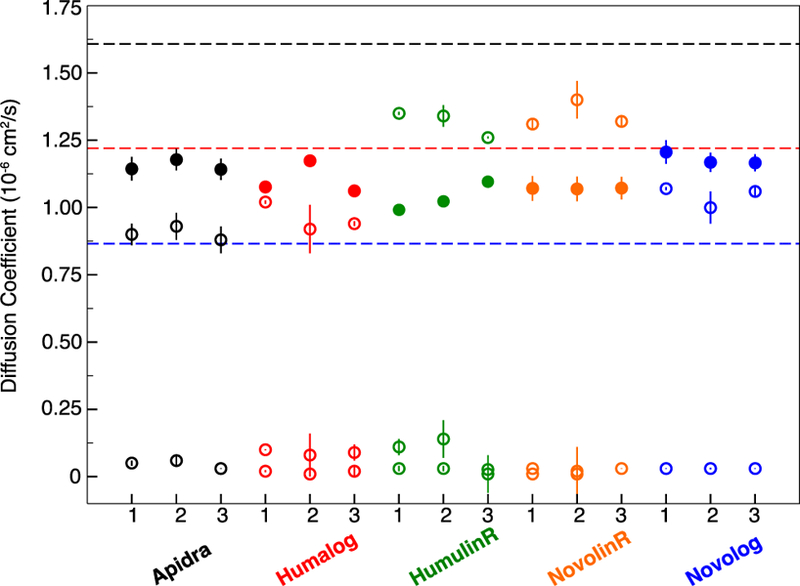
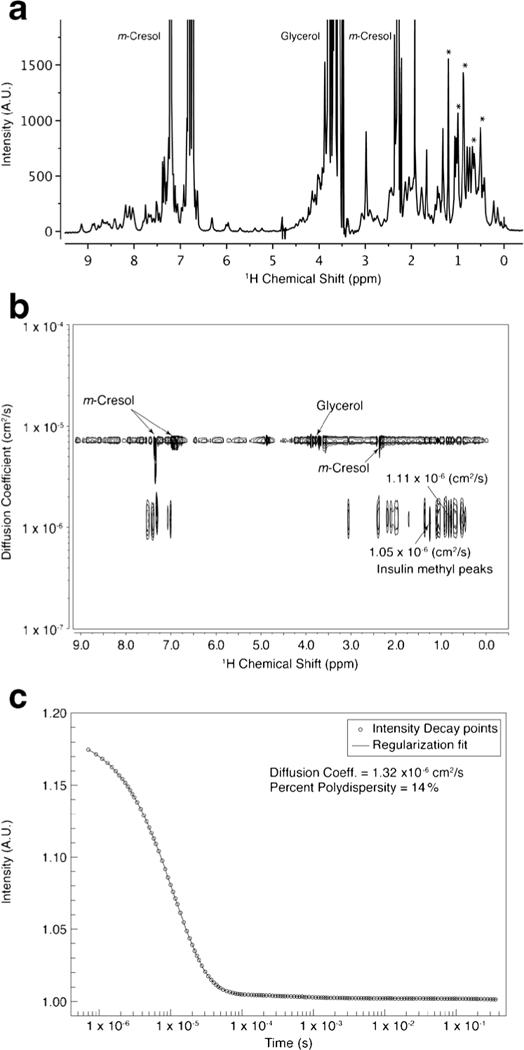
Particle size distribution, a measurable physicochemical quantity, is a critical quality attribute of drug products that needs to be controlled in drug manufacturing. The non-invasive methods of dynamic light scattering (DLS) and Diffusion Ordered SpectroscopY (DOSY) NMR can be used to measure diffusion coefficient and derive the corresponding hydrodynamic radius. However, little is known about their use and sensitivity as analytical tools for particle size measurement of formulated protein therapeutics. Here, DLS and DOSY-NMR methods are shown to be orthogonal and yield identical diffusion coefficient results for a homogenous monomeric protein standard, ribonuclease A. However, different diffusion coefficients were observed for five insulin drug products measured using the two methods. DOSY-NMR yielded an averaged diffusion coefficient among fast exchanging insulin oligomers, ranging between dimer and hexamer in size. By contrast, DLS showed several distinct species, including dimer, hexamer, dodecamer and other aggregates. The heterogeneity or polydisperse nature of insulin oligomers in formulation caused DOSY-NMR and DLS results to differ from each other. DLS measurements provided more quality attributes and higher sensitivity to larger aggregates than DOSY-NMR. Nevertheless, each method was sensitive to a different range of particle sizes and complemented each other. The application of both methods increases the assurance of complex drug quality in this similarity comparison.
粒径分布是药物产品的一个关键质量属性,是药物制造中需要控制的可测量物理化学参数。动态光散射(DLS)和扩散有序光谱(DOSY)NMR 等非侵入性方法可用于测量扩散系数,并推导出相应的流体力学半径。然而,对于制剂蛋白治疗药物的粒径测量,其作为分析工具的用途和灵敏度知之甚少。本研究表明,DLS 和 DOSY-NMR 方法是正交的,对于均一单分子蛋白标准品核糖核酸酶 A 可得到相同的扩散系数结果。然而,用两种方法测量的五种胰岛素药物产品的扩散系数却不同。DOSY-NMR 得到了在快速交换胰岛素低聚物中的平均扩散系数,大小介于二聚体和六聚体之间。相比之下,DLS 显示出几种不同的物质,包括二聚体、六聚体、十二聚体和其他聚集体。制剂中胰岛素低聚物的异质性或多分散性导致 DOSY-NMR 和 DLS 的结果不同。DLS 测量提供了更多的质量属性,对较大聚集体的灵敏度高于 DOSY-NMR。然而,每种方法都对不同范围的粒径敏感,并相互补充。两种方法的应用增加了在这种相似性比较中对复杂药物质量的保证。