Huang Xintao, Wan Dahai, Lin Yunpeng, Xue Naizhao, Hao Jiehe, Ma Ning, Pei Xile, Li Ruilong, Zhang Wenju
Department of Neurosurgery, Shanxi Medical University First Affiliated Hospital, Taiyuan, China.
Department of Neurosurgery, Tianjin Medical University General Hospital, Tianjin, China.
Yonsei Med J. 2017 Sep;58(5):1012-1017. doi: 10.3349/ymj.2017.58.5.1012.
Endothelial progenitor cells (EPCs) play a key role in tissue repair and regeneration. Previous studies have shown that infusion of human umbilical cord blood-derived endothelial colony-forming cells improves outcomes in mice subjected to experimental traumatic brain injury (TBI). However, the efficiency of cell transplantation is not satisfactory. Oxidative stress plays a significant role in the survival of transplanted cells following ischemic reperfusion injury. This observational clinical study investigated the correlation between the number of circulating EPCs and plasma levels of superoxide dismutase (SOD) and malonyldialdehyde (MDA).
Peripheral blood samples were collected from 20 patients with mild TBI at day-1, day-2, day-3, day-4, and day-7 post TBI. The number of circulating EPCs and the plasma levels of SOD and MDA were measured.
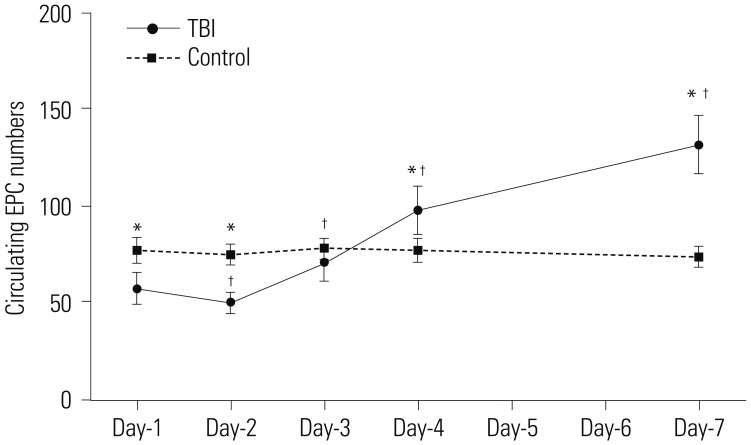
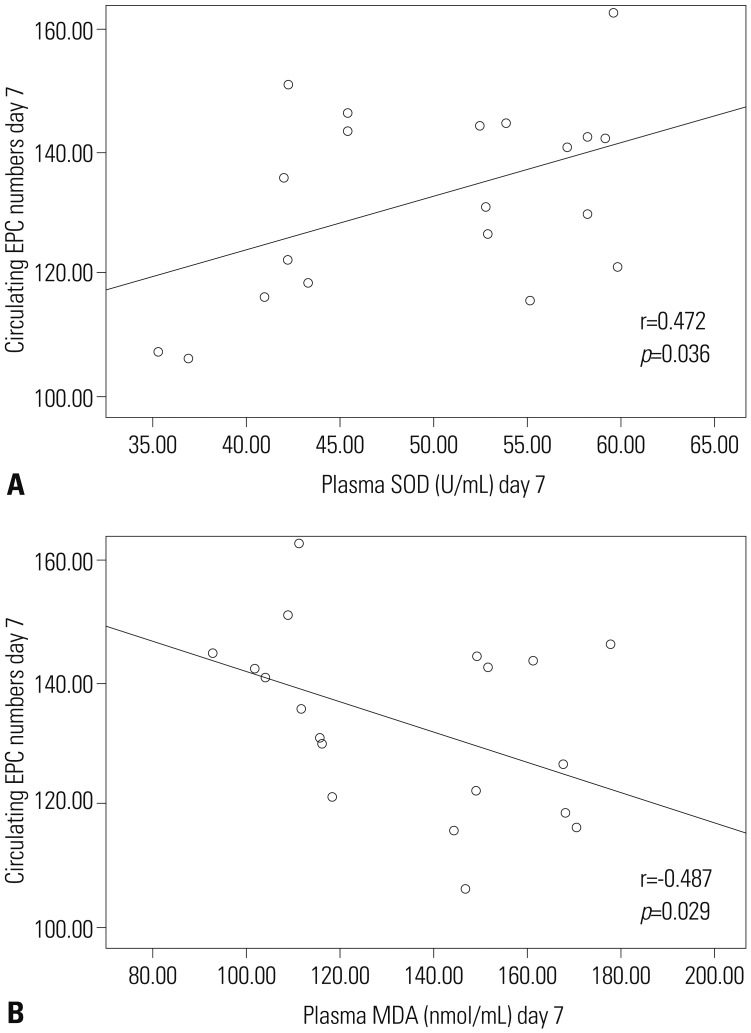
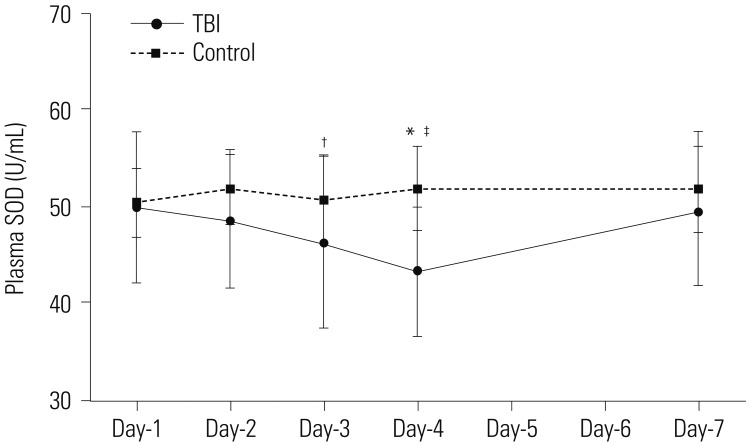
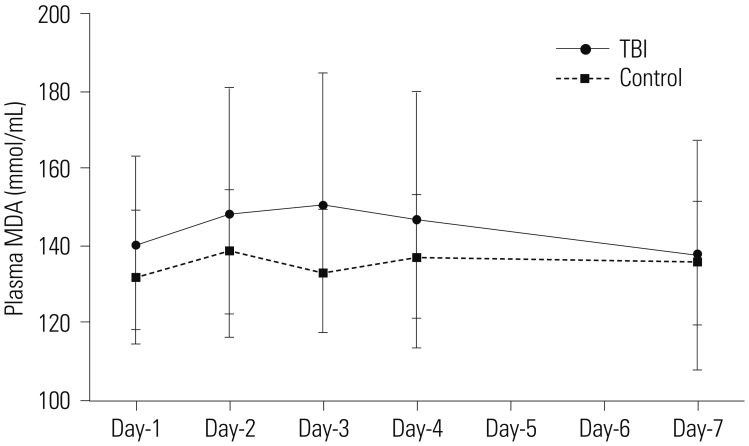
The average of circulating EPCs in TBI patients decreased initially, but increased thereafter, compared with healthy controls. Plasma levels of SOD in TBI patients were significantly lower than those in healthy controls at day-4 post-TBI. MDA levels showed no difference between the two groups. Furthermore, when assessed on day-7 post-TBI, the circulating EPC number were correlated with the plasma levels of SOD and MDA.
These results suggest that the number of circulating EPCs is weakly to moderately correlated with plasma levels of SOD and MDA at day-7 post-TBI, which may offer a novel antioxidant strategy for EPCs transplantation after TBI.
内皮祖细胞(EPCs)在组织修复和再生中起关键作用。先前的研究表明,输注人脐带血来源的内皮集落形成细胞可改善实验性创伤性脑损伤(TBI)小鼠的预后。然而,细胞移植的效率并不令人满意。氧化应激在缺血再灌注损伤后移植细胞的存活中起重要作用。这项观察性临床研究调查了循环EPCs数量与超氧化物歧化酶(SOD)和丙二醛(MDA)血浆水平之间的相关性。
在TBI后第1天、第2天、第3天、第4天和第7天从20例轻度TBI患者采集外周血样本。测量循环EPCs数量以及SOD和MDA的血浆水平。
与健康对照相比,TBI患者循环EPCs的平均值最初下降,但随后增加。TBI患者在TBI后第4天的血浆SOD水平显著低于健康对照。两组间MDA水平无差异。此外,在TBI后第7天进行评估时,循环EPCs数量与SOD和MDA的血浆水平相关。
这些结果表明,TBI后第7天循环EPCs数量与SOD和MDA的血浆水平呈弱至中度相关,这可能为TBI后EPCs移植提供一种新的抗氧化策略。