Málek Přemysl, Šlapáková Poková Michaela, Cieslar Miroslav
Department of Physics of Materials, Charles University in Prague, Faculty of Mathematics and Physics, Ke Karlovu 5, Prague 2 12116, Czech Republic.
Materials (Basel). 2015 Nov 12;8(11):7650-7662. doi: 10.3390/ma8115401.
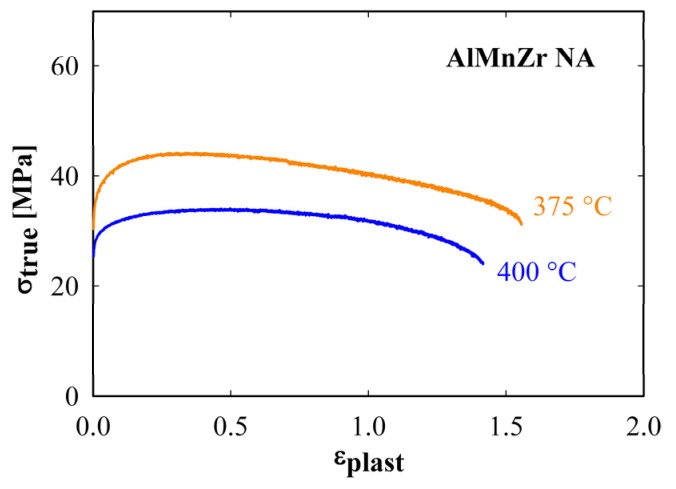
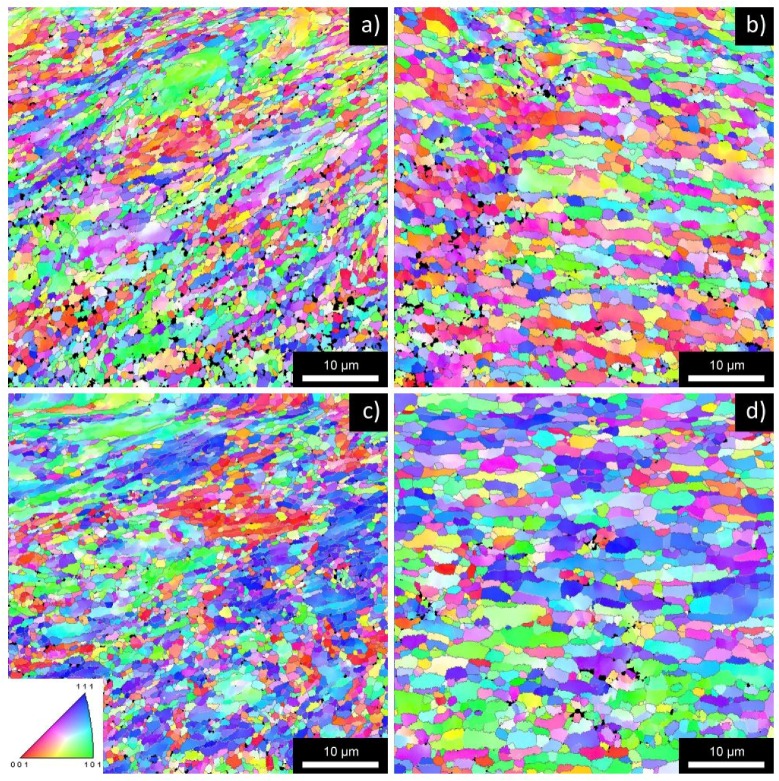
Twin roll cast Al-Mn- and Al-Mn-Zr-based alloys were subjected to four passes of equal channel angular pressing. The resulting grain size of 400 nm contributes to a significant strengthening at room temperature. This microstructure is not fully stable at elevated temperatures and recrystallization and vast grain growth occur at temperatures between 350 and 450 °C. The onset of these microstructure changes depends on chemical and phase composition. Better stability is observed in the Al-Mn-Zr-based alloy. High temperature tensile tests reveal that equal channel angular pressing results in a softening of all studied materials at high temperatures. This can be explained by an active role of grain boundaries in the deformation process. The maximum values of ductility and strain rate sensitivity parameter found in the Al-Mn-Zr-based alloy are below the bottom limit of superplasticity (155%, = 0.25). However, some features typical for superplastic behavior were observed-the strain rate dependence of the parameter , the strengthening with increasing grain size, and the fracture by diffuse necking. Grain boundary sliding is believed to contribute partially to the overall strain in specimens where the grain size remained in the microcrystalline range.
对双辊铸轧的Al-Mn基和Al-Mn-Zr基合金进行了四道次等通道转角挤压。所得400 nm的晶粒尺寸在室温下促成了显著强化。这种微观结构在高温下并不完全稳定,在350至450℃之间会发生再结晶和大量晶粒长大。这些微观结构变化的起始取决于化学和相组成。在Al-Mn-Zr基合金中观察到更好的稳定性。高温拉伸试验表明,等通道转角挤压导致所有研究材料在高温下软化。这可以通过晶界在变形过程中的积极作用来解释。在Al-Mn-Zr基合金中发现的伸长率和应变速率敏感性参数的最大值低于超塑性的下限(155%,m = 0.25)。然而,观察到了一些超塑性行为的典型特征——参数m的应变速率依赖性、随晶粒尺寸增加而强化以及通过扩散颈缩断裂。在晶粒尺寸保持在微晶范围内的试样中,晶界滑动被认为部分促成了整体应变。