Abdallah Chadi G, Geha Paul
Department of Psychiatry, Yale University School of Medicine, New Haven, CT, USA.
National Center for PTSD-Clinical Neurosciences Division, US Department of Veterans Affairs, West Haven, CT, USA.
Chronic Stress (Thousand Oaks). 2017 Feb;1. doi: 10.1177/2470547017704763. Epub 2017 Jun 8.
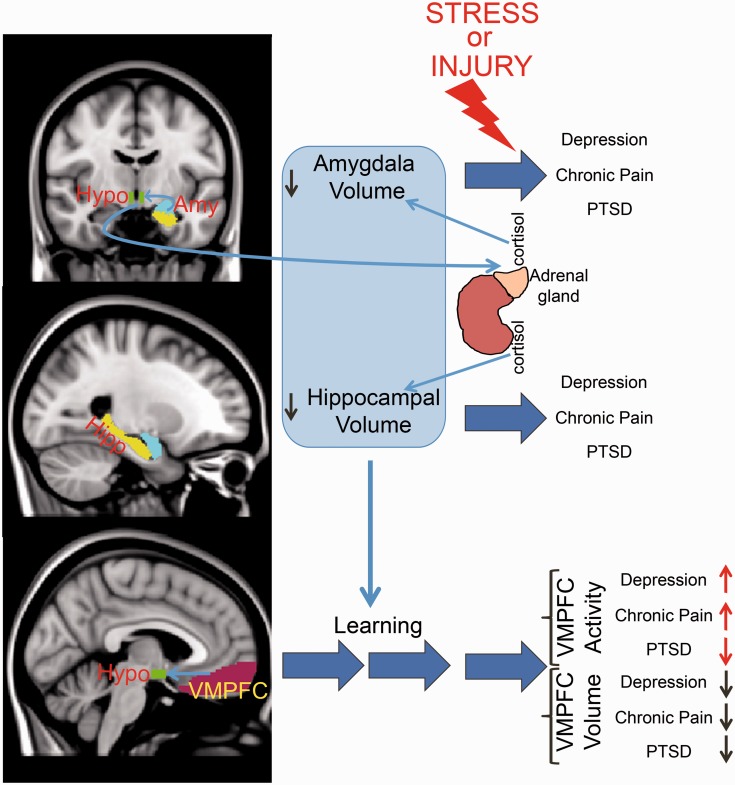
Pain and stress share significant conceptual and physiological overlaps. Both phenomena challenge the body's homeostasis and necessitate decision-making to help animals adapt to their environment. In addition, chronic stress and chronic pain share a common behavioral model of failure to extinguish negative memories. Yet, they also have discrepancies such that the final brain endophenotype of posttraumatic stress disorder, depression, and chronic pain appears to be different among the three conditions, and the role of the hypothalamic-pituitary-adrenal axis remains unclear in the physiology of pain. Persistence of either stress or pain is maladaptive and could lead to compromised well-being. In this brief review, we highlight the commonalities and differences between chronic stress and chronic pain, while focusing particularly on the central role of the limbic brain. We assess the current attempts in the field to conceptualize and understand chronic pain, within the context of knowledge gained from the stress literature. The limbic brain-including hippocampus, amygdala, and ventromedial pre-frontal cortex-plays a critical role in learning. These brain areas integrate incoming nociceptive or stress signals with internal state, and generate learning signals necessary for decision-making. Therefore, the physiological and structural remodeling of this learning circuitry is observed in conditions such as chronic pain, depression, and posttraumatic stress disorder, and is also linked to the risk of onset of these conditions.
疼痛和应激在概念和生理方面存在显著重叠。这两种现象都会挑战身体的内稳态,并且都需要做出决策来帮助动物适应环境。此外,慢性应激和慢性疼痛有着共同的行为模式,即无法消除负面记忆。然而,它们也存在差异,例如创伤后应激障碍、抑郁症和慢性疼痛的最终脑内表型在这三种情况中似乎有所不同,并且下丘脑 - 垂体 - 肾上腺轴在疼痛生理学中的作用仍不明确。应激或疼痛的持续存在都是适应不良的,可能会导致幸福感受损。在这篇简短的综述中,我们强调慢性应激和慢性疼痛之间的共性和差异,尤其关注边缘脑的核心作用。我们在从应激文献中获得的知识背景下,评估该领域目前对慢性疼痛进行概念化和理解的尝试。边缘脑——包括海马体、杏仁核和腹内侧前额叶皮层——在学习中起着关键作用。这些脑区将传入的伤害性或应激信号与内部状态整合起来,并产生决策所需的学习信号。因此,在慢性疼痛、抑郁症和创伤后应激障碍等情况下,可以观察到这种学习回路的生理和结构重塑,并且这也与这些情况的发病风险相关。