Alan Edwards Centre for Research on Pain, McGill University, Montreal, Quebec, H3A 0C7, Canada.
Faculty of Dentistry, McGill University, Montreal, Quebec, H3A 0C7, Canada.
Sci Rep. 2017 Aug 10;7(1):7790. doi: 10.1038/s41598-017-08454-4.
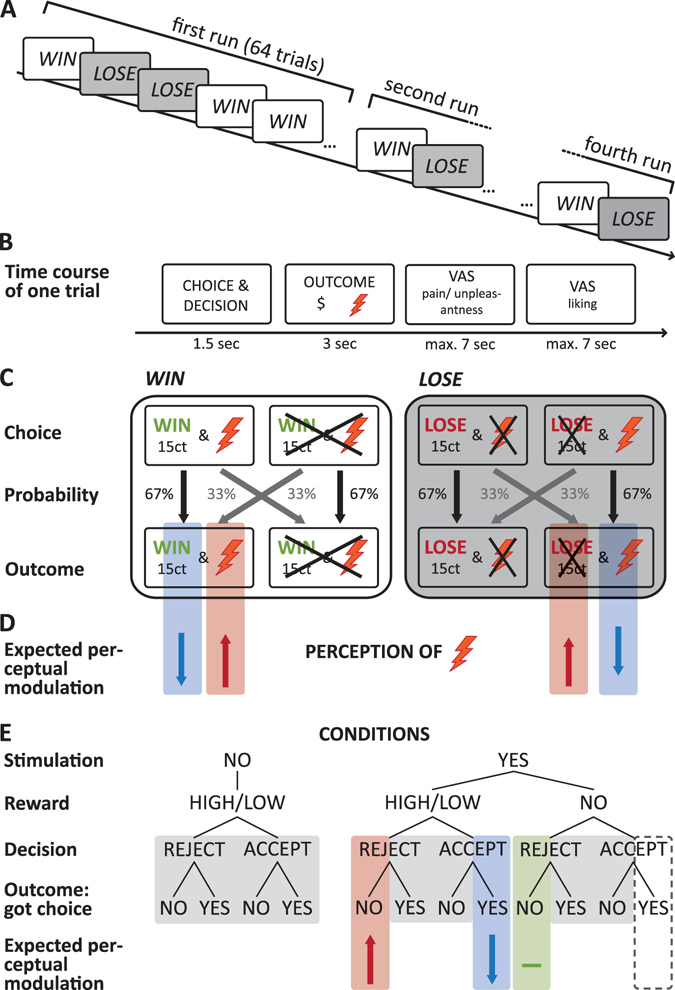
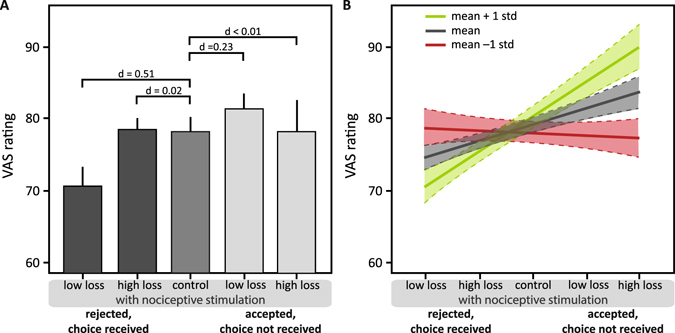
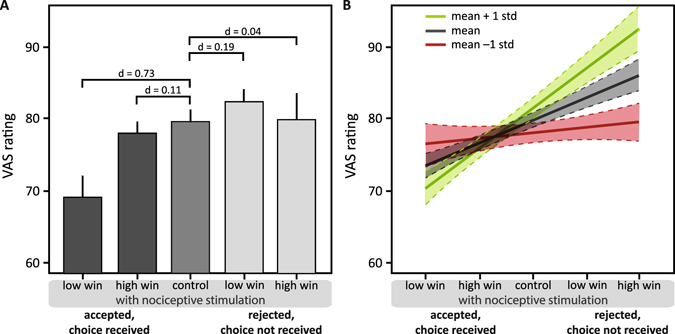
Minimizing pain and maximizing pleasure are conflicting motivations when pain and reward co-occur. Decisions to prioritize reward consumption or pain avoidance are assumed to lead to pain inhibition or facilitation, respectively. Such decisions are a function of the subjective utility of the stimuli involved, i.e. the relative value assigned to the stimuli to compare the potential outcomes of a decision. To test perceptual pain modulation by varying degrees of motivational conflicts and the role of subjective utility, we implemented a task in which healthy volunteers had to decide between accepting a reward at the cost of receiving a nociceptive electrocutaneous stimulus or rejecting both. Subjective utility of the stimuli was assessed by a matching task between the stimuli. Accepting reward coupled to a nociceptive stimulus resulted in decreased perceived intensity, while rejecting the reward to avoid pain resulted in increased perceived intensity, but in both cases only if a high motivational conflict was present. Subjective utility of the stimuli involved moderated these bidirectional perceptual effects: the more a person valued money over pain, the more perceived intensity increased or decreased. These findings demonstrate pain modulation when pain and reward are simultaneously present and highlight the importance of subjective utility for such modulation.
当疼痛和奖励同时出现时,最小化疼痛和最大化愉悦是相互冲突的动机。人们假设,优先考虑奖励消费或避免疼痛的决策分别会导致疼痛抑制或促进。这些决策是所涉及刺激的主观效用的函数,即分配给刺激的相对价值,以比较决策的潜在结果。为了通过不同程度的动机冲突和主观效用来测试感知疼痛调节,我们实施了一项任务,要求健康志愿者在接受奖励而接受伤害性电击刺激或两者都拒绝之间做出选择。通过刺激之间的匹配任务来评估刺激的主观效用。接受与伤害性刺激相关的奖励会导致感知强度降低,而拒绝奖励以避免疼痛会导致感知强度增加,但只有在存在高动机冲突的情况下才会如此。所涉及的刺激的主观效用调节了这些双向感知效应:一个人越看重金钱而不是疼痛,感知强度增加或减少的幅度就越大。这些发现表明,当疼痛和奖励同时存在时会进行疼痛调节,并强调了主观效用对于这种调节的重要性。