Haac Bryce E, O'Hara Nathan N, Mullins C Daniel, Stein Deborah M, Manson Theodore T, Johal Herman, Castillo Renan, O'Toole Robert V, Slobogean Gerard P
School of Medicine, University of Maryland, Baltimore, Maryland, USA.
School of Pharmacy, University of Maryland, Baltimore, Maryland, USA.
BMJ Open. 2017 Aug 11;7(8):e016676. doi: 10.1136/bmjopen-2017-016676.
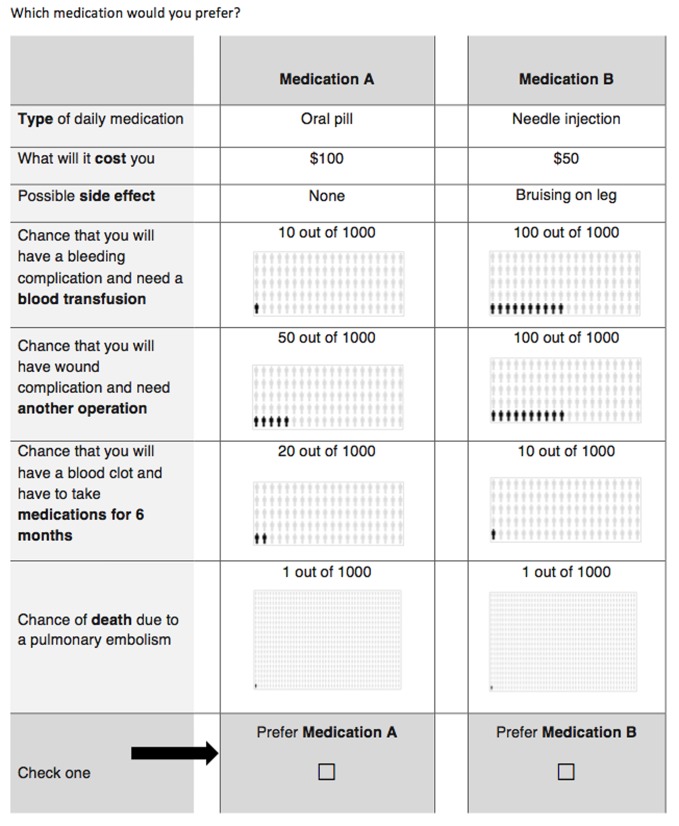
Limited evidence for the optimal venous thromboembolism (VTE) prophylaxis regimen in orthopaedic trauma leads to variability in regimens. We sought to delineate patient preferences towards cost, complication profile, and administration route (oral tablet vs. subcutaneous injection).
Discrete choice experiment (DCE).
Level 1 trauma center in Baltimore, USA.
232 adult trauma patients (mean age 47.9 years) with pelvic or acetabular fractures or operative extremity fractures.
Relative preferences and trade-off estimates for a 1% reduction in complications were estimated using multinomial logit modelling. Interaction terms were added to the model to assess heterogeneity in preferences.
Patients preferred oral tablets over subcutaneous injections (marginal utility, 0.16; 95% CI: 0.11 - 0.21, <0.0001). Preferences changed in favor of subcutaneous injections with an absolute risk reduction of 6.98% in bleeding, 4.53% in wound complications requiring reoperation, 1.27% in VTE, and 0.07% in death from pulmonary embolism (PE). Patient characteristics (sex, race, type of injury, time since injury) affected patient preferences (<0.01).
Patients preferred oral prophylaxis and were most concerned about risk of death from PE. Furthermore, the findings estimated the trade-offs acceptable to patients and heterogeneity in preferences for VTE prophylaxis.
骨科创伤中最佳静脉血栓栓塞症(VTE)预防方案的证据有限,导致方案存在差异。我们试图明确患者对成本、并发症情况及给药途径(口服片剂与皮下注射)的偏好。
离散选择实验(DCE)。
美国巴尔的摩的一级创伤中心。
232名成年创伤患者(平均年龄47.9岁),患有骨盆或髋臼骨折或手术肢体骨折。
使用多项logit模型估计并发症降低1%时的相对偏好和权衡估计值。在模型中添加交互项以评估偏好的异质性。
患者更喜欢口服片剂而非皮下注射(边际效用,0.16;95%置信区间:0.11 - 0.21,<0.0001)。当出血绝对风险降低6.98%、需要再次手术的伤口并发症降低4.53%、VTE降低1.27%以及肺栓塞(PE)导致的死亡降低0.07%时,偏好转向支持皮下注射。患者特征(性别、种族、损伤类型、受伤时间)影响患者偏好(<0.01)。
患者更喜欢口服预防措施,且最关注PE导致的死亡风险。此外,研究结果估计了患者可接受的权衡以及VTE预防偏好的异质性。