Behavioral Neuroscience Program, Department of Psychology, Binghamton University-State University of New York, Binghamton, NY, USA.
J Neuroendocrinol. 2017 Sep;29(9). doi: 10.1111/jne.12514.
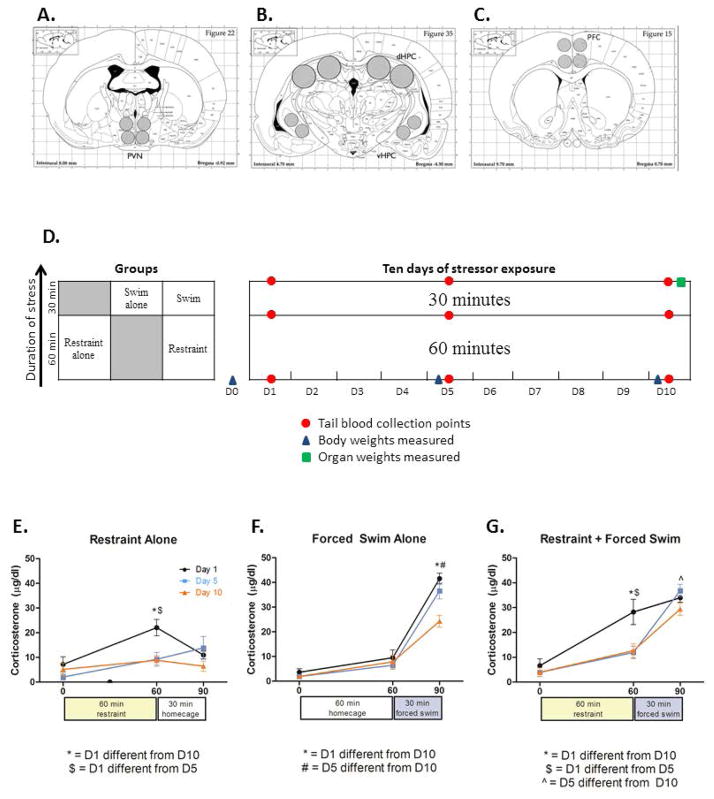
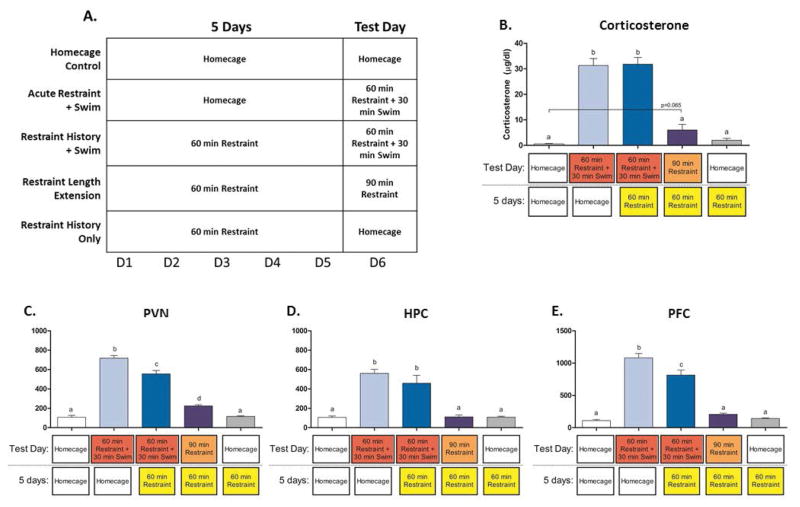
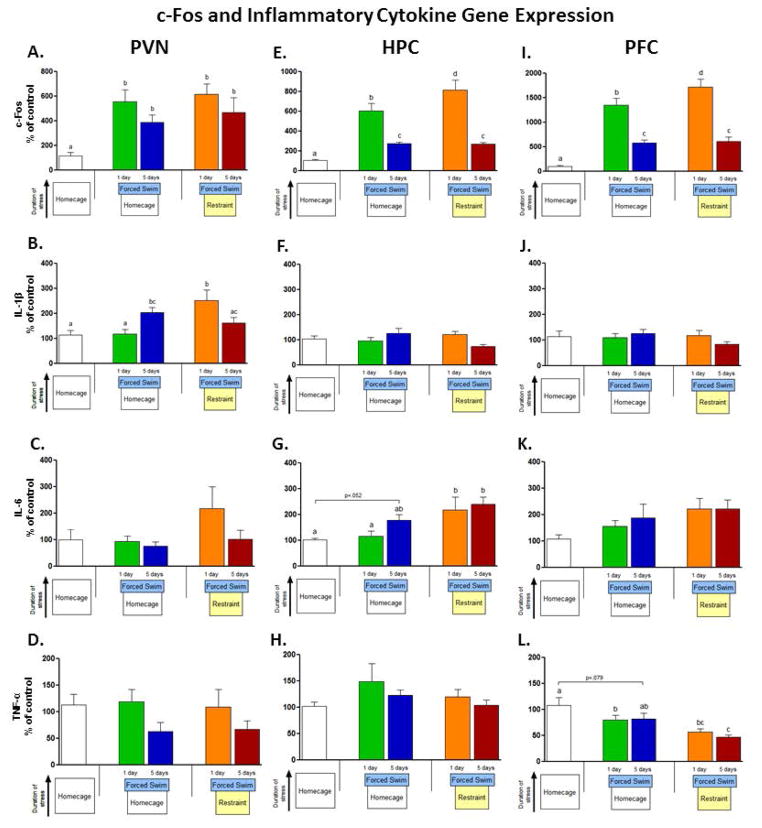
A wide range of stress-related pathologies such as post-traumatic stress disorder are considered to arise from aberrant or maladaptive forms of stress adaptation. The hypothalamic-pituitary-adrenal (HPA) axis readily adapts to repeated stressor exposure, yet little is known about adaptation in neuroimmune responses to repeated or sequential stress challenges. In Experiment 1, rats were exposed to 10 days of restraint alone (60 minutes daily), forced swim alone (30 minutes daily) or daily sequential exposure to restraint (60 minutes) followed immediately by forced swim (30 minutes), termed sequential stress exposure. Habituation of the corticosterone (CORT) response occurred to restraint by 5 days and swim at 10 days, whereas rats exposed to sequential stress exposure failed to display habituation to the combined challenge. Experiment 2 compared 1 or 5 days of forced swim with sequential stress exposure and examined how each affected expression of several neuroimmune and cellular activation genes in the paraventricular nucleus of the hypothalamus (PVN), prefrontal cortex (PFC) and hippocampus (HPC). Sequential exposure to restraint and swim increased interleukin (IL)-1β in the PVN, an effect that was attenuated after 5 days. Sequential stress exposure also elicited IL-6 and tumour necrosis factor-α responses in the HPC and PFC, respectively, which did not habituate after 5 days. Experiment 3 tested whether prior habituation to restraint (5 days) would alter the IL-1β response evoked by swim exposure imposed immediately after the sixth day of restraint. Surprisingly, a history of repeated exposure to restraint attenuated the PVN IL-1β response after swim in comparison to acutely-exposed subjects despite an equivalent CORT response. Overall, these findings suggest that habituation of neuroimmune responses to stress proceeds: (i) independent of HPA axis habituation; (ii) likely requires more daily sessions of stress to develop; and (iii) IL-1β displays a greater tendency to habituate after repeated stress challenges compared to other stress-reactive cytokines.
广泛的与应激相关的病理学,如创伤后应激障碍,被认为是由于应激适应的异常或适应不良形式而产生的。下丘脑-垂体-肾上腺(HPA)轴很容易适应重复的应激暴露,但对于重复或连续的应激挑战,神经免疫反应的适应知之甚少。在实验 1 中,大鼠单独暴露于 10 天的束缚(每天 60 分钟)、单独强迫游泳(每天 30 分钟)或每天连续暴露于束缚(60 分钟)后立即进行强迫游泳(30 分钟),称为连续应激暴露。束缚的皮质酮(CORT)反应在第 5 天和游泳第 10 天出现习惯化,而连续应激暴露的大鼠未能对联合挑战表现出习惯化。实验 2 比较了 1 天或 5 天的强迫游泳与连续应激暴露,并研究了每种方法如何影响下丘脑室旁核(PVN)、前额叶皮层(PFC)和海马(HPC)中几种神经免疫和细胞激活基因的表达。连续暴露于束缚和游泳增加了 PVN 中的白细胞介素(IL)-1β,这种作用在 5 天后减弱。连续应激暴露还分别在 HPC 和 PFC 中引起了 IL-6 和肿瘤坏死因子-α的反应,这些反应在 5 天后没有习惯化。实验 3 测试了在进行第六天束缚后立即进行游泳暴露之前,对束缚的习惯化(5 天)是否会改变游泳引起的 IL-1β反应。令人惊讶的是,与急性暴露的大鼠相比,重复暴露于束缚会减弱游泳后的 PVN IL-1β反应,尽管皮质酮反应相当。总体而言,这些发现表明,应激神经免疫反应的习惯化会:(i)独立于 HPA 轴习惯化;(ii)可能需要更多的每日应激来发展;(iii)与其他应激反应性细胞因子相比,IL-1β在重复应激挑战后更倾向于习惯化。