• 文献检索
  • 文档翻译
  • 深度研究
  • 学术资讯
  • Suppr Zotero 插件Zotero 插件
  • 邀请有礼
  • 套餐&价格
  • 历史记录
应用&插件
Suppr Zotero 插件Zotero 插件浏览器插件Mac 客户端Windows 客户端微信小程序
定价
高级版会员购买积分包购买API积分包
服务
文献检索文档翻译深度研究API 文档MCP 服务
关于我们
关于 Suppr公司介绍联系我们用户协议隐私条款
关注我们

Suppr 超能文献

核心技术专利:CN118964589B侵权必究
粤ICP备2023148730 号-1Suppr @ 2026

文献检索

告别复杂PubMed语法,用中文像聊天一样搜索,搜遍4000万医学文献。AI智能推荐,让科研检索更轻松。

立即免费搜索

文件翻译

保留排版,准确专业,支持PDF/Word/PPT等文件格式,支持 12+语言互译。

免费翻译文档

深度研究

AI帮你快速写综述,25分钟生成高质量综述,智能提取关键信息,辅助科研写作。

立即免费体验

马拉维产后感染艾滋病毒和未感染艾滋病毒妇女的双重方法使用情况:一项前瞻性队列研究。

Dual Method Use among Postpartum HIV-Infected and HIV-Uninfected Malawian Women: A Prospective Cohort Study.

作者信息

Kopp Dawn M, Tang Jennifer H, Stuart Gretchen S, Miller William C, O'Shea Michele S, Hosseinipour Mina C, Bonongwe Phylos, Mwale Mwawi, Rosenberg Nora E

机构信息

UNC Project-Malawi, Tidziwe Centre, Private Bag A-104, Lilongwe, Malawi.

UNC Department of Obstetrics & Gynecology, 101 Manning Drive, Chapel Hill, NC 27514, USA.

出版信息

Infect Dis Obstet Gynecol. 2017;2017:1475813. doi: 10.1155/2017/1475813. Epub 2017 Jul 18.

DOI:10.1155/2017/1475813
PMID:28804240
原文链接:https://pmc.ncbi.nlm.nih.gov/articles/PMC5540462/
Abstract

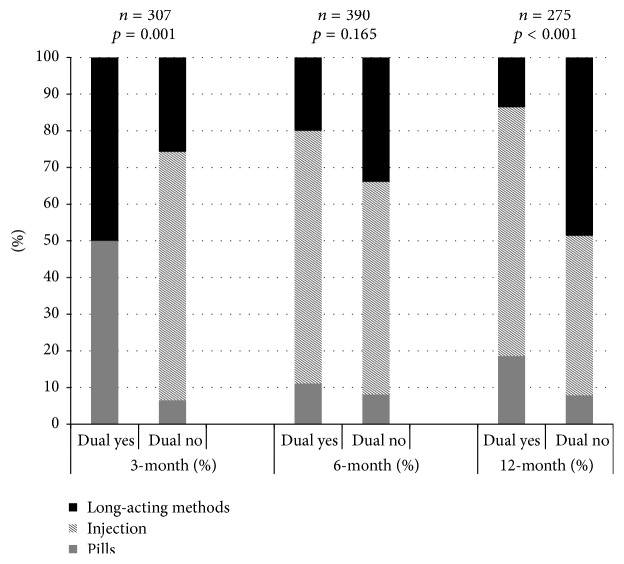
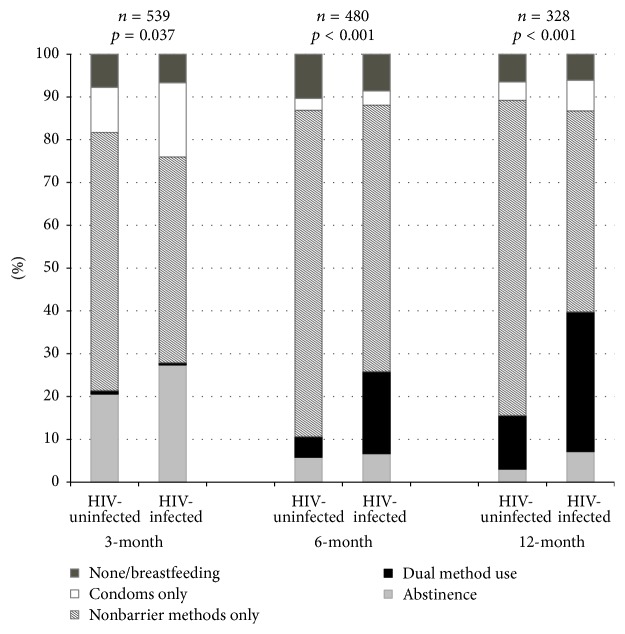
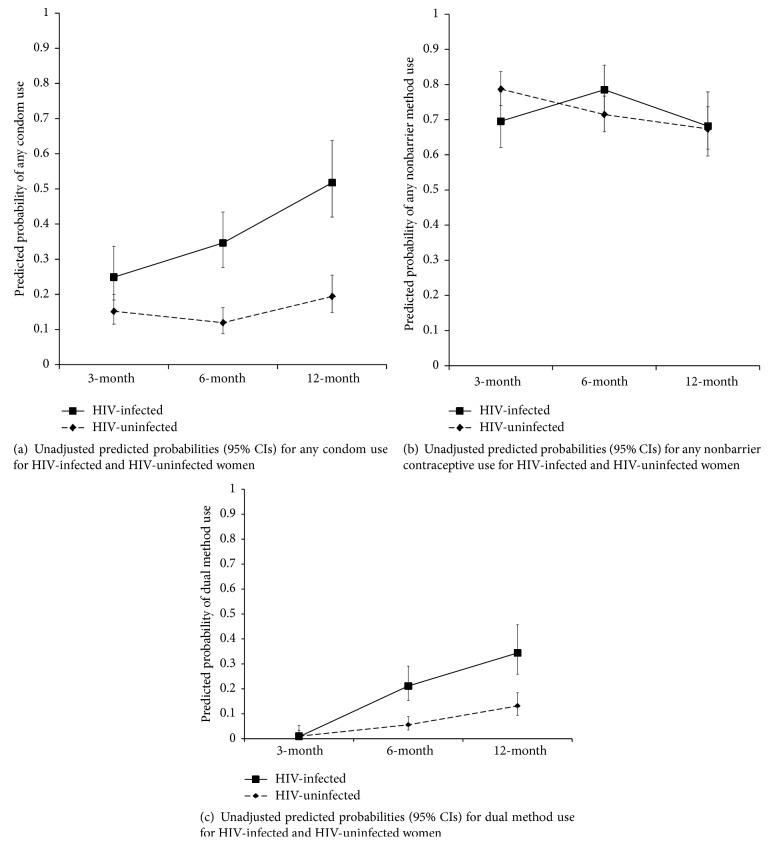
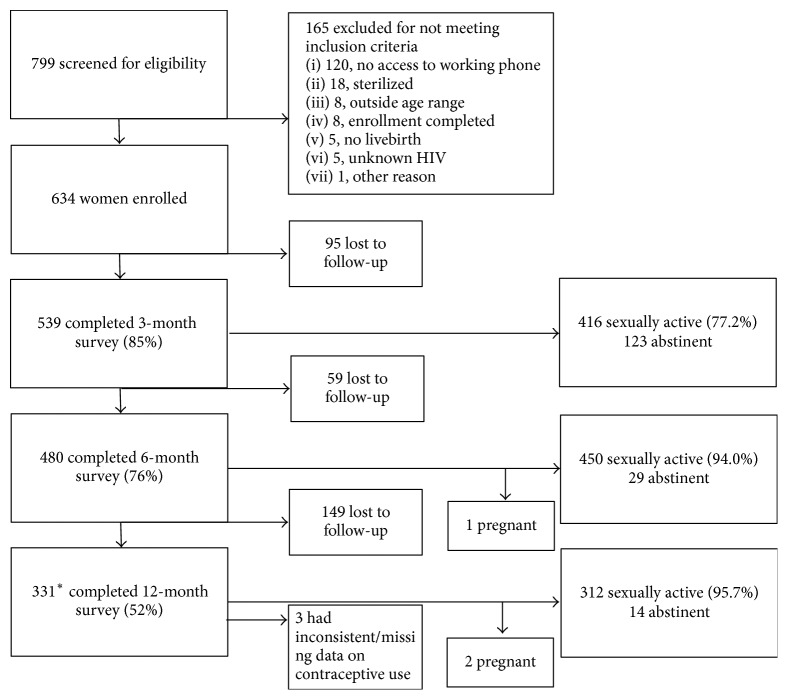
Dual method use, use of condoms plus another effective contraceptive method, is important in settings with high rates of unintended pregnancy and HIV infection. We evaluated the association of HIV status with dual method use in a cohort of postpartum women. Women completed baseline surveys in the postpartum ward and telephone surveys about contraceptive use 3, 6, and 12 months later. Nonpregnant women who completed at least one follow-up survey were eligible for this secondary analysis. Prevalence ratios were calculated using generalized estimating equations. Of the 511 sexually active women who completed a follow-up survey, condom use increased from 17.6% to 27.7% and nonbarrier contraceptive use increased from 73.8% to 87.6% from 3 to 12 months after delivery. Dual method use increased from 1.0% to 18.9% at 3 to 12 months after delivery. Dual method use was negligible and comparable between HIV-infected and HIV-uninfected women at 3 months but significantly higher among HIV-infected women at 6 months (APR = 3.9, 95% CI 2.2, 7.1) and 12 months (APR = 2.7, 95% CI 1.7, 4.3). Dual method use was low but largely driven by condom use among HIV-infected women at 6 and 12 months after delivery.

摘要

双重方法的使用,即避孕套与另一种有效避孕方法的结合使用,在意外怀孕和艾滋病毒感染率较高的环境中很重要。我们在一组产后妇女队列中评估了艾滋病毒感染状况与双重方法使用之间的关联。妇女在产后病房完成了基线调查,并在3个月、6个月和12个月后接受了关于避孕方法使用情况的电话调查。完成至少一次随访调查的非怀孕妇女符合此次二次分析的条件。使用广义估计方程计算患病率比值。在完成随访调查的511名性活跃妇女中,产后3个月至12个月期间,避孕套的使用率从17.6%增至27.7%,非屏障避孕方法的使用率从73.8%增至87.6%。产后3个月至12个月期间,双重方法的使用率从1.0%增至18.9%。在3个月时,艾滋病毒感染妇女和未感染艾滋病毒的妇女使用双重方法的情况可忽略不计且相当,但在6个月时(患病率比值比=3.9,95%置信区间2.2至7.1)和12个月时(患病率比值比=2.7,95%置信区间1.7至4.3),艾滋病毒感染妇女中双重方法的使用率显著更高。产后6个月和12个月时,艾滋病毒感染妇女双重方法的使用率较低,但主要由避孕套的使用推动。
https://cdn.ncbi.nlm.nih.gov/pmc/blobs/269c/5540462/2ca928898c68/IDOG2017-1475813.004.jpg
https://cdn.ncbi.nlm.nih.gov/pmc/blobs/269c/5540462/c2b03263831a/IDOG2017-1475813.001.jpg
https://cdn.ncbi.nlm.nih.gov/pmc/blobs/269c/5540462/831a01e4f7de/IDOG2017-1475813.002.jpg
https://cdn.ncbi.nlm.nih.gov/pmc/blobs/269c/5540462/087c6071eeb1/IDOG2017-1475813.003.jpg
https://cdn.ncbi.nlm.nih.gov/pmc/blobs/269c/5540462/2ca928898c68/IDOG2017-1475813.004.jpg
https://cdn.ncbi.nlm.nih.gov/pmc/blobs/269c/5540462/c2b03263831a/IDOG2017-1475813.001.jpg
https://cdn.ncbi.nlm.nih.gov/pmc/blobs/269c/5540462/831a01e4f7de/IDOG2017-1475813.002.jpg
https://cdn.ncbi.nlm.nih.gov/pmc/blobs/269c/5540462/087c6071eeb1/IDOG2017-1475813.003.jpg
https://cdn.ncbi.nlm.nih.gov/pmc/blobs/269c/5540462/2ca928898c68/IDOG2017-1475813.004.jpg

相似文献

1
Dual Method Use among Postpartum HIV-Infected and HIV-Uninfected Malawian Women: A Prospective Cohort Study.马拉维产后感染艾滋病毒和未感染艾滋病毒妇女的双重方法使用情况:一项前瞻性队列研究。
Infect Dis Obstet Gynecol. 2017;2017:1475813. doi: 10.1155/2017/1475813. Epub 2017 Jul 18.
2
Unintended pregnancy, contraceptive use, and childbearing desires among HIV-infected and HIV-uninfected women in Botswana: across-sectional study.博茨瓦纳感染和未感染 HIV 的女性中的意外怀孕、避孕措施使用和生育愿望:一项横断面研究。
BMC Public Health. 2016 Jan 16;16:44. doi: 10.1186/s12889-015-2498-3.
3
To use or not to use a condom: a prospective cohort study comparing contraceptive practices among HIV-infected and HIV-negative youth in Uganda.使用或不使用避孕套:一项在乌干达比较感染 HIV 的青少年和未感染 HIV 的青少年避孕措施的前瞻性队列研究。
BMC Infect Dis. 2011 May 23;11:144. doi: 10.1186/1471-2334-11-144.
4
Optimizing Prevention of HIV and Unplanned Pregnancy in Discordant African Couples.优化非洲异性伴侣中艾滋病病毒感染状况不一致者的艾滋病预防及意外怀孕预防工作
J Womens Health (Larchmt). 2017 Aug;26(8):900-910. doi: 10.1089/jwh.2016.6169.
5
Effect of HIV status on fertility desire and knowledge of long-acting reversible contraception of postpartum Malawian women.艾滋病毒感染状况对马拉维产后妇女的生育意愿及长效可逆避孕知识的影响。
AIDS Care. 2015;27(4):489-98. doi: 10.1080/09540121.2014.972323. Epub 2014 Nov 4.
6
Postpartum uptake of contraception in rural northern Malawi: A prospective study.马拉维北部农村地区产后避孕措施的采用情况:一项前瞻性研究。
Contraception. 2016 Nov;94(5):499-504. doi: 10.1016/j.contraception.2016.05.007. Epub 2016 May 27.
7
Trends of HIV-1 and sexually transmitted diseases among pregnant and postpartum women in urban Malawi.马拉维城市地区孕妇和产后妇女中艾滋病毒-1和性传播疾病的趋势
AIDS. 1998 Jan 22;12(2):197-203. doi: 10.1097/00002030-199802000-00010.
8
Factors associated with uptake of dual contraception among HIV-infected women in Bungoma County, Kenya: a cross-sectional study.肯尼亚邦戈马县感染艾滋病毒妇女采用双重避孕措施的相关因素:一项横断面研究。
Pan Afr Med J. 2017 Nov 2;28(Suppl 1):2. doi: 10.11604/pamj.supp.2017.28.1.9289. eCollection 2017.
9
Reproductive intentions and family planning practices of pregnant HIV-infected Malawian women on antiretroviral therapy.接受抗逆转录病毒治疗的马拉维感染艾滋病毒孕妇的生育意愿和计划生育措施
AIDS Care. 2016 Aug;28(8):1027-34. doi: 10.1080/09540121.2016.1140891. Epub 2016 Feb 10.
10
Messages about dual contraception in areas of high HIV prevalence are not heeded.在艾滋病高发地区,关于双重避孕的宣传未得到重视。
S Afr Med J. 2008 Mar;98(3):209-12.

引用本文的文献

1
Making the Case for Joint Decision-Making in Future Multipurpose Prevention Technology (MPT) Choice: Qualitative Findings on MPT Attribute Preferences from the CUPID Study (MTN-045).为未来多用途预防技术(MPT)选择中的联合决策提供依据:CUPID 研究(MTN-045)中关于 MPT 属性偏好的定性发现
J Int AIDS Soc. 2022 Oct;25(10):e26024. doi: 10.1002/jia2.26024.
2
Condom, modern contraceptive, and dual method use are associated with HIV status and relationship concurrency in a context of high mobility: A cross-sectional study of women of reproductive age in rural Kenya and Uganda, 2016.在高度流动的背景下,避孕套、现代避孕药具和双重方法的使用与艾滋病毒状况和关系同时发生有关:肯尼亚和乌干达农村育龄妇女的横断面研究,2016 年。
Contraception. 2023 Jan;117:13-21. doi: 10.1016/j.contraception.2022.09.001. Epub 2022 Sep 14.
3

本文引用的文献

1
Family Planning Providers' Experiences and Perceptions of Long-Acting Reversible Contraception in Lilongwe, Malawi.马拉维利隆圭计划生育服务提供者对长效可逆避孕法的经验与看法
Afr J Reprod Health. 2016 Jun;20(2):62-71. doi: 10.29063/ajrh2016/v20i2.7.
2
The Effect of Interpregnancy Interval on the Recurrence Rate of Spontaneous Preterm Birth: A Retrospective Cohort Study.妊娠间隔对自发性早产复发率的影响:一项回顾性队列研究
Am J Perinatol. 2017 Jan;34(2):174-182. doi: 10.1055/s-0036-1584896. Epub 2016 Jul 1.
3
Postpartum uptake of contraception in rural northern Malawi: A prospective study.
Dual contraceptive utilization and determinant factors among HIV positive women in Ethiopia: a systematic review and meta-analysis, 2020.埃塞俄比亚艾滋病毒阳性女性的双重避孕措施使用情况及决定因素:一项系统评价与荟萃分析,2020年
Contracept Reprod Med. 2021 Jul 1;6(1):19. doi: 10.1186/s40834-021-00161-w.
4
Sexual risk behavior among HIV-infected women in South Africa at 12-months postpartum.南非产后12个月的HIV感染女性中的性风险行为。
AIDS Care. 2019 Sep;31(9):1114-1123. doi: 10.1080/09540121.2019.1620168. Epub 2019 May 23.
5
Influences on birth spacing intentions and desired interventions among women who have experienced a poor obstetric outcome in Lilongwe Malawi: a qualitative study.在马拉维利隆圭,经历过不良产科结局的女性的生育间隔意愿和期望干预措施的影响:一项定性研究。
BMC Pregnancy Childbirth. 2018 May 31;18(1):197. doi: 10.1186/s12884-018-1835-9.
马拉维北部农村地区产后避孕措施的采用情况:一项前瞻性研究。
Contraception. 2016 Nov;94(5):499-504. doi: 10.1016/j.contraception.2016.05.007. Epub 2016 May 27.
4
Patterns and trends of postpartum family planning in Ethiopia, Malawi, and Nigeria: evidence of missed opportunities for integration.埃塞俄比亚、马拉维和尼日利亚产后计划生育的模式与趋势:整合存在错失机遇的证据。
Glob Health Action. 2015 Nov 9;8:29738. doi: 10.3402/gha.v8.29738. eCollection 2015.
5
Postpartum contraceptive use and unmet need for family planning in five low-income countries.五个低收入国家的产后避孕措施使用情况及未满足的计划生育需求
Reprod Health. 2015;12 Suppl 2(Suppl 2):S11. doi: 10.1186/1742-4755-12-S2-S11. Epub 2015 Jun 8.
6
Resumption of intercourse after childbirth in southwest Nigeria.尼日利亚西南部产后恢复性生活情况
Eur J Contracept Reprod Health Care. 2015;20(4):241-8. doi: 10.3109/13625187.2014.971742. Epub 2014 Nov 5.
7
Effect of HIV status on fertility desire and knowledge of long-acting reversible contraception of postpartum Malawian women.艾滋病毒感染状况对马拉维产后妇女的生育意愿及长效可逆避孕知识的影响。
AIDS Care. 2015;27(4):489-98. doi: 10.1080/09540121.2014.972323. Epub 2014 Nov 4.
8
Determinants of postnatal service utilisation among mothers in rural settings of Malawi.马拉维农村地区母亲产后服务利用的决定因素。
Health Soc Care Community. 2015 Sep;23(5):493-501. doi: 10.1111/hsc.12165. Epub 2014 Oct 15.
9
HIV status and postpartum contraceptive use in an antenatal population in Durban, South Africa.南非德班产前人群中的艾滋病毒感染状况与产后避孕措施的使用情况
Contraception. 2015 Jan;91(1):39-43. doi: 10.1016/j.contraception.2014.09.007. Epub 2014 Sep 19.
10
Understanding patterns of temporary method use among urban women from Uttar Pradesh, India.了解印度北方邦城市女性使用临时避孕方法的模式。
BMC Public Health. 2014 Sep 29;14:1018. doi: 10.1186/1471-2458-14-1018.