Hofman Paul
Laboratory of Clinical and Experimental Pathology, Pasteur Hospital, 30 avenue de la voie romaine, 06001 Nice cedex 01, France.
FHU OncoAge, Côte d'Azur University, 30 avenue de la voie romaine, 06001 Nice cedex 01, France.
Cancers (Basel). 2017 Aug 12;9(8):107. doi: 10.3390/cancers9080107.
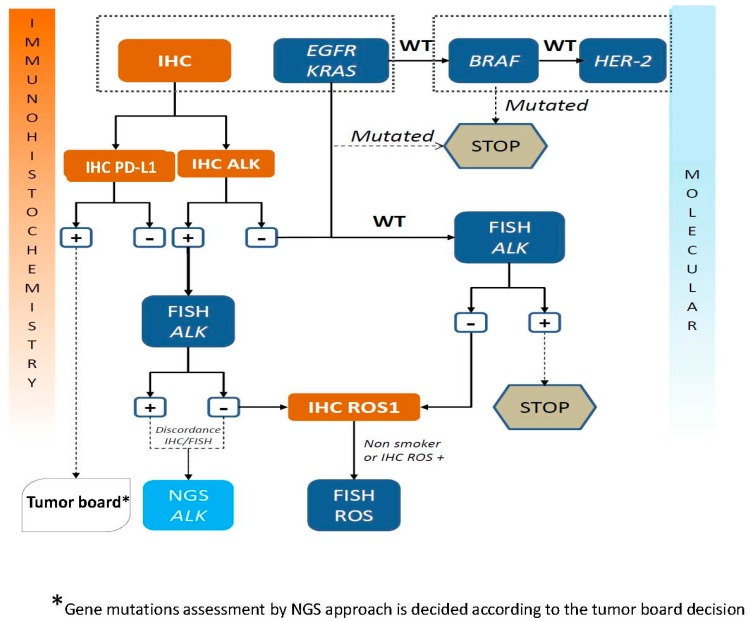
Patients with advanced-stage non-small cell lung carcinoma (NSCLC) harboring an ALK rearrangement, detected from a tissue sample, can benefit from targeted ALK inhibitor treatment. Several increasingly effective ALK inhibitors are now available for treatment of patients. However, despite an initial favorable response to treatment, in most cases relapse or progression occurs due to resistance mechanisms mainly caused by mutations in the tyrosine kinase domain of ALK. The detection of an ALK rearrangement is pivotal and can be done using different methods, which have variable sensitivity and specificity depending, in particular, on the quality and quantity of the patient's sample. This review will first highlight briefly some information regarding the pathobiology of an ALK rearrangement and the epidemiology of patients harboring this genomic alteration. The different methods used to detect an ALK rearrangement as well as their advantages and disadvantages will then be examined and algorithms proposed for detection in daily routine practice.
通过组织样本检测出存在ALK重排的晚期非小细胞肺癌(NSCLC)患者可从靶向ALK抑制剂治疗中获益。目前有几种越来越有效的ALK抑制剂可用于治疗此类患者。然而,尽管初始治疗反应良好,但在大多数情况下,由于主要由ALK酪氨酸激酶结构域突变引起的耐药机制,疾病会复发或进展。ALK重排的检测至关重要,可使用不同方法进行,这些方法的敏感性和特异性各不相同,尤其取决于患者样本的质量和数量。本综述将首先简要强调一些关于ALK重排的病理生物学以及携带这种基因组改变的患者流行病学的信息。然后将研究用于检测ALK重排的不同方法及其优缺点,并提出日常实践中的检测算法。