Ema Ryoichi, Wakahara Taku, Hirayama Kuniaki, Kawakami Yasuo
Graduate School of Engineering and Science, Shibaura Institute of Technology, Saitama, Japan.
Research Fellow of Japan Society for the Promotion of Science, Tokyo, Japan.
PLoS One. 2017 Aug 14;12(8):e0183148. doi: 10.1371/journal.pone.0183148. eCollection 2017.
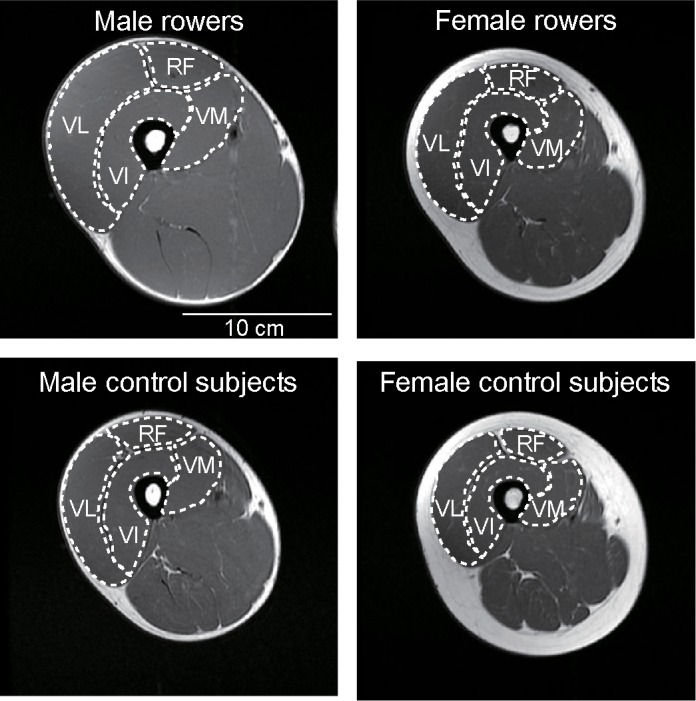
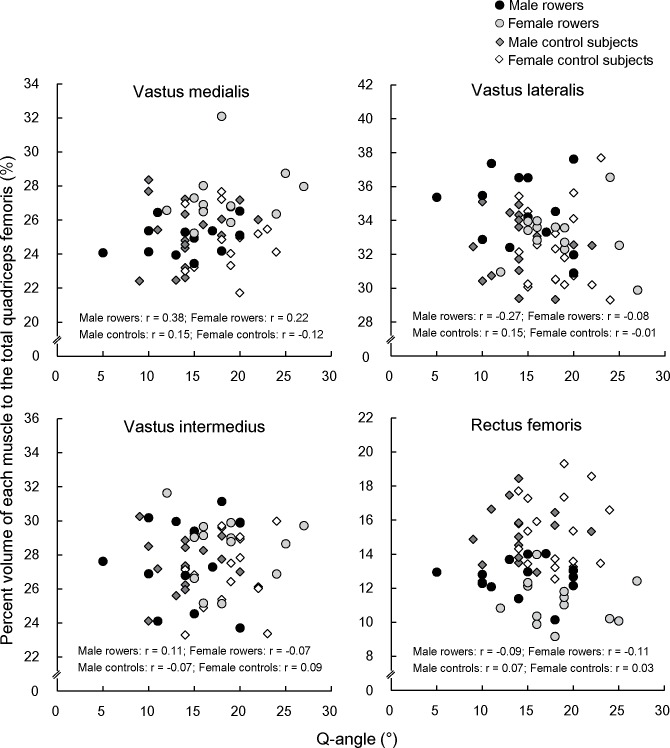
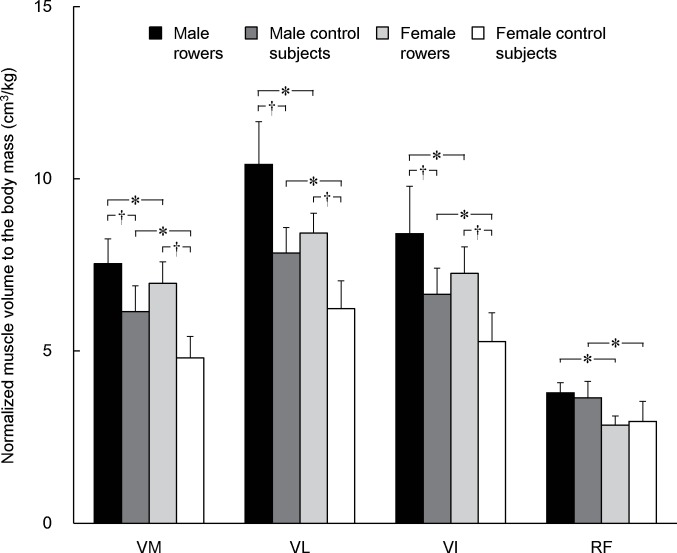
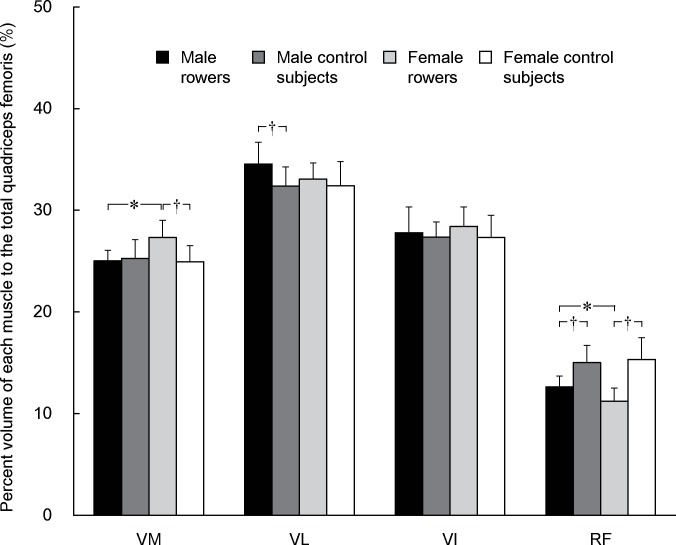
Knee alignment is suggested to be a factor affecting each quadriceps femoris muscle size, and knee alignment such as Q-angle differs between men and women. Also, training can induce inhomogeneous hypertrophy among the quadriceps femoris, thereby leading to different component characteristics of the muscles. If Q-angle is a major determinant of the quadriceps femoris muscularity, it is hypothesized that the sex-related difference in the quadriceps femoris muscularity, if any, is further highlighted in trained individuals, being associated with Q-angle. We tested this hypothesis. Magnetic resonance images of the right thigh were obtained from 26 varsity rowers as trained subjects (13 for each sex) and 34 untrained individuals as controls (17 for each sex). From the images, muscle volume of each constituent of the quadriceps femoris (vastus lateralis, VL; medialis, VM; intermedius; rectus femoris) was determined. The Q-angle was measured during quiet bilateral standing with hand support as needed. Percent volume of VM to the total quadriceps femoris was greater in female rowers than male rowers and female controls, and that of VL was greater in male rowers than male controls. There were no correlations between Q-angle and percent muscle volume in any muscles regardless of rowing experience or sex. The current study revealed that well-trained rowers have sex-related quadriceps femoris muscularity but no significant correlations between percent muscle volume in any muscles and Q-angle. Our findings suggest that Q-angle is not a major determinant of the quadriceps femoris muscularity in either well-trained or untrained individuals.
膝关节对线被认为是影响股四头肌各部分肌肉大小的一个因素,并且诸如Q角等膝关节对线在男性和女性之间存在差异。此外,训练可导致股四头肌之间出现不均匀的肥大,从而导致肌肉的不同组成特征。如果Q角是股四头肌肌肉发达程度的主要决定因素,那么可以推测,股四头肌肌肉发达程度的性别差异(如果存在的话)在受过训练的个体中会进一步凸显,且与Q角相关。我们对这一假设进行了检验。从26名大学赛艇运动员(训练组受试者,男女各13名)和34名未经训练的个体(对照组,男女各17名)获取了右侧大腿的磁共振图像。从图像中确定了股四头肌各组成部分(股外侧肌、VL;股内侧肌、VM;股中间肌;股直肌)的肌肉体积。必要时,在双手支撑的安静双侧站立位测量Q角。女性赛艇运动员的VM占股四头肌总体积的百分比高于男性赛艇运动员和女性对照组,而男性赛艇运动员的VL占股四头肌总体积的百分比高于男性对照组。无论赛艇经验或性别如何,任何肌肉的Q角与肌肉体积百分比之间均无相关性。当前研究表明,训练有素的赛艇运动员存在与性别相关的股四头肌肌肉发达情况,但任何肌肉的肌肉体积百分比与Q角之间均无显著相关性。我们的研究结果表明,无论是训练有素的个体还是未经训练的个体,Q角都不是股四头肌肌肉发达程度的主要决定因素。