Wu Xiao, Zhang Wei, Qin Yuanyuan, Liu Xuguang, Wang Zhengyan
Chengdu University of Traditional Chinese Medicine, 37 Shi'er Qiao Road, Jinniu District, Chengdu, Sichuan, 610072, People's Republic of China.
Traditional Chinese Medicine Hospital Affiliated to Southwest Medical University, 16 Chunhui Road, Longmatan District, Luzhou, Sichuan, 646000, People's Republic of China.
Trials. 2017 Aug 14;18(1):377. doi: 10.1186/s13063-017-2072-7.
Perimenopausal insomnia is one of the core symptoms of the menopausal transition. Acupuncture is considered to exert a positive effect on restoring the normal sleep-wake cycle. However, there is little intuitive evidence besides evaluation using clinical effectiveness scales. We therefore designed this study, aiming to use more intuitive and reliable detection techniques such as functional magnetic resonance imaging before and after applying acupuncture to provide neuroimaging evidence, as well as to verify the effectiveness with other curative effect indicators.
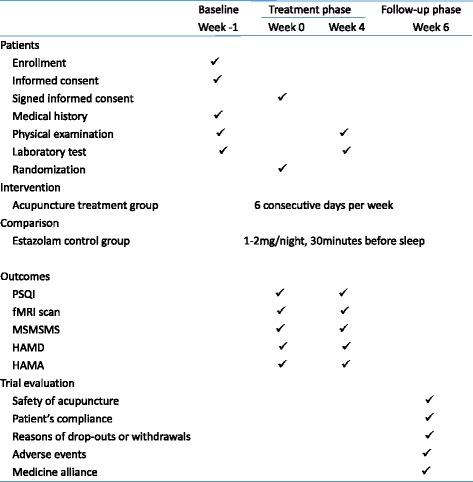
METHODS/DESIGN: This study is a randomized, assessor-statistician-blinded, positive medicine controlled trial involving 40 participants. A total of 40 eligible patients with perimenopausal insomnia will be randomly assigned to two groups in a 1:1 ratio as an intervention group using acupuncture and a control group taking estazolam. Participants in the intervention group will receive six acupuncture treatment sessions per week for 4 consecutive weeks, for a total of 24 sessions during the study. Meanwhile, the medicine control group will be prescribed estazolam 1-2 mg/day to be taken 30 minutes before sleep for 4 weeks. The primary outcome is the Pittsburgh Sleep Quality Index. Secondary outcomes are the micro-movement sensitive mattress-type sleep monitoring system, the Hamilton Depression Scale, and the Hamilton Anxiety Scale. All outcomes will be evaluated before and after treatment. The safety of interventions will be assessed at every visit.
The results of this trial, which will be available in 2018, will investigate the impact of acupuncture treating perimenopausal insomnia from assessment of the sleep architecture, hormone level, and emotional-circuit neurological function, and will uncover the effective mechanism of acupuncture regulating the emotional center integrated effect.
Chinese Clinical Trials Register, ChCTR-IPC-16007832 . Registered on 26 January 2016.
围绝经期失眠是绝经过渡的核心症状之一。针灸被认为对恢复正常的睡眠-觉醒周期有积极作用。然而,除了使用临床疗效量表进行评估外,几乎没有直观的证据。因此,我们设计了本研究,旨在使用更直观可靠的检测技术,如在针刺前后进行功能磁共振成像,以提供神经影像学证据,并使用其他疗效指标验证其有效性。
方法/设计:本研究是一项随机、评估者-统计学家双盲、阳性药物对照试验,涉及40名参与者。总共40名符合条件的围绝经期失眠患者将按1:1的比例随机分为两组,一组为针刺干预组,另一组为服用艾司唑仑的对照组。干预组的参与者将每周接受6次针刺治疗,连续4周,研究期间共24次。同时,药物对照组将被开1-2毫克/天的艾司唑仑,在睡前30分钟服用,持续4周。主要结局指标是匹兹堡睡眠质量指数。次要结局指标是微动敏感床垫式睡眠监测系统、汉密尔顿抑郁量表和汉密尔顿焦虑量表。所有结局指标将在治疗前后进行评估。每次就诊时将评估干预措施的安全性。
本试验结果将于2018年公布,将从睡眠结构、激素水平和情绪-回路神经功能评估等方面研究针刺治疗围绝经期失眠的影响,并揭示针刺调节情绪中枢综合效应的有效机制。
中国临床试验注册中心,ChCTR-IPC-16007832。于2016年1月26日注册。