Sung Ki Hyuk, Lee Jaebong, Chung Chin Youb, Lee Kyoung Min, Cho Byung Chae, Moon Seung Jun, Kim Jaeyoung, Park Moon Seok
Department of Orthopaedic Surgery, Seoul National University Bundang Hospital, 82 Gumi-ro 173 Beon-gil, Bundang-Gu, Seongnam, Gyeonggi, South Korea.
Medical Research Collaborating Center, Seoul National University Bundang Hospital, 82 Gumi-ro 173 Beon-gil, Bundang-Gu, Seongnam, Gyeonggi, South Korea.
J Neuroeng Rehabil. 2017 Aug 14;14(1):83. doi: 10.1186/s12984-017-0296-0.
Although several studies have investigated the outcomes after distal hamstring lengthening (DHL), no study has undertaken an approach that included all or most of the important factors that could influence the results. This study was performed to evaluate the outcomes after DHL and analyze the factors that influence the improvement and serial change in knee motion after surgery in patients with cerebral palsy (CP), using a linear mixed model (LMM).
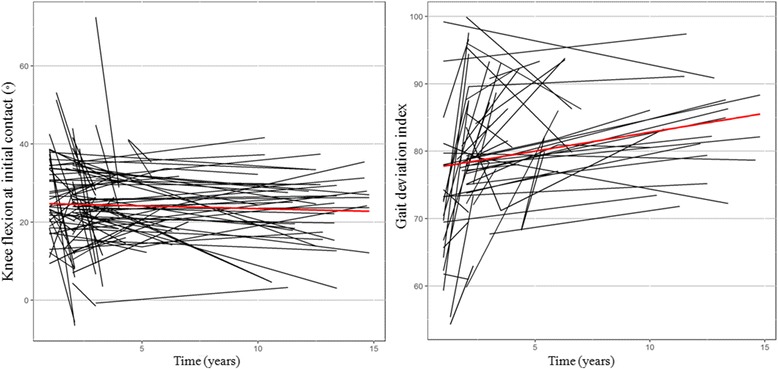
The study included 314 ambulatory CP patients (594 limbs) with spsastic diplegia who were followed up after undergoing DHL as part of a single-event multilevel surgery and who underwent preoperative and postoperative 3-dimensional (3D) gait analyses. Relevant kinematic values, including knee flexion at initial contact, minimum knee flexion in the stance phase, knee range of motion (ROM), mean pelvic tilt and gait deviation index (GDI) score, were the outcome measures. Changes in knee motion and the GDI score were adjusted for multiple factors, such as sex, the Gross Motor Function Classification System (GMFCS) level, and concomitant surgeries as fixed effects, and follow-up duration, laterality, and each subject as random effects, using a LMM.
We found significant improvements in knee flexion at initial contact, minimum knee flexion in the stance phase, knee ROM, and GDI score 2 years after DHL. In patients with GMFCS level I and II, improvement in all sagittal knee kinematics was maintained during follow-up. In addition, GDI score, which represents overall gait pathology, consistently improved throughout the follow-up duration (1.2 per year, p = 0.008).
Medial hamstring lengthening with semitendinosus transfer, as a part of a SEMLS, was effective procedure in treating flexed knee gait with regard to sagittal knee kinematics and GDI score in spastic CP with flexed knee gait.
尽管有多项研究调查了腘绳肌远端延长术(DHL)后的结果,但尚无研究采用涵盖所有或大部分可能影响结果的重要因素的方法。本研究旨在使用线性混合模型(LMM)评估DHL后的结果,并分析影响脑瘫(CP)患者术后膝关节活动改善及连续变化的因素。
本研究纳入了314例痉挛型双瘫的门诊CP患者(594条肢体),这些患者在接受单期多节段手术的一部分——DHL后接受了随访,并进行了术前和术后三维(3D)步态分析。相关运动学指标,包括初始接触时的膝关节屈曲、站立期最小膝关节屈曲、膝关节活动范围(ROM)、平均骨盆倾斜度和步态偏差指数(GDI)评分,作为观察指标。使用LMM对膝关节活动和GDI评分的变化进行多因素校正,如性别、粗大运动功能分类系统(GMFCS)水平和同期手术作为固定效应,随访时间、患侧和每个受试者作为随机效应。
我们发现DHL术后2年,初始接触时的膝关节屈曲、站立期最小膝关节屈曲、膝关节ROM和GDI评分有显著改善。在GMFCS I级和II级患者中,随访期间所有矢状面膝关节运动学指标的改善均得以维持。此外,代表整体步态病理学的GDI评分在整个随访期间持续改善(每年改善1.2,p = 0.008)。
作为单期多节段手术的一部分,半腱肌转移的内侧腘绳肌延长术在治疗痉挛型CP伴屈膝步态的矢状面膝关节运动学和GDI评分方面是一种有效的手术方法。