Lee Jen Y, Garcia-Murillas Isaac, Cutts Rosalind J, De Castro David Gonzalez, Grove Lorna, Hurley Tara, Wang Fuqiang, Nutting Christopher, Newbold Katie, Harrington Kevin, Turner Nicholas, Bhide Shreerang
The Institute of Cancer Research, Fulham Road, London SW3 6JB, UK.
The Royal Marsden Hospital, Fulham Road, London SW3 6JJ and Downs Road Sutton, SM2 5PT, UK.
Br J Cancer. 2017 Sep 5;117(6):876-883. doi: 10.1038/bjc.2017.258. Epub 2017 Aug 15.
Following chemo-radiotherapy (CCRT) for human papilloma virus positive (HPV+) locally advanced head and neck cancer, patients frequently undergo unnecessary neck dissection (ND) and/or repeated biopsies for abnormal PET-CT, which causes significant morbidity. We assessed the role of circulating HPV DNA in identifying 'true' residual disease.
We prospectively recruited test (n=55) and validation (n=33) cohorts. HPV status was confirmed by E7 RT-PCR. We developed a novel amplicon-based next generation sequencing assay (HPV16-detect) to detect circulating HPV DNA. Circulating HPV DNA levels post-CCRT were correlated to disease response (PET-CT).
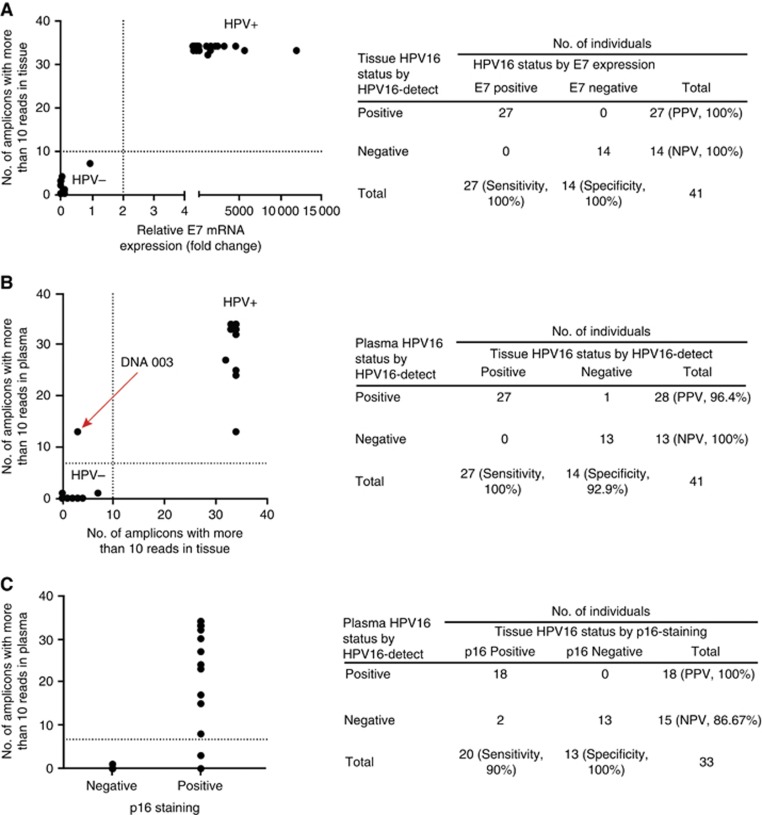
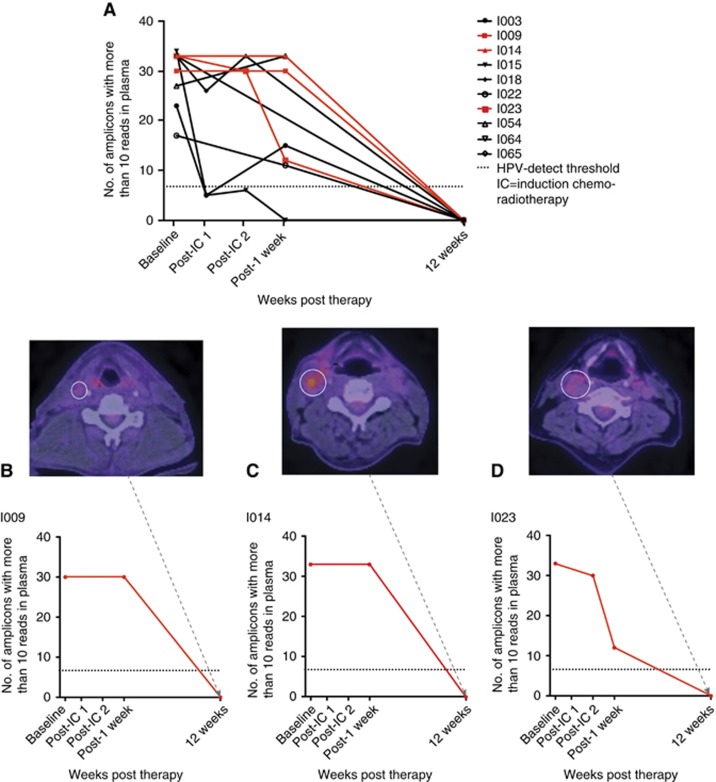
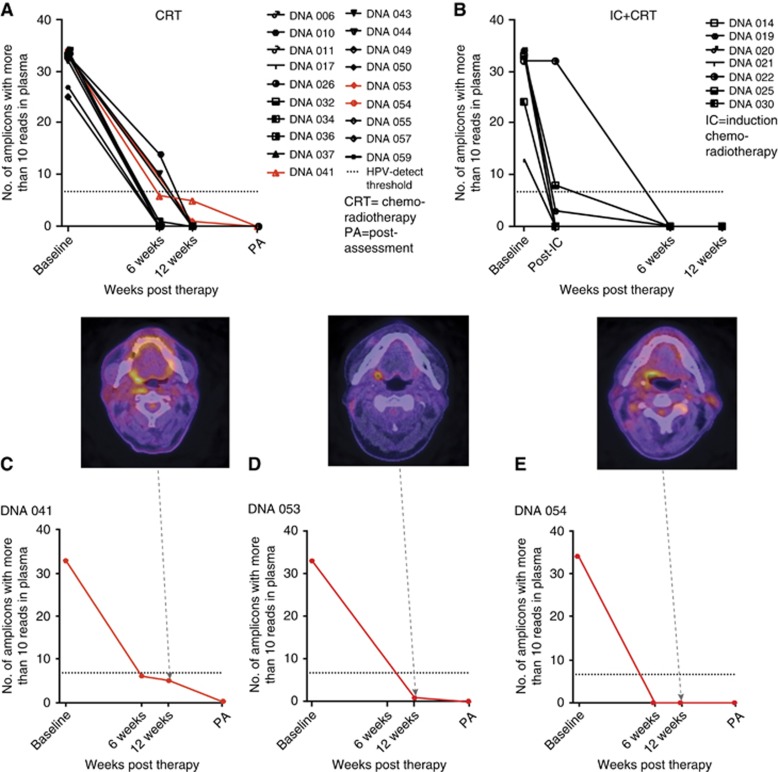
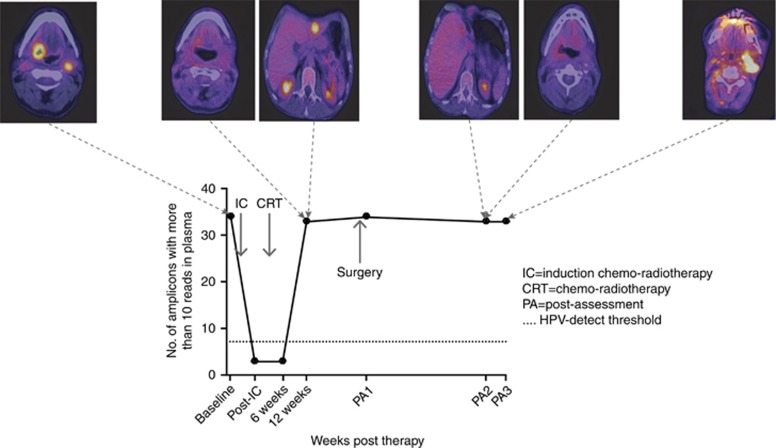
In pre-CCRT plasma, HPV-detect demonstrated 100% sensitivity and 93% specificity, and 90% sensitivity and 100% specificity for the test (27 HPV+) and validation (20 HPV+) cohorts, respectively. Thirty-six out of 37 patients (test and validation cohort) with complete samples-set had negative HPV-detect at end of treatment. Six patients underwent ND (3) and repeat primary site biopsies (3) for positive PET-CT but had no viable tumour. One patient had positive HPV-detect and positive PET-CT and liver biopsy, indicating 100% agreement for HPV-detect and residual cancer.
We demonstrate that HPV16-detect is a highly sensitive and specific test for identification of HPV DNA in plasma at diagnosis. HPV DNA post-treatment correlates with clinical response.
对于人乳头瘤病毒阳性(HPV+)的局部晚期头颈癌患者,在接受放化疗(CCRT)后,常因PET-CT异常而进行不必要的颈部清扫术(ND)和/或重复活检,这会导致严重的发病率。我们评估了循环HPV DNA在识别“真正”残留疾病中的作用。
我们前瞻性招募了测试队列(n=55)和验证队列(n=33)。通过E7 RT-PCR确认HPV状态。我们开发了一种基于扩增子的新型下一代测序检测方法(HPV16-detect)来检测循环HPV DNA。CCRT后循环HPV DNA水平与疾病反应(PET-CT)相关。
在CCRT前的血浆中,HPV-detect对测试队列(27例HPV+)和验证队列(20例HPV+)的敏感性分别为100%和90%,特异性分别为93%和100%。在37例有完整样本集的患者(测试和验证队列)中,36例在治疗结束时HPV-detect为阴性。6例患者因PET-CT阳性接受了ND(3例)和重复原发部位活检(3例),但未发现存活肿瘤。1例患者HPV-detect阳性、PET-CT阳性且肝活检阳性,表明HPV-detect与残留癌的一致性为100%。
我们证明HPV16-detect是一种在诊断时用于识别血浆中HPV DNA的高度敏感和特异的检测方法。治疗后HPV DNA与临床反应相关。