Wang Zili, Zheng Chenhuang, Jiang Kunqi, He Jinshen, Cao Xu, Wu Song
Department of Orthopedics, Third Xiangya Hospital of Central South University, Changsha, Hunan 410013, P.R. China.
Exp Ther Med. 2017 Aug;14(2):1547-1553. doi: 10.3892/etm.2017.4648. Epub 2017 Jun 22.
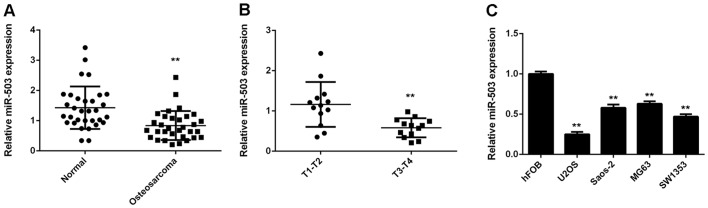
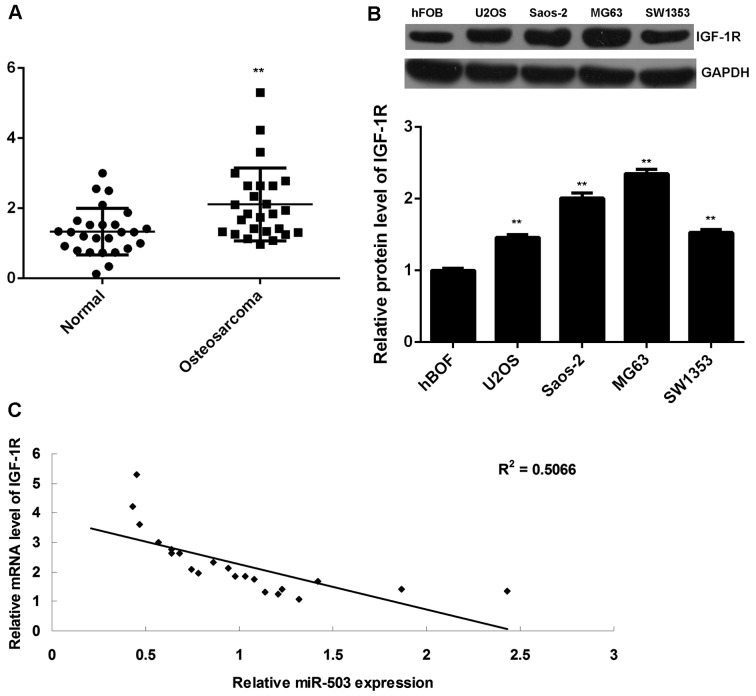
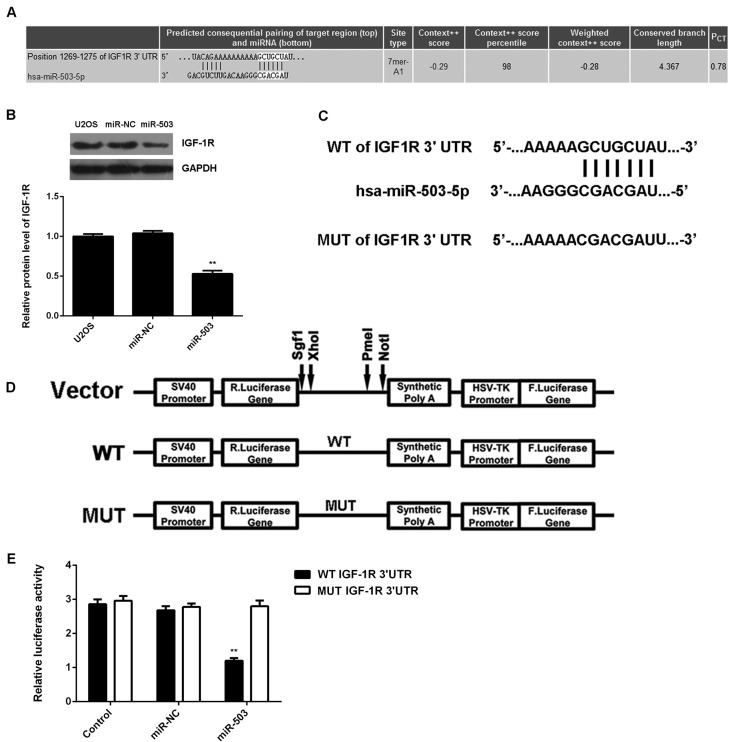
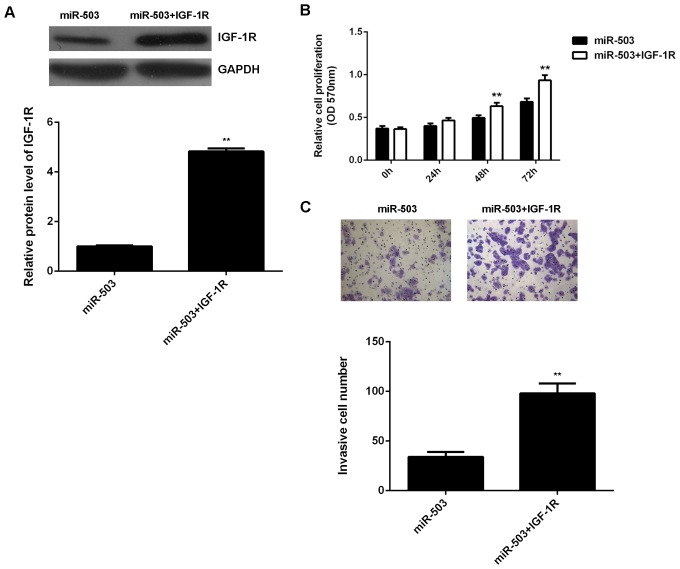
MicroRNAs (miRs) are a class of small non-coding RNAs and have key roles in various cancer types. Recently, miR-503 has been reported to act as a tumor suppressor in osteosarcoma. However, the detailed mechanism of the regulatory role of miR-503 in osteosarcoma cell proliferation and invasion has largely remained elusive. The present study found that miR-503 was significantly downregulated in osteosarcoma tissues compared to that in matched adjacent non-tumorous tissues. In addition, the expression of miR-503 in osteosarcoma of T3-T4 stage was significantly lower when compared with that in T1-T2 stage samples. miR-503 was also downregulated in osteosarcoma cell lines (Saos-2, MG63, U2OS and SW1353), when compared with that in the normal osteoblast cell line hFOB. Overexpression of miR-503 significantly inhibited the proliferation and invasion of U2OS cells and decreased the protein levels of insulin-like growth factor 1 receptor (IGF-1R), which was further identified as a novel target of miR-503 by a luciferase reporter assay. Moreover, overexpression of IGF-1R eliminated the suppressive effects of miR-503 on the proliferation and invasion of U2OS cells, suggesting that miR-503 inhibits osteosarcoma cell proliferation and invasion by directly targeting IGF-1R. Furthermore, IGF-1R was significantly upregulated in osteosarcoma tissues compared with that in adjacent non-tumor tissues, as well as in osteosarcoma cell lines compared with that in hFOB cells. In addition, the expression levels of IGF-1R were inversely correlated to the miR-503 levels in osteosarcoma tissues, suggesting that the increased IGF-1R expression may be caused by the reduced expression of miR-503. In conclusion, the present study demonstrated that miR-503 suppresses cell proliferation and invasion in osteosarcoma via targeting IGF-1R and thus highlights the importance of miR-503/IGF-1R signaling in the malignant progression of osteosarcoma.
微小RNA(miR)是一类小的非编码RNA,在多种癌症类型中发挥关键作用。最近,有报道称miR-503在骨肉瘤中起肿瘤抑制作用。然而,miR-503在骨肉瘤细胞增殖和侵袭中调控作用的详细机制在很大程度上仍不清楚。本研究发现,与配对的相邻非肿瘤组织相比,miR-503在骨肉瘤组织中显著下调。此外,与T1-T2期样本相比,T3-T4期骨肉瘤中miR-503的表达显著降低。与正常成骨细胞系hFOB相比,miR-503在骨肉瘤细胞系(Saos-2、MG63、U2OS和SW1353)中也下调。miR-503的过表达显著抑制U2OS细胞的增殖和侵袭,并降低胰岛素样生长因子1受体(IGF-1R)的蛋白水平,荧光素酶报告基因检测进一步确定其为miR-503的一个新靶点。此外,IGF-1R的过表达消除了miR-503对U2OS细胞增殖和侵袭的抑制作用,表明miR-503通过直接靶向IGF-1R抑制骨肉瘤细胞增殖和侵袭。此外,与相邻非肿瘤组织相比,IGF-1R在骨肉瘤组织中显著上调,与hFOB细胞相比,在骨肉瘤细胞系中也显著上调。此外,骨肉瘤组织中IGF-1R的表达水平与miR-503水平呈负相关,提示IGF-1R表达增加可能是由于miR-503表达降低所致。总之,本研究表明miR-503通过靶向IGF-1R抑制骨肉瘤细胞增殖和侵袭,从而突出了miR-503/IGF-1R信号通路在骨肉瘤恶性进展中的重要性。