Philips Lauren, Visser Janicke, Nel Daan, Blaauw Renée
Division of Human Nutrition, Faculty of Medicine and Health Sciences, Stellenbosch University, Cape Town, South Africa.
Centre for Statistical Consultation, Stellenbosch University, Cape Town, South Africa.
BMC Infect Dis. 2017 Aug 15;17(1):570. doi: 10.1186/s12879-017-2657-5.
The existence of a bi-directional relationship between tuberculosis (TB) and insulin resistance (IR)/diabetes has been alluded to in literature. Although diabetes has been linked to increased tuberculosis risk, the relationship between tuberculosis as a causative factor for IR remains unclear. The study aimed to determine if an association existed between tuberculosis and IR development in adults with newly diagnosed pulmonary tuberculosis at baseline. It was additionally aimed to document changes in IR status during TB follow-up periods.
This cross-sectional study evaluated ambulatory participants at baseline for IR prevalence via anthropometry, biochemistry and diagnostic IR tests [homeostasis model assessment-IR (HOMA-IR) and quantitative insulin sensitivity check index (QUICKI)]. A prospective cohort sub-section study was additionally performed on approximately half of the baseline study population, who were followed-up at two and five months whilst on tuberculosis treatment. Summary statistics, correlation co-efficients and appropriate analysis of variance were used to describe and analyse data. Participants were excluded if they presented with other forms of tuberculosis, were HIV-positive, obese or had any pre-disposing IR conditions such as diabetes or metabolic syndrome.
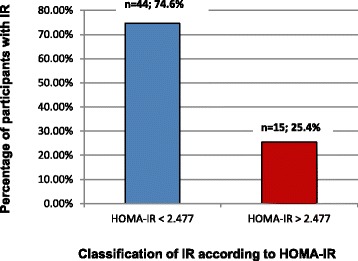
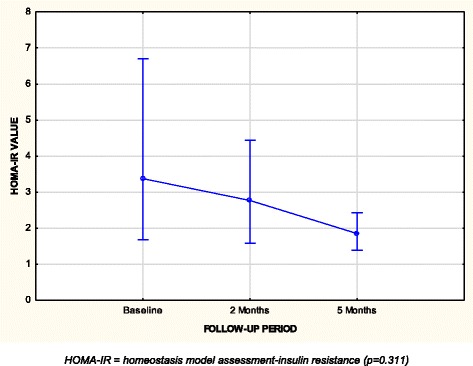
Fifty-nine participants were included from August 2013 until December 2014 (33.95 ± 12.02 years old; 81.4% male). IR prevalence was 25.4% at baseline, determined by a calculated HOMA-IR cut-off point of 2.477. Patients with IR were younger (p = 0.04). Although the difference between IR levels in participants between baseline and follow-up was not significant, a decrease was observed over time. The majority of participants (61.0%) presented with a normal BMI at baseline. Mean baseline values of fasting glucose were within normal ranges (4.82 ± 0.80 mmol/L), whereas increased mean CRP levels (60.18 ± 50.92 mg/L) and decreased mean HDL-cholesterol levels (males: 0.94 ± 0.88 mmol/L; females: 1.14 ± 0.88 mmol/L) were found.
The study found an association between tuberculosis and IR development in newly diagnosed pulmonary tuberculosis patients. Although not significant, IR levels decreased over time, which could be indicative of a clinical improvement. A high prevalence of IR amongst young tuberculosis patients therefore highlights the need for early identification in order to facilitate a reversal of IR and prevent possible IR-related complications.
结核病(TB)与胰岛素抵抗(IR)/糖尿病之间的双向关系在文献中已有提及。虽然糖尿病与结核病风险增加有关,但结核病作为IR的致病因素之间的关系仍不清楚。该研究旨在确定基线时新诊断为肺结核的成年人中结核病与IR发生之间是否存在关联。此外,旨在记录结核病随访期间IR状态的变化。
这项横断面研究通过人体测量、生物化学和诊断性IR测试[稳态模型评估-IR(HOMA-IR)和定量胰岛素敏感性检查指数(QUICKI)]评估了基线时门诊参与者的IR患病率。另外,对大约一半的基线研究人群进行了前瞻性队列子研究,这些人在接受结核病治疗的2个月和5个月时进行了随访。使用汇总统计、相关系数和适当的方差分析来描述和分析数据。如果参与者患有其他形式的结核病、HIV阳性、肥胖或有任何易患IR的疾病,如糖尿病或代谢综合征,则将其排除。
从2013年8月至2014年12月共纳入59名参与者(年龄33.95±12.02岁;81.4%为男性)。根据计算得出的HOMA-IR临界值2.477,基线时IR患病率为25.4%。IR患者更年轻(p=0.04)。虽然基线和随访期间参与者的IR水平差异不显著,但随着时间的推移观察到有所下降。大多数参与者(61.0%)在基线时BMI正常。空腹血糖的平均基线值在正常范围内(4.82±0.80 mmol/L),而平均CRP水平升高(60.18±50.92 mg/L),平均HDL胆固醇水平降低(男性:0.94±0.88 mmol/L;女性:1.14±0.88 mmol/L)。
该研究发现新诊断的肺结核患者中结核病与IR发生之间存在关联。虽然不显著,但IR水平随时间下降,这可能表明临床有所改善。因此,年轻结核病患者中IR的高患病率凸显了早期识别的必要性,以便促进IR的逆转并预防可能的IR相关并发症。