Arnup Sarah J, McKenzie Joanne E, Hemming Karla, Pilcher David, Forbes Andrew B
School of Public Health and Preventive Medicine, Monash University, The Alfred Centre, Melbourne, VIC, 3004, Australia.
Institute of Applied Health Research, University of Birmingham, Edgbaston, Birmingham, B15 2TT, UK.
Trials. 2017 Aug 15;18(1):381. doi: 10.1186/s13063-017-2113-2.
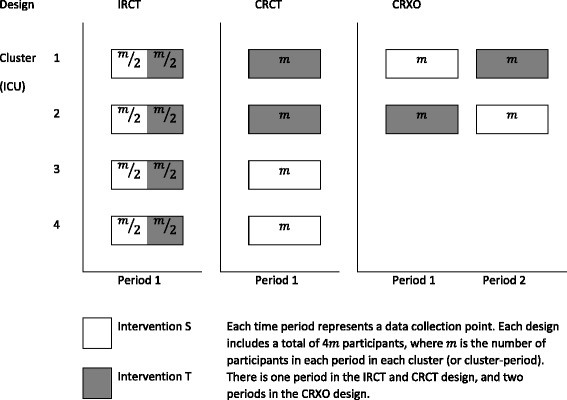
In a cluster randomised crossover (CRXO) design, a sequence of interventions is assigned to a group, or 'cluster' of individuals. Each cluster receives each intervention in a separate period of time, forming 'cluster-periods'. Sample size calculations for CRXO trials need to account for both the cluster randomisation and crossover aspects of the design. Formulae are available for the two-period, two-intervention, cross-sectional CRXO design, however implementation of these formulae is known to be suboptimal. The aims of this tutorial are to illustrate the intuition behind the design; and provide guidance on performing sample size calculations.
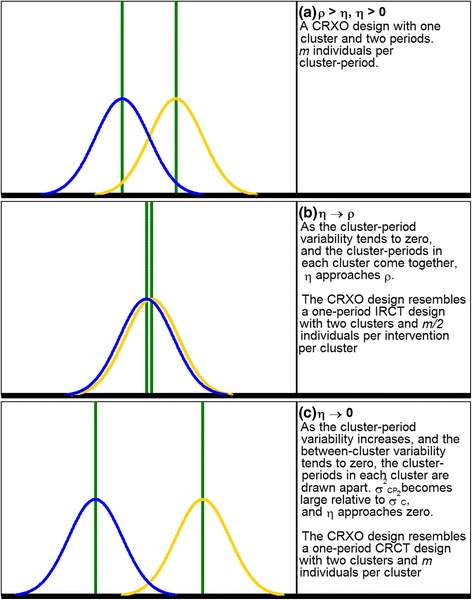
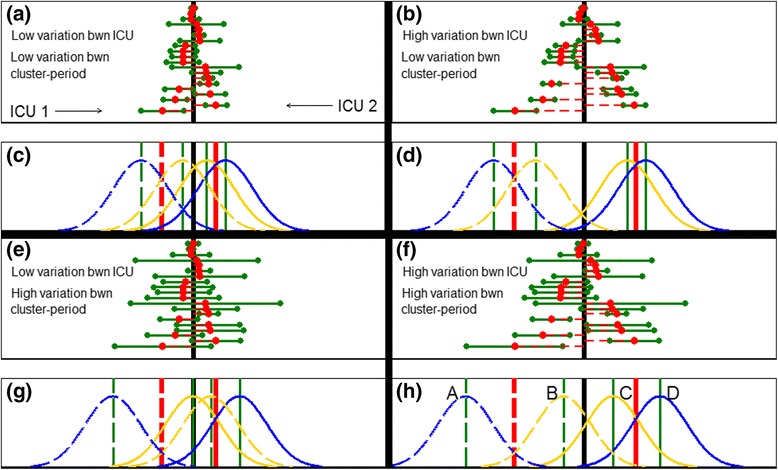
Graphical illustrations are used to describe the effect of the cluster randomisation and crossover aspects of the design on the correlation between individual responses in a CRXO trial. Sample size calculations for binary and continuous outcomes are illustrated using parameters estimated from the Australia and New Zealand Intensive Care Society - Adult Patient Database (ANZICS-APD) for patient mortality and length(s) of stay (LOS).
The similarity between individual responses in a CRXO trial can be understood in terms of three components of variation: variation in cluster mean response; variation in the cluster-period mean response; and variation between individual responses within a cluster-period; or equivalently in terms of the correlation between individual responses in the same cluster-period (within-cluster within-period correlation, WPC), and between individual responses in the same cluster, but in different periods (within-cluster between-period correlation, BPC). The BPC lies between zero and the WPC. When the WPC and BPC are equal the precision gained by crossover aspect of the CRXO design equals the precision lost by cluster randomisation. When the BPC is zero there is no advantage in a CRXO over a parallel-group cluster randomised trial. Sample size calculations illustrate that small changes in the specification of the WPC or BPC can increase the required number of clusters.
By illustrating how the parameters required for sample size calculations arise from the CRXO design and by providing guidance on both how to choose values for the parameters and perform the sample size calculations, the implementation of the sample size formulae for CRXO trials may improve.
在整群随机交叉(CRXO)设计中,一系列干预措施被分配给一组个体或“群组”。每个群组在不同时间段接受每种干预措施,形成“群组 - 时间段”。CRXO试验的样本量计算需要考虑设计中的整群随机化和交叉两个方面。对于两阶段、两种干预措施的横断面CRXO设计,已有公式可用,但已知这些公式的实施效果并不理想。本教程的目的是阐述该设计背后的原理,并为进行样本量计算提供指导。
使用图形说明来描述CRXO试验中整群随机化和交叉方面对个体反应之间相关性的影响。使用从澳大利亚和新西兰重症监护学会成人患者数据库(ANZICS - APD)估计的患者死亡率和住院时间(LOS)参数,说明二元和连续结局的样本量计算。
CRXO试验中个体反应之间的相似性可以从变异的三个组成部分来理解:群组平均反应的变异;群组 - 时间段平均反应的变异;以及同一群组 - 时间段内个体反应之间的变异;或者等效地从同一群组 - 时间段内个体反应之间的相关性(组内同期相关性,WPC)以及同一群组但不同时间段内个体反应之间的相关性(组内不同期相关性,BPC)来理解。BPC介于零和WPC之间。当WPC和BPC相等时,CRXO设计的交叉方面所获得的精度等于整群随机化所损失的精度。当BPC为零时,CRXO相对于平行组整群随机试验没有优势。样本量计算表明,WPC或BPC规格的微小变化会增加所需的群组数量。
通过说明样本量计算所需的参数如何从CRXO设计中产生,并提供关于如何选择参数值以及进行样本量计算的指导,CRXO试验样本量公式的实施可能会得到改进。