The Institute of Biochemistry, Food and Nutrition, The Robert H Smith Faculty of Agriculture, Food and Environment, The Hebrew University, 76100 Rehovot, and The Fritz Haber Center for Molecular Dynamics, The Hebrew University, Jerusalem, 91904, Israel.
German Institute of Human Nutrition Potsdam-Rehbruecke, Dept. Molecular Genetics, 14558, Nuthetal, Germany.
Sci Rep. 2017 Aug 15;7(1):8223. doi: 10.1038/s41598-017-08344-9.
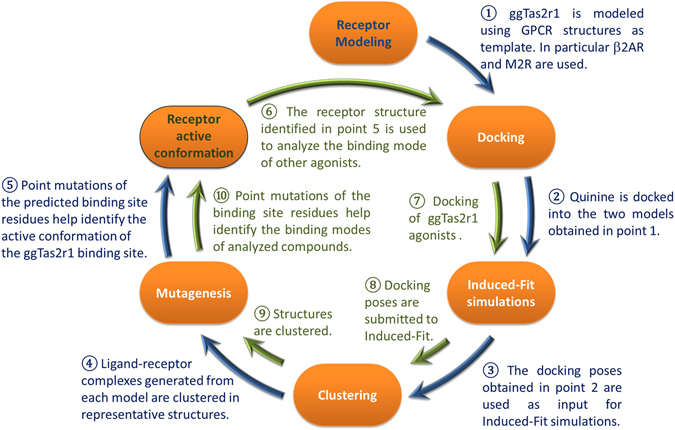
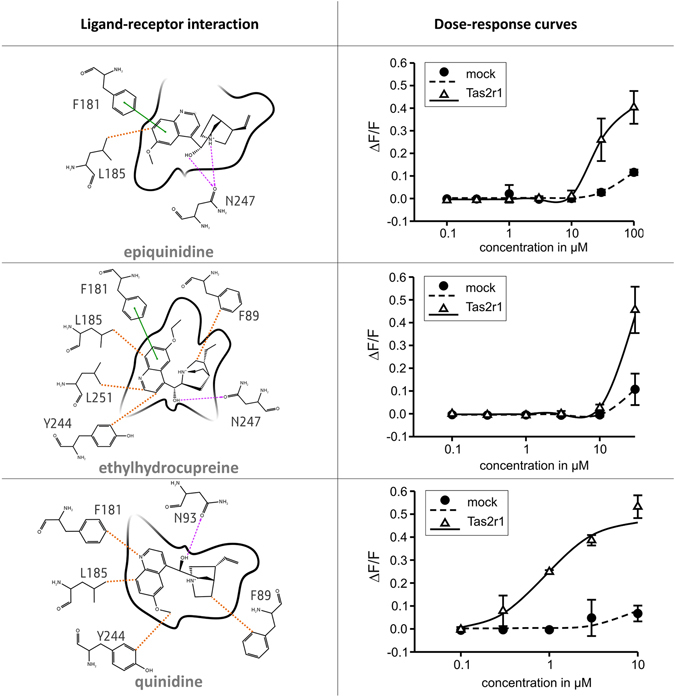
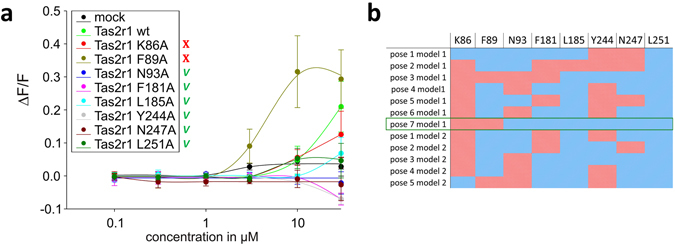
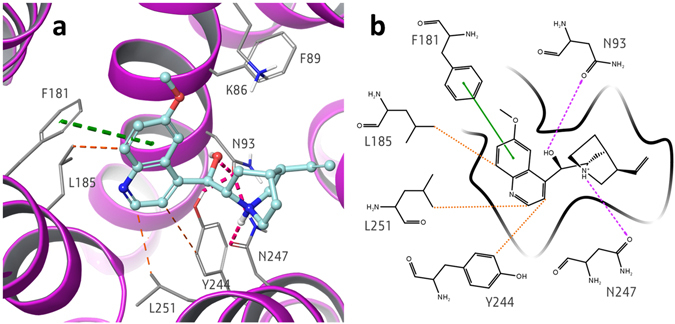
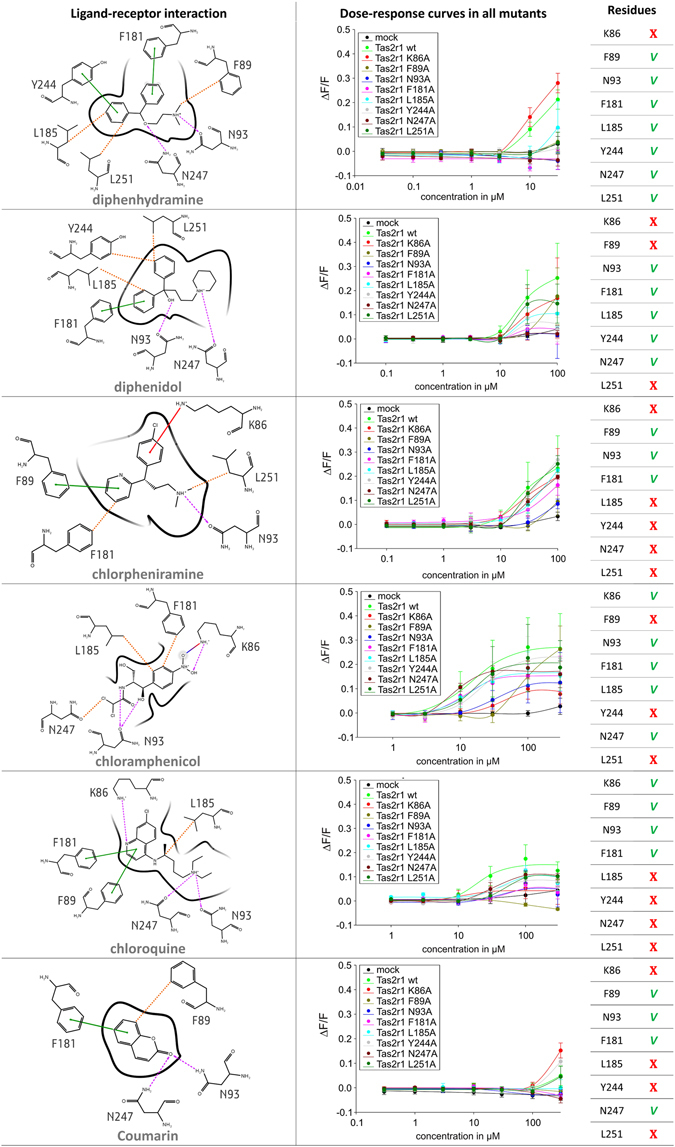
Bitter taste is one of the basic taste modalities, warning against consuming potential poisons. Bitter compounds activate members of the bitter taste receptor (Tas2r) subfamily of G protein-coupled receptors (GPCRs). The number of functional Tas2rs is species-dependent. Chickens represent an intriguing minimalistic model, because they detect the bitter taste of structurally different molecules with merely three bitter taste receptor subtypes. We investigated the binding modes of several known agonists of a representative chicken bitter taste receptor, ggTas2r1. Because of low sequence similarity between ggTas2r1 and crystallized GPCRs (~10% identity, ~30% similarity at most), the combination of computational approaches with site-directed mutagenesis was used to characterize the agonist-bound conformation of ggTas2r1 binding site between TMs 3, 5, 6 and 7. We found that the ligand interactions with N93 in TM3 and/or N247 in TM5, combined with hydrophobic contacts, are typically involved in agonist recognition. Next, the ggTas2r1 structural model was successfully used to identify three quinine analogues (epiquinidine, ethylhydrocupreine, quinidine) as new ggTas2r1 agonists. The integrated approach validated here may be applicable to additional cases where the sequence identity of the GPCR of interest and the existing experimental structures is low.
苦味是基本味觉模式之一,可提示人们避免食用潜在的毒物。苦味化合物激活 G 蛋白偶联受体 (GPCR) 中苦味受体 (Tas2r) 亚家族的成员。功能性 Tas2r 的数量取决于物种。鸡是一种有趣的极简模型,因为它们仅用三种苦味受体亚型就能检测到结构不同的分子的苦味。我们研究了几种代表性鸡苦味受体 ggTas2r1 的已知激动剂的结合模式。由于 ggTas2r1 与结晶 GPCR 之间的序列相似性较低(10%的同一性,最多30%的相似性),因此我们结合使用计算方法和定点突变来表征 TM3、5、6 和 7 之间 ggTas2r1 结合位点的激动剂结合构象。我们发现,配体与 TM3 中的 N93 和/或 TM5 中的 N247 的相互作用,结合疏水性接触,通常参与激动剂识别。接下来,ggTas2r1 结构模型成功地将三种奎宁类似物(表奎宁、乙基海因碱、奎宁)鉴定为新的 ggTas2r1 激动剂。这里验证的综合方法可能适用于其他感兴趣的 GPCR 与现有实验结构的序列同一性较低的情况。