Jiang Xian-Feng, Li Qing-Jun
Key Laboratory of Tropical Forest Ecology Xishuangbanna Tropical Botanical Garden Chinese Academy of Sciences Mengla China.
University of Chinese Academy of Sciences Beijing China.
Ecol Evol. 2017 Jun 15;7(15):5746-5753. doi: 10.1002/ece3.3151. eCollection 2017 Aug.
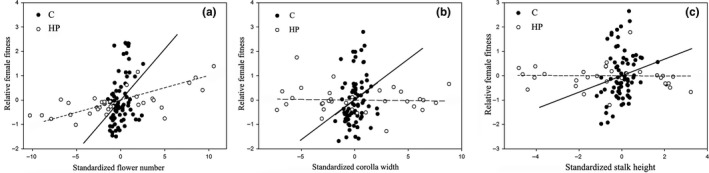
There is discussion over whether pollen limitation exerts selection on floral traits to increase floral display or selects for traits that promote autonomous self-fertilization. Some studies have indicated that pollen limitation does not mediate selection on traits associated with either pollinator attraction or self-fertilization. is an inconspicuous cross-fertilized plant that may suffer from pollen limitation. We conducted a selection analysis on to investigate whether pollen limitation results in selection for an increased floral display in case the evolution of autonomous self-fertilization has been difficult for this plant. The self- and intra-morph incompatibility features, the capacity for autonomous self-fertilization, and the magnitude of pollen limitation were examined through hand-pollination experiments. In 2016, we applied selection analysis on the flowering time, corolla width, stalk height, flower tube length, and flower number in by tagging 76 open-pollinated plants and 37 hand-pollinated plants in the field. Our results demonstrated that was strictly self- and intra-morph incompatible. Moreover, the study population underwent severe pollen limitation during the 2016 flowering season. The selection gradients were found to be significantly positive for flowering time, flower number, and corolla width, and marginally significant for the stalk height. Pollinator-mediated selection was found to be significant on the flower number and corolla width, and marginally significant on stalk height. Our results indicate that the increased floral display may be a vital strategy for small distylous species that have faced difficulty in evolving autonomous self-fertilization.
关于花粉限制是否会对花部性状施加选择压力以增加花展示,或者是否会选择促进自动自花受精的性状,存在着讨论。一些研究表明,花粉限制不会介导对与传粉者吸引或自花受精相关性状的选择。[植物名称]是一种不显眼的异花受精植物,可能会受到花粉限制。我们对[植物名称]进行了一项选择分析,以调查在这种植物难以进化出自动自花受精的情况下,花粉限制是否会导致对增加花展示的选择。通过人工授粉实验,研究了自交和同型不亲和特征、自动自花受精能力以及花粉限制的程度。2016年,我们通过在田间标记76株开放授粉植物和37株人工授粉植物,对[植物名称]的开花时间、花冠宽度、茎高、花管长度和花数量进行了选择分析。我们的结果表明,[植物名称]严格自交和同型不亲和。此外,研究种群在2016年开花季节遭受了严重的花粉限制。发现开花时间、花数量和花冠宽度的选择梯度显著为正,茎高的选择梯度接近显著。发现传粉者介导的选择对花数量和花冠宽度显著,对茎高接近显著。我们的结果表明,增加花展示可能是小型二型花柱植物在进化自动自花受精方面面临困难时的一种重要策略。