Keesey Ian W, Koerte Sarah, Khallaf Mohammed A, Retzke Tom, Guillou Aurélien, Grosse-Wilde Ewald, Buchon Nicolas, Knaden Markus, Hansson Bill S
Department of Evolutionary Neuroethology, Max Planck Institute for Chemical Ecology, Beutenberg Campus, Hans-Knöll-Straße 8, D-07745, Jena, Germany.
Department of Entomology, Cornell University, 5124 Comstock Hall, Ithaca, NY, 14853, USA.
Nat Commun. 2017 Aug 16;8(1):265. doi: 10.1038/s41467-017-00334-9.
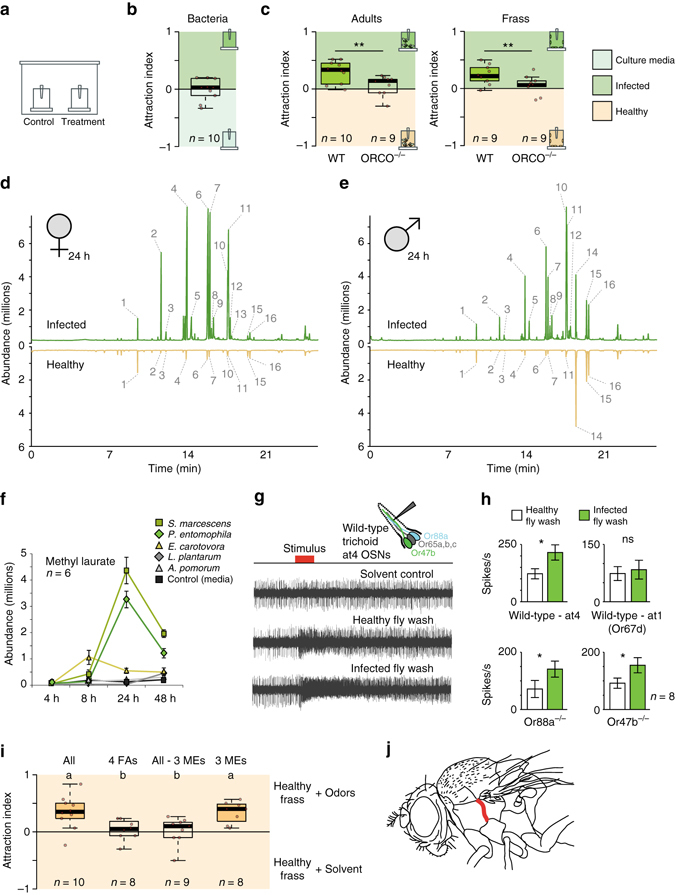
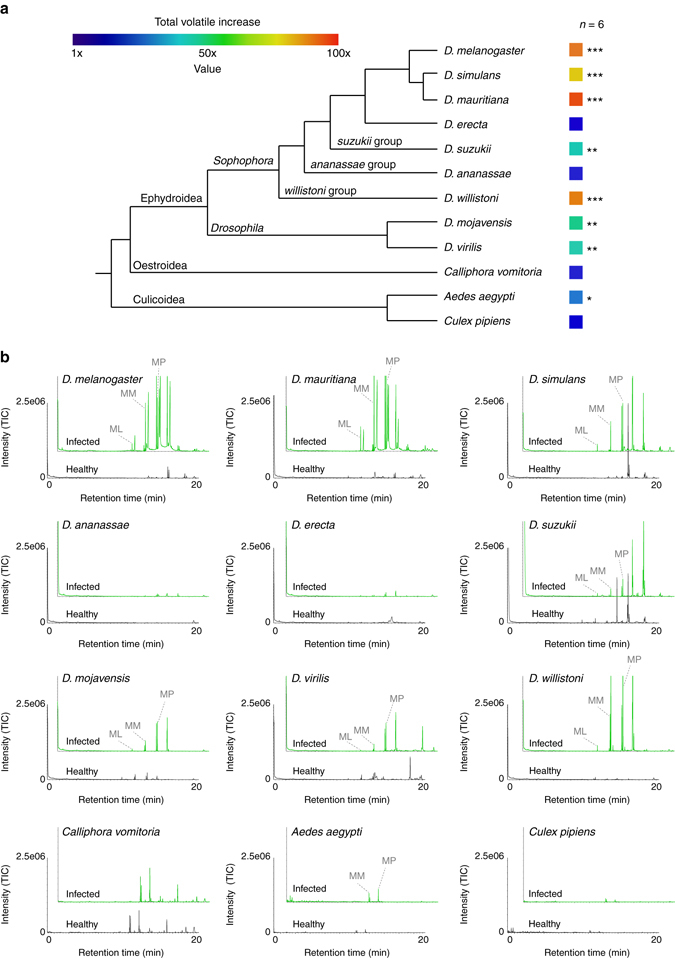
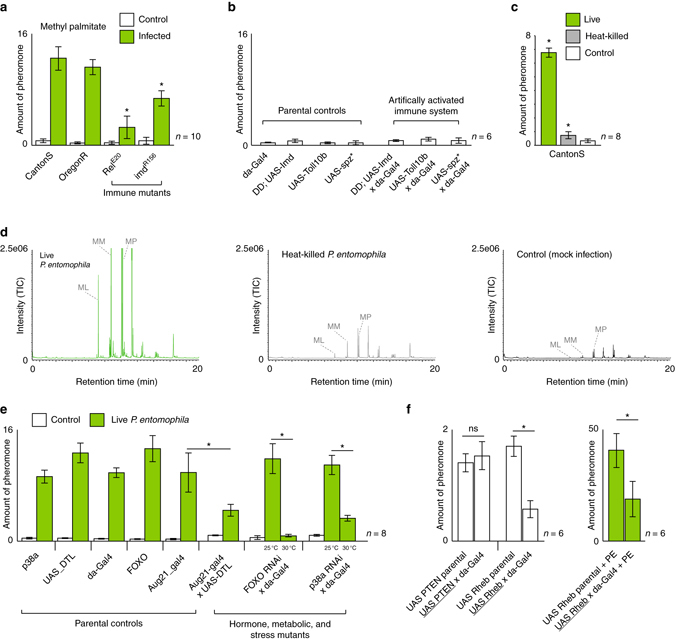
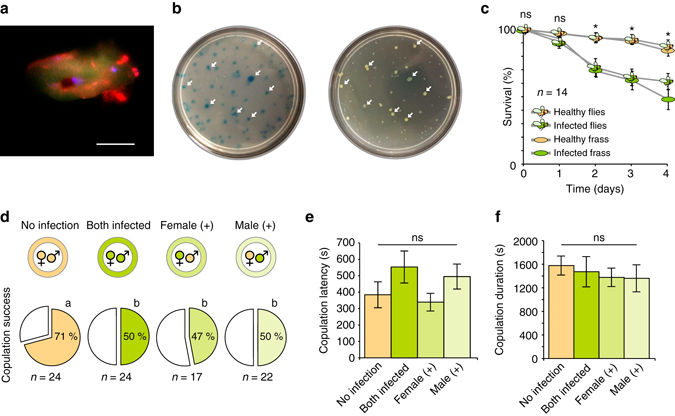
Pathogens and parasites can manipulate their hosts to optimize their own fitness. For instance, bacterial pathogens have been shown to affect their host plants' volatile and non-volatile metabolites, which results in increased attraction of insect vectors to the plant, and, hence, to increased pathogen dispersal. Behavioral manipulation by parasites has also been shown for mice, snails and zebrafish as well as for insects. Here we show that infection by pathogenic bacteria alters the social communication system of Drosophila melanogaster. More specifically, infected flies and their frass emit dramatically increased amounts of fly odors, including the aggregation pheromones methyl laurate, methyl myristate, and methyl palmitate, attracting healthy flies, which in turn become infected and further enhance pathogen dispersal. Thus, olfactory cues for attraction and aggregation are vulnerable to pathogenic manipulation, and we show that the alteration of social pheromones can be beneficial to the microbe while detrimental to the insect host.Behavioral manipulation of host by pathogens has been observed in vertebrates, invertebrates, and plants. Here the authors show that in Drosophila, infection with pathogenic bacteria leads to increased pheromone release, which attracts healthy flies. This process benefits the pathogen since it enhances bacterial dispersal, but is detrimental to the host.
病原体和寄生虫能够操控其宿主以优化自身的适应性。例如,已有研究表明,细菌病原体可影响其宿主植物的挥发性和非挥发性代谢产物,这会导致昆虫媒介对植物的吸引力增加,进而使病原体的传播增多。寄生虫对行为的操控在小鼠、蜗牛、斑马鱼以及昆虫中也有发现。在此我们表明,致病性细菌感染会改变黑腹果蝇的社会交流系统。更具体地说,受感染的果蝇及其粪便会释放出大量显著增加的果蝇气味,包括聚集信息素月桂酸甲酯、肉豆蔻酸甲酯和棕榈酸甲酯,吸引健康果蝇,而这些健康果蝇反过来又会被感染,从而进一步促进病原体传播。因此,用于吸引和聚集的嗅觉线索易受病原体操控,并且我们表明社会信息素的改变对微生物有益而对昆虫宿主有害。病原体对宿主行为的操控在脊椎动物、无脊椎动物和植物中均有观察到。在此,作者表明在果蝇中,致病性细菌感染会导致信息素释放增加,从而吸引健康果蝇。这一过程对病原体有益,因为它增强了细菌传播,但对宿主有害。