Department of Clinical Pharmacology, Xiangya Hospital, Central South University and Institute of Clinical Pharmacology, Central South University; Hunan Key Laboratory of Pharmacogenetics, Changsha, 410008, P.R. China.
Department of Radiation Oncology, Hunan Provincial Tumor Hospital & Affiliated Tumor Hospital of Xiangya Medical School, Central South University; Hunan Key Laboratory of Translational Radiation Oncology, ChangSha, 410013, P.R. China.
Sci Rep. 2017 Aug 16;7(1):8320. doi: 10.1038/s41598-017-08890-2.
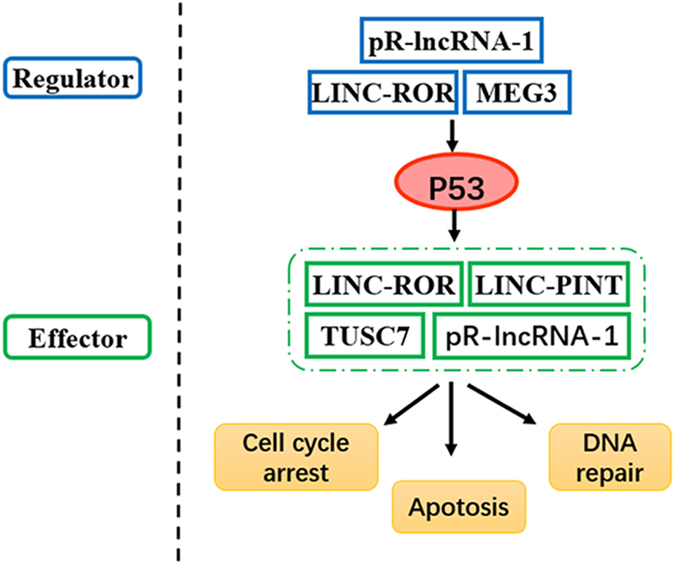
The relevance of the transcription factor p53 in cancer is inarguable, and numerous lncRNAs are involved in the p53 regulatory network as either regulators or effectors, triggering a transcriptional response that causes either cell arrest or apoptosis following DNA damage in a p53-dependent manner. Despite the fact that the therapeutic response is improved in NPC, heterogeneity among people remains with regard to the susceptibility of adverse effects and the efficacy of treatments. Therefore, we analysed eight potentially functional SNPs of five genes in the lncRNA-p53 regulatory network in a discovery cohort of 505 NPC patients. By performing multivariate logistic regression, the impact of genetic variations on the efficacy and risk of CRT-induced toxicities was investigated. The most dramatic finding was that the MEG3 rs10132552 CC genotype had a greater than three-fold increased risk of developing grade 3-4 anaemia (OR = 3.001, 95%CI = 1.355-6.646, P = 0.007). Furthermore, the rs10132552 CT genotype had a better response to treatment (OR = 0.261, 95%CI = 0.089-0.770, P = 0.015). Individuals carrying LINC-ROR rs2027701 with one or two variant alleles had significant associations with a reduced risk of neutropaenia (OR = 0.503, 95%CI = 0.303-0.835, P = 0.008). In conclusion, our results suggested that genetic polymorphisms of the lncRNA-p53 regulatory network could play a potential role in reducing treatment-related toxicities and improving outcomes for NPC patients.
p53 转录因子在癌症中的相关性是不可否认的,许多长链非编码 RNA 作为调节剂或效应物参与 p53 调控网络,触发转录反应,导致 DNA 损伤后以 p53 依赖的方式使细胞停滞或凋亡。尽管 NPC 的治疗反应得到了改善,但人们对不良反应的易感性和治疗效果的异质性仍然存在。因此,我们在一个包含 505 例 NPC 患者的发现队列中分析了长链非编码 RNA-p53 调控网络中五个基因的八个潜在功能 SNP。通过进行多变量逻辑回归,研究了遗传变异对 CRT 诱导毒性的疗效和风险的影响。最显著的发现是,MEG3 rs10132552 CC 基因型发生 3 级-4 级贫血的风险增加了三倍以上(OR=3.001,95%CI=1.355-6.646,P=0.007)。此外,rs10132552 CT 基因型对治疗有更好的反应(OR=0.261,95%CI=0.089-0.770,P=0.015)。携带 LINC-ROR rs2027701 一个或两个变异等位基因的个体与中性粒细胞减少症风险降低显著相关(OR=0.503,95%CI=0.303-0.835,P=0.008)。总之,我们的结果表明,长链非编码 RNA-p53 调控网络的遗传多态性可能在降低治疗相关毒性和改善 NPC 患者结局方面发挥潜在作用。