aClinica Medica, Department of Medicine and Surgery, University Milano-Bicocca bIRCCS Multimedica, Sesto San Giovanni cIRCCS Istituto Auxologico Italiano, Milan dDepartment of Molecular Medicine, University of Pavia, Pavia, Italy.
J Hypertens. 2017 Dec;35(12):2532-2536. doi: 10.1097/HJH.0000000000001498.
Baroreflex activation therapy (BAT) exerts in severe heart failure sympathoinhibitory effects, improving clinical variables and reducing hospitalization rate. The current follow-up study was aimed at determining the long-term effects of BAT, assessing whether BAT in heart failure allows to restore physiological levels of sympathetic function.
Seven patients out of the 11 heart failure patients aged 66.5 ± 3 years (mean ± SEM) in New York Heart Association Class III with left ventricular ejection fraction 40% or less and impaired functional capacity recruited in the study survived at the final follow-up (43.5 ± 2.1 months). Measurements included muscle sympathetic nerve activity (MSNA, microneurography) and spontaneous baroreflex-MSNA sensitivity together with hospitalization rate, echocardiography, Minnesota score, New York Heart Association class and standard clinical data. Measurements were collected before and at 6, 21 and 43 months following BAT. Data were compared with those collected in 17 age-matched healthy controls. All assessments were made with the heart failure patient on optimal active therapy.
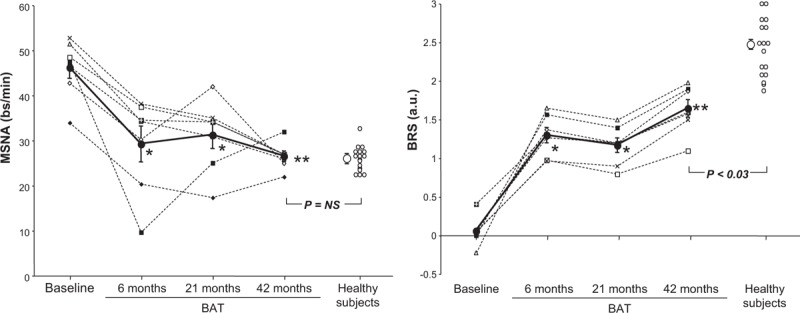
In the seven patients, BAT maintained its beneficial effects over 43.5 ± 2.1 months of follow-up. MSNA values underwent a progressive significant reduction from baseline to 21 and 43 months follow-up following BAT (from 46.2 ± 2.4 to 31.3 ± 3.0 e 26.6 ± 2.0 bursts/min, P < 0.05 at least), becoming almost superimposable to the ones seen in healthy controls (25.5 ± 0.8 bursts/min). Baroreflex-MSNA sensitivity improved, without achieving, however, a full normalization. Blood pressure and heart rate did not change. Left ventricular ejection fraction improved significantly from 32.3 ± 2 to 36.7 ± 3% (P < 0.05). Hospitalization rate decreased substantially when measured as days/year/patients it decreased from 10.3 ± 2.5 preimplant to 1.01 ± 1.4 at the 43.5th month follow-up (P < 0.02). No side effects were reported in the long-term period.
The current study provides evidence that BAT in heart failure with reduced ejection fraction allows not only to improve hemodynamic and clinical profile but also to exert profound sympathoinhibitory effects, allowing an almost complete restoration of physiological levels of the sympathetic neural function.
压力反射激活疗法(BAT)对严重心力衰竭具有抑制交感神经的作用,可改善临床变量并降低住院率。本随访研究旨在确定 BAT 的长期效果,评估心力衰竭患者的 BAT 是否可以恢复生理水平的交感神经功能。
11 例纽约心脏协会(NYHA)III 级心力衰竭患者中,7 例(66.5±3 岁,平均±SEM)左心室射血分数<40%且心功能受损的患者存活至最终随访(43.5±2.1 个月)。测量包括肌肉交感神经活动(MSNA,微神经记录)和自发性压力反射-MSNA 敏感性,以及住院率、超声心动图、明尼苏达评分、纽约心脏协会(NYHA)分级和标准临床数据。在 BAT 前和 6、21 和 43 个月时收集测量值。将数据与 17 名年龄匹配的健康对照组进行比较。所有评估均在心力衰竭患者接受最佳积极治疗时进行。
在 7 例患者中,BAT 在 43.5±2.1 个月的随访中保持了其有益效果。MSNA 值在 BAT 后 21 和 43 个月时从基线逐渐显著降低(从 46.2±2.4 降至 31.3±3.0 和 26.6±2.0 爆发/分钟,至少 P<0.05),几乎与健康对照组(25.5±0.8 爆发/分钟)相似。压力反射-MSNA 敏感性得到改善,但未完全正常化。血压和心率没有变化。左心室射血分数从 32.3±2 显著增加至 36.7±3%(P<0.05)。当以患者/年/天的天数测量时,住院率大大降低,从植入前的 10.3±2.5 降至第 43.5 个月的 1.01±1.4(P<0.02)。在长期随访中未报告任何副作用。
本研究提供了证据表明,心力衰竭伴射血分数降低的 BAT 不仅可以改善血液动力学和临床状况,还可以发挥深刻的抑制交感神经作用,使交感神经功能几乎完全恢复到生理水平。