Ginzel Marco, Feng Xiaoyan, Kuebler Joachim F, Klemann Christian, Yu Yi, von Wasielewski Reinhard, Park Joon-Keun, Hornef Mathias W, Vieten Gertrud, Ure Benno M, Kaussen Torsten, Gosemann Jan Hendrik, Mayer Steffi, Suttkus Anne, Lacher Martin
Center of Pediatric Surgery, Hannover Medical School, Hannover, Germany.
Department of Pediatric Surgery, University of Leipzig, Leipzig, Germany.
PLoS One. 2017 Aug 17;12(8):e0182732. doi: 10.1371/journal.pone.0182732. eCollection 2017.
Necrotizing enterocolitis (NEC) is an inflammatory bowel disease of preterm human newborns with yet unresolved etiology. An established neonatal murine model for NEC employs oral administration of lipopolysaccharides (LPS) combined with hypoxia/hypothermia. In adult mice, feeding dextran sodium sulfate (DSS) represents a well-established model for experimental inflammatory bowel disease. Here we investigated the effect of DSS administration on the neonatal murine intestine in comparison with the established NEC model.
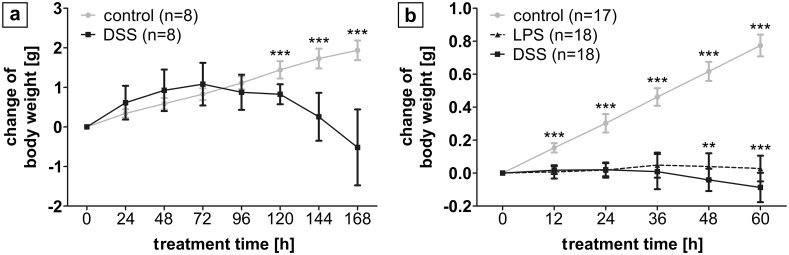
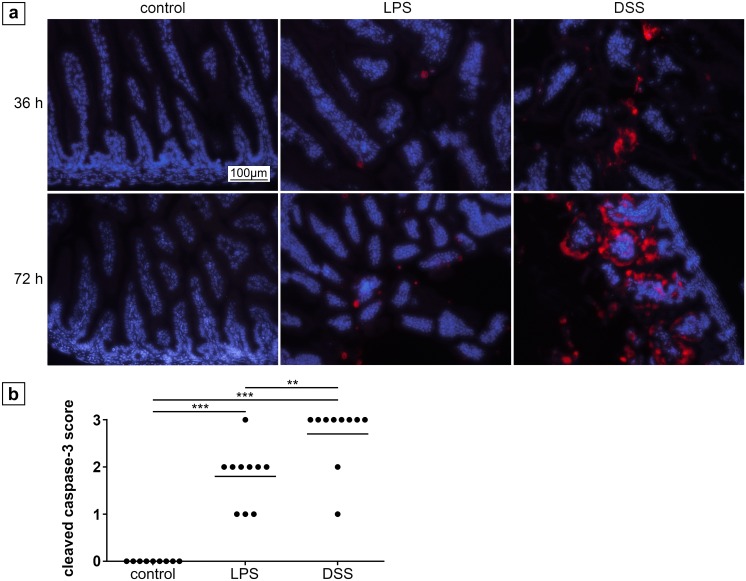
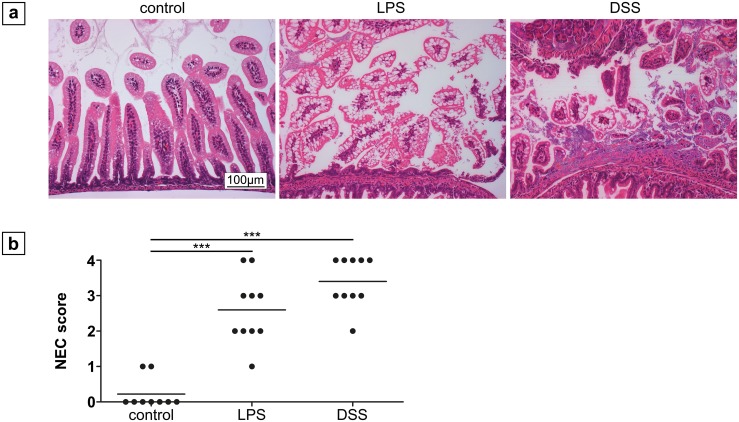
3-day-old C57BL/6J mice were either fed formula containing DSS or LPS. LPS treated animals were additionally stressed by hypoxia/hypothermia twice daily. After 72 h, mice were euthanized, their intestinal tissue harvested and analyzed by histology, qRT-PCR and flow cytometry. For comparison, adult C57BL/6J mice were fed with DSS for 8 days and examined likewise. Untreated, age matched animals served as controls.
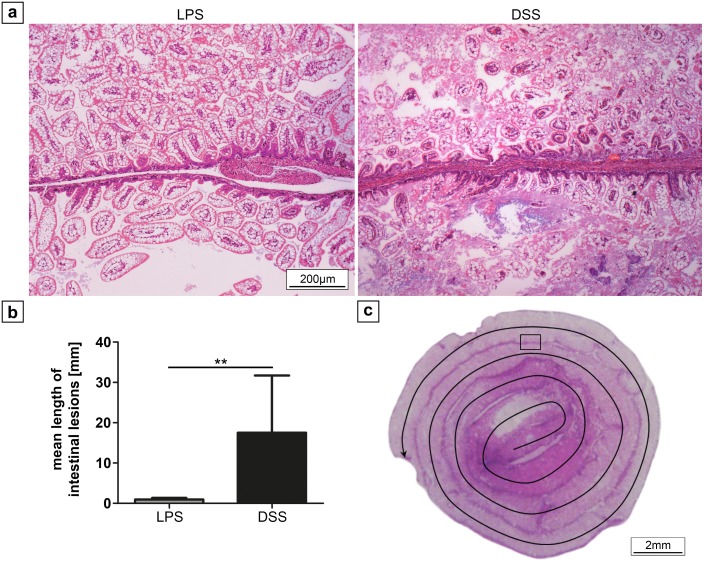
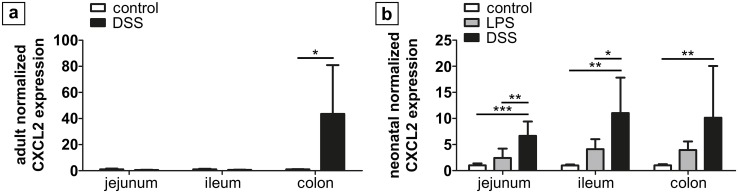
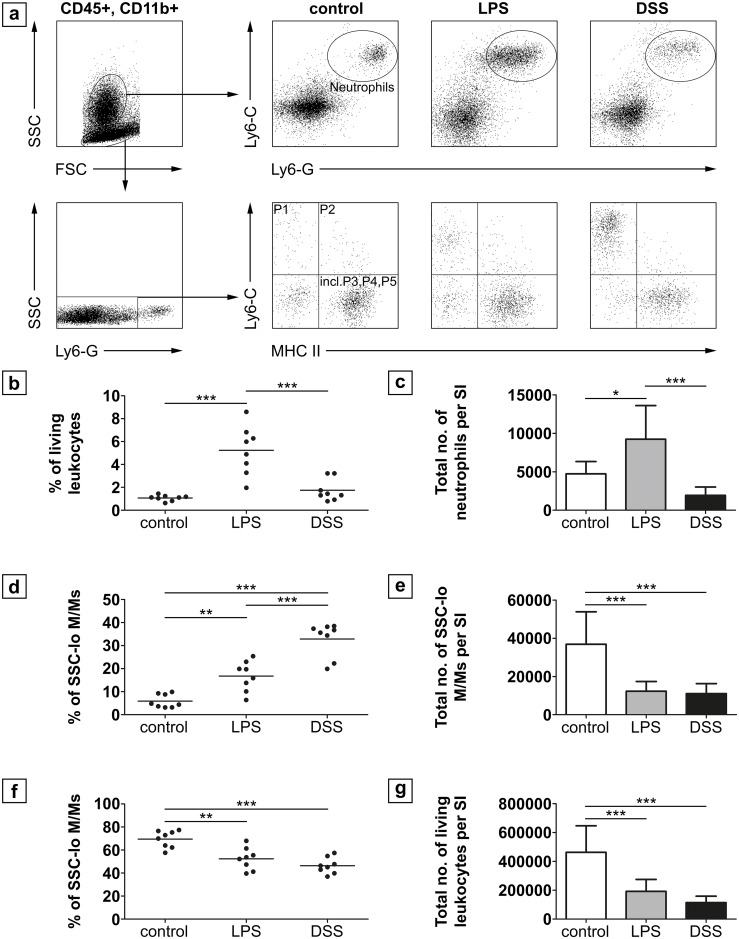
Adult mice treated with DSS exhibited colonic inflammation with significantly increased Cxcl2 mRNA expression. In contrast, tissue inflammation in neonatal mice treated with DSS or LPS plus hypoxia/hypothermia was present in colon and small intestine as well. Comparative analysis of neonatal mice revealed a significantly increased lesion size and intestinal Cxcl2 mRNA expression after DSS exposure. Whereas LPS administration mainly induced local neutrophil recruitment, DSS treated animals displayed increased monocytes/macrophages infiltration.
Our study demonstrates the potential of DSS to induce NEC-like lesions accompanied by a significant humoral and cellular immune response in the small and large intestine of neonatal mice. The new model therefore represents a good alternative to LPS plus hypoxia/hypothermia administration requiring no additional physical stress.
坏死性小肠结肠炎(NEC)是一种早产人类新生儿的炎症性肠病,其病因尚未明确。一种已确立的NEC新生小鼠模型采用口服脂多糖(LPS)并结合缺氧/低温。在成年小鼠中,喂食葡聚糖硫酸钠(DSS)是一种已确立的实验性炎症性肠病模型。在此,我们将DSS给药对新生小鼠肠道的影响与已确立的NEC模型进行了比较。
给3日龄的C57BL/6J小鼠喂食含DSS或LPS的配方奶。LPS处理的动物每天还进行两次缺氧/低温应激。72小时后,对小鼠实施安乐死,采集其肠道组织并通过组织学、qRT-PCR和流式细胞术进行分析。作为对照,给成年C57BL/6J小鼠喂食DSS 8天并同样进行检查。未处理的、年龄匹配的动物作为对照。
用DSS处理的成年小鼠出现结肠炎症,Cxcl2 mRNA表达显著增加。相比之下,用DSS或LPS加缺氧/低温处理的新生小鼠的结肠和小肠也出现了组织炎症。对新生小鼠的比较分析显示,DSS暴露后病变大小和肠道Cxcl2 mRNA表达显著增加。LPS给药主要诱导局部中性粒细胞募集,而DSS处理的动物则表现出单核细胞/巨噬细胞浸润增加。
我们的研究表明,DSS有潜力在新生小鼠的小肠和大肠中诱导类似NEC的病变,并伴有显著的体液和细胞免疫反应。因此,新模型是LPS加缺氧/低温给药的良好替代方案,无需额外的物理应激。