Ture Maria, Angst Felix, Aeschlimann André, Renner Christoph, Schnyder Ulrich, Zerkiebel Nic, Perseus Josef, Barth Jürgen, Bredell Marius, Soelch Chantal Martin, Walt Heinrich, Jenewein Josef
Department of Cranio-, Maxillo-Facial and Oral Surgery, University Hospital Zurich, University of Zurich, Zurich, Switzerland.
RehaClinic Bad Zurzach, Zurzach, Switzerland.
J Cancer. 2017 Jul 1;8(10):1717-1725. doi: 10.7150/jca.19564. eCollection 2017.
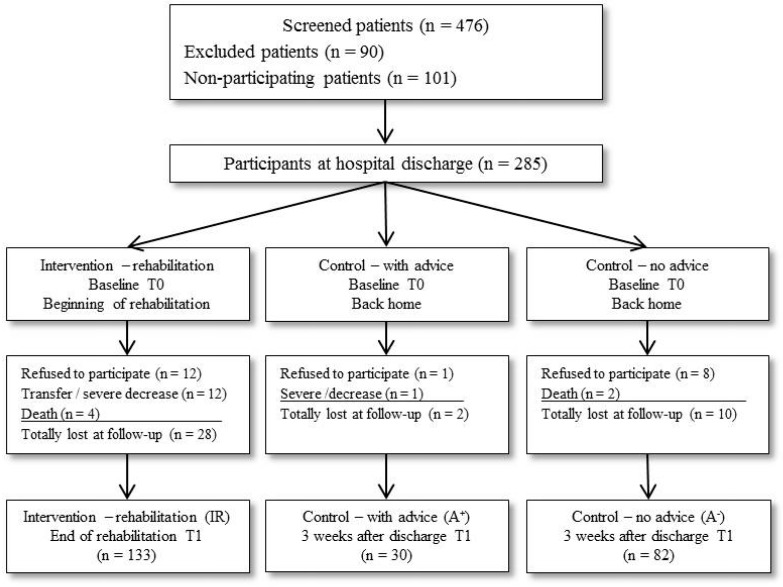
Inpatient rehabilitation for cancer patients has been demonstrated to improve patients' health related quality of life (HRQoL) effectively. The purpose of this study was to compare changes in general health and HRQoL of cancer patients who were referred to inpatient rehabilitation (IR) with those in two control groups who underwent outpatient management either with advice for inpatient rehabilitation (A) or without (A). In this naturalistic, longitudinal, controlled cohort study, changes in general health and HRQoL were assessed at either discharge of acute hospital or start of rehabilitation (baseline) and at the follow-up 3 weeks later or end of rehabilitation. Outcome variables included general health and HRQoL assessed by the Short Form 36 (SF-36) and the Functional Assessment of Cancer Therapy (FACT), and fatigue (FACT-F), depression and anxiety by the Hospital Anxiety and Depression Scale (HADS). Changes on the scores were compared with bivariate and multivariate analyses using standardized mean differences (SMD). IR patients (n=133) were on average older, reported lower HRQoL and health, and suffered more frequently from carcinoma than patients of the A (n=30) and the A (n=82) groups. In the IR patients, pain, physical functioning, mental health, vitality, and fatigue improved significantly compared to the A controls. Compared to the A group, the bivariate effects were lower but still statistically significant on many scales. IR showed moderate, statistically significant superior effects over outpatient management of cancer patients after acute treatment. Findings indicate that inpatient cancer rehabilitation can be recommended as an effective management after acute treatment. As today, referrals to inpatient rehabilitation for cancer patients are still not based on structured standardized procedures, the implementation of such screening is needed to address patients' needs and to render the potential for rehabilitation more reliable.
癌症患者的住院康复已被证明能有效改善患者的健康相关生活质量(HRQoL)。本研究的目的是比较转至住院康复(IR)的癌症患者与两个对照组患者在一般健康状况和HRQoL方面的变化,其中一个对照组接受住院康复建议的门诊管理(A组),另一个对照组未接受此类建议(A组)。在这项自然主义、纵向、对照队列研究中,在急性医院出院时或康复开始时(基线)以及3周后的随访或康复结束时评估一般健康状况和HRQoL的变化。结果变量包括通过简明健康调查问卷(SF - 36)和癌症治疗功能评估(FACT)评估的一般健康状况和HRQoL,以及通过医院焦虑抑郁量表(HADS)评估的疲劳(FACT - F)、抑郁和焦虑。使用标准化平均差(SMD)通过双变量和多变量分析比较得分变化。与A组(n = 30)和A组(n = 82)的患者相比,IR组患者(n = 133)平均年龄更大,HRQoL和健康状况更低,患癌频率更高。与A组对照组相比,IR组患者的疼痛、身体功能、心理健康、活力和疲劳有显著改善。与A组相比,双变量效应在许多量表上较低但仍具有统计学意义。IR在急性治疗后对癌症患者的门诊管理显示出中等程度、具有统计学意义的优越效果。研究结果表明,住院癌症康复可被推荐为急性治疗后的有效管理方式。由于目前癌症患者转至住院康复仍未基于结构化标准化程序,因此需要实施此类筛查以满足患者需求并使康复潜力更可靠。