Pham Cong-Dat, Smith Charles E, Hu Yuanyuan, Hu Jan C-C, Simmer James P, Chun Yong-Hee P
Department of Periodontics, School of Dentistry, University of Texas Health Science Center at San AntonioSan Antonio, TX, United States.
Department of Anatomy and Cell Biology, McGill UniversityMontreal, QC, Canada.
Front Physiol. 2017 Jul 31;8:529. doi: 10.3389/fphys.2017.00529. eCollection 2017.
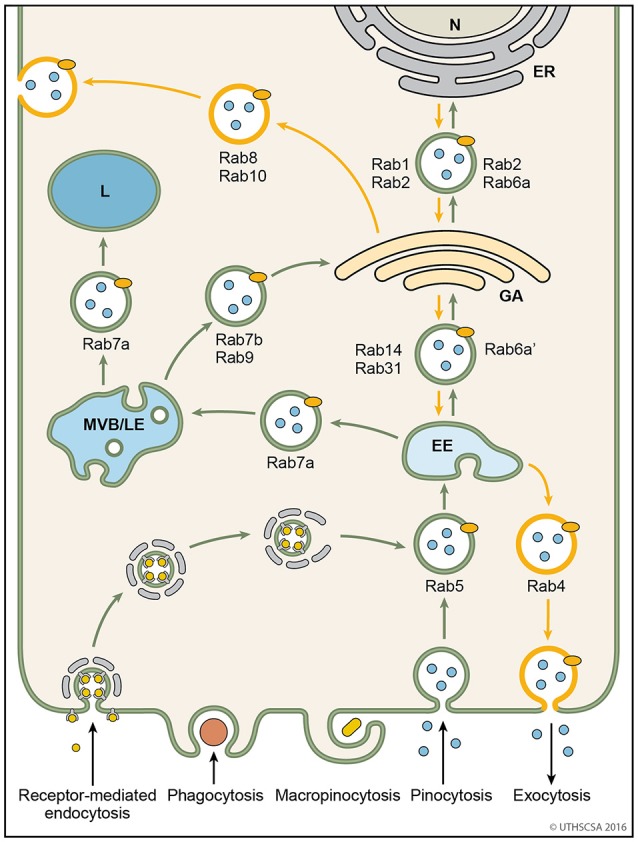
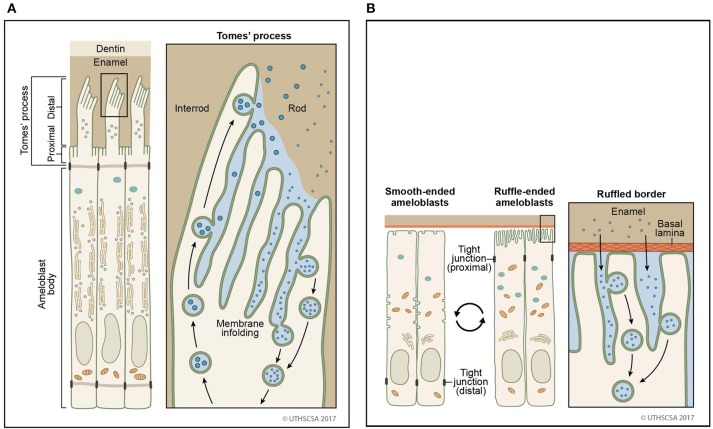
Enamel formation requires consecutive stages of development to achieve its characteristic extreme mineral hardness. Mineralization depends on the initial presence then removal of degraded enamel proteins from the matrix via endocytosis. The ameloblast membrane resides at the interface between matrix and cell. Enamel formation is controlled by ameloblasts that produce enamel in stages to build the enamel layer (secretory stage) and to reach final mineralization (maturation stage). Each stage has specific functional requirements for the ameloblasts. Ameloblasts adopt different cell morphologies during each stage. Protein trafficking including the secretion and endocytosis of enamel proteins is a fundamental task in ameloblasts. The sites of internalization of enamel proteins on the ameloblast membrane are specific for every stage. In this review, an overview of endocytosis and trafficking of vesicles in ameloblasts is presented. The pathways for internalization and routing of vesicles are described. Endocytosis is proposed as a mechanism to remove debris of degraded enamel protein and to obtain feedback from the matrix on the status of the maturing enamel.
釉质形成需要连续的发育阶段才能达到其特有的极高矿物质硬度。矿化取决于降解的釉质蛋白最初存在于基质中,然后通过胞吞作用从基质中清除。成釉细胞膜位于基质与细胞的界面处。釉质形成由成釉细胞控制,成釉细胞分阶段产生釉质以构建釉质层(分泌阶段)并达到最终矿化(成熟阶段)。每个阶段对成釉细胞都有特定的功能要求。成釉细胞在每个阶段会呈现不同的细胞形态。包括釉质蛋白分泌和胞吞作用在内的蛋白质运输是成釉细胞的一项基本任务。釉质蛋白在成釉细胞膜上的内化位点在每个阶段都是特定的。在本综述中,概述了成釉细胞中囊泡的胞吞作用和运输情况。描述了囊泡内化和转运的途径。胞吞作用被认为是一种清除降解釉质蛋白碎片并从基质获得成熟釉质状态反馈的机制。