Beirnaert Els, Desmyter Aline, Spinelli Silvia, Lauwereys Marc, Aarden Lucien, Dreier Torsten, Loris Remy, Silence Karen, Pollet Caroline, Cambillau Christian, de Haard Hans
Ablynx NV, Ghent, Belgium.
Architecture et Fonction des Macromolécules Biologiques, Aix-Marseille Université, Campus de Luminy, Marseille, France.
Front Immunol. 2017 Jul 31;8:867. doi: 10.3389/fimmu.2017.00867. eCollection 2017.
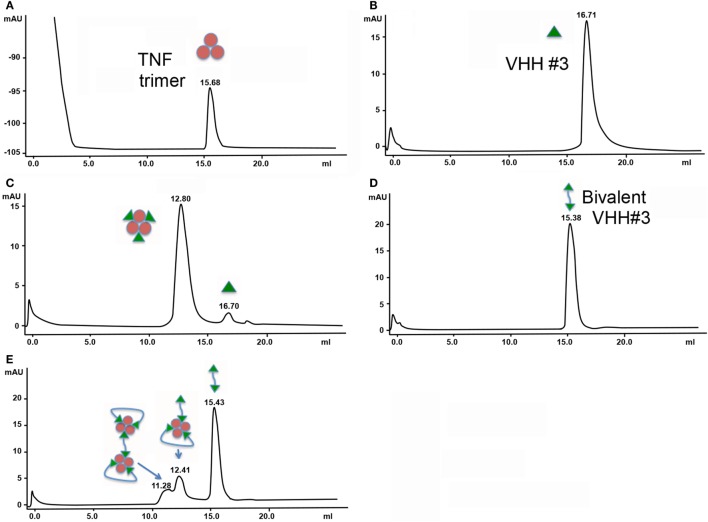
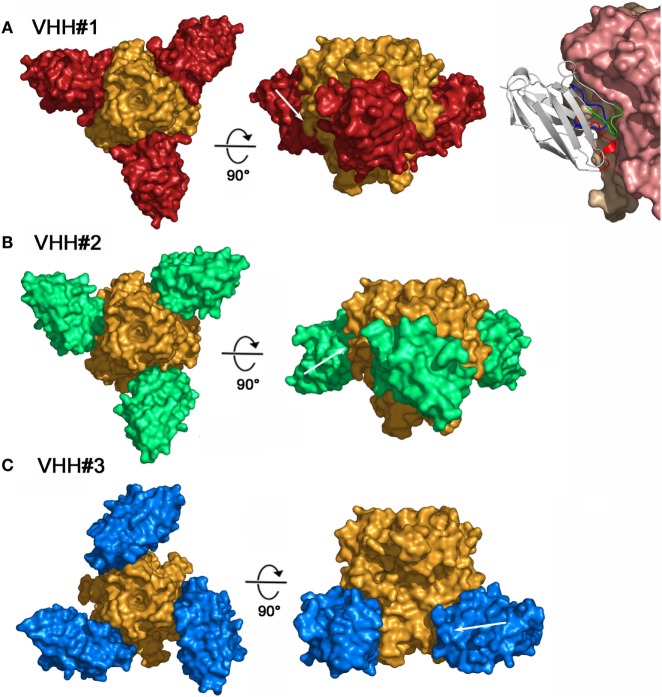
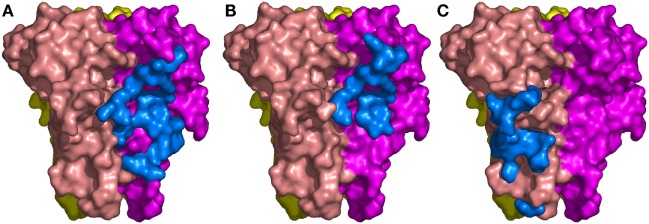
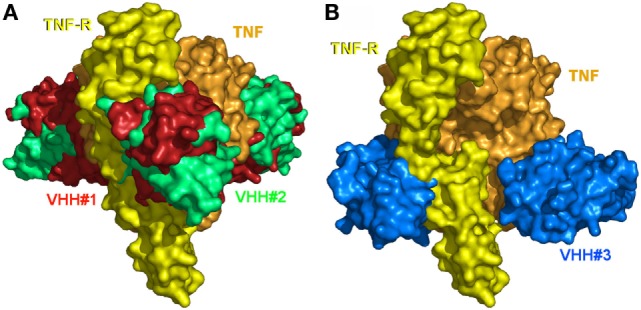
The activity of tumor necrosis factor (TNF), a cytokine involved in inflammatory pathologies, can be inhibited by antibodies or trap molecules. Herein, llama-derived variable heavy-chain domains of heavy-chain antibody (VHH, also called Nanobodies™) were generated for the engineering of bivalent constructs, which antagonize the binding of TNF to its receptors with picomolar potencies. Three monomeric VHHs (VHH#1, VHH#2, and VHH#3) were characterized in detail and found to bind TNF with sub-nanomolar affinities. The crystal structures of the TNF-VHH complexes demonstrate that VHH#1 and VHH#2 share the same epitope, at the center of the interaction area of TNF with its TNFRs, while VHH#3 binds to a different, but partially overlapping epitope. These structures rationalize our results obtained with bivalent constructs in which two VHHs were coupled linkers of different lengths. Contrary to conventional antibodies, these bivalent Nanobody™ constructs can bind to a single trimeric TNF, thus binding with avidity and blocking two of the three receptor binding sites in the cytokine. The different mode of binding to antigen and the engineering into bivalent constructs supports the design of highly potent VHH-based therapeutic entities.
肿瘤坏死因子(TNF)是一种参与炎症性疾病的细胞因子,其活性可被抗体或陷阱分子抑制。在此,为了构建二价结构,我们制备了源自骆驼的重链抗体可变重链结构域(VHH,也称为纳米抗体™),这些二价结构能够以皮摩尔级的效力拮抗TNF与其受体的结合。我们详细表征了三种单体VHH(VHH#1、VHH#2和VHH#3),发现它们以亚纳摩尔级的亲和力结合TNF。TNF-VHH复合物的晶体结构表明,VHH#1和VHH#2共享相同的表位,位于TNF与其TNFRs相互作用区域的中心,而VHH#3结合到一个不同但部分重叠的表位。这些结构解释了我们用不同长度连接子连接两个VHH的二价结构所获得的结果。与传统抗体不同,这些二价纳米抗体™结构可以结合单个三聚体TNF,从而以亲和力结合并阻断细胞因子中三个受体结合位点中的两个。与抗原的不同结合模式以及构建为二价结构支持了基于VHH的高效治疗实体的设计。