Oberhoffer Martin, Eifert Sandra, Jaeger Beate, Blessing Frithjof, Beiras-Fernandez A, Seidel D, Reichart B
Department of Cardiac Surgery, Asklepios Clinic St. Georg, Hamburg, Germany.
Department of Cardiac Surgery, Ludwig-Maximilians-University, Munich, Germany.
Surg J (N Y). 2016 May 10;2(2):e5-e9. doi: 10.1055/s-0036-1584167. eCollection 2016 Apr.
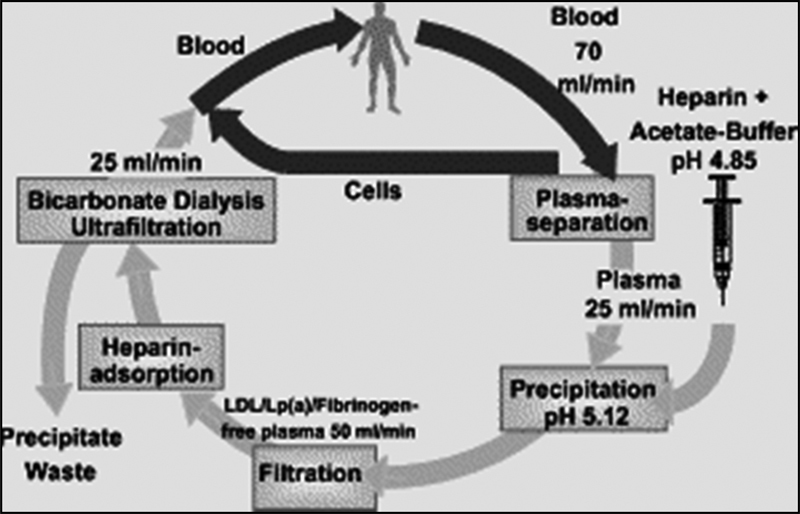
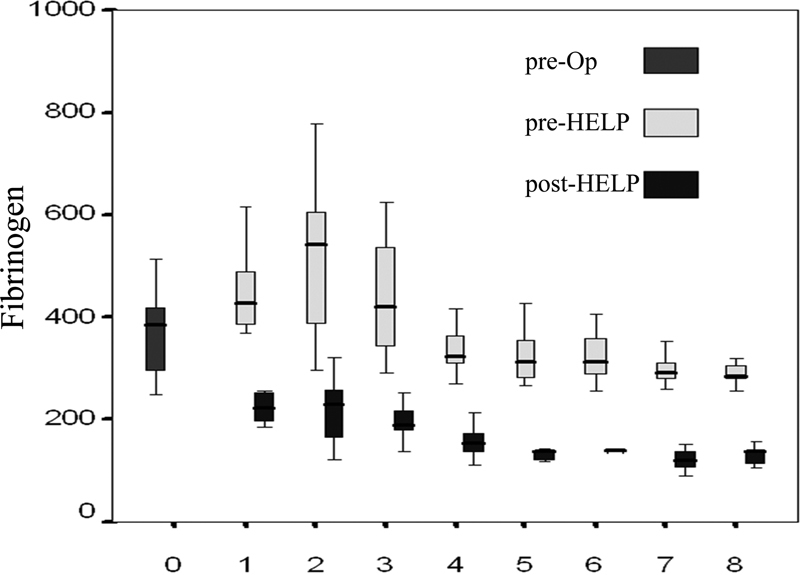
Early graft occlusion due to thromboembolic events is a well-known complication after coronary artery bypass grafting (CABG). Fibrinogen, the coagulation factor I, is a glycoprotein that is transformed by thrombin into fibrin. It plays a major role in thrombus formation and is highly elevated after CABG. Our aim was to determine if postoperative lowering of fibrinogen levels by H.E.L.P. (heparin-mediated extracorporeal low-density lipoprotein [LDL] fibrinogen precipitation) aphaeresis could reduce the rate of early graft occlusion in patients with hypercholesterolemia undergoing CABG. Between December 2004 and September 2009, 36 male patients with hypercholesterolemia (mean LDL cholesterol 128 ± 12 mg/dL), mean age 58 ± 9 years, underwent CABG. Mean preoperative fibrinogen level was 387 ± 17 mg/dL. H.E.L.P. aphaeresis was postoperatively performed when fibrinogen levels exceeded 350 mg/dL on day 1 and 250 mg/dL every consecutive day up to day 8. Pre- and postaphaeresis blood samples were obtained and plasma fibrinogen level reduction was calculated. Early graft occlusion was evaluated by means of coronary angiography or multislice computed tomography before discharge. A total of 128 distal anastomoses were performed in 36 patients (mean 3.6/patient). Postoperatively, 191 H.E.L.P. aphaeresis sessions were performed (mean 5.3/patient). Fibrinogen levels were lowered from 391 ± 10 mg/dL (preaphaeresis) to 171 ± 5 mg/dL (postaphaeresis; < 0.001). Coronary angiography (multislice computed tomography in 7 patients) revealed graft patency in 125 of 128 grafts (98% patency) with three occluded venous grafts to target vessels of 1.5 mm. H.E.L.P. aphaeresis-related complications were limited to hypotensive episodes in two patients and bacteremia in one patient. H.E.L.P. apheresis offers an easy, save, and efficient method to decrease fibrinogen postoperatively in patients having CABG. Showing excellent graft patency rates in comparison to the literature, this method is a promising tool to reduce early graft occlusion after CABG.
冠状动脉搭桥术(CABG)后,血栓栓塞事件导致的早期移植物闭塞是一种众所周知的并发症。纤维蛋白原是凝血因子I,是一种糖蛋白,可被凝血酶转化为纤维蛋白。它在血栓形成中起主要作用,并且在CABG后会显著升高。我们的目的是确定通过H.E.L.P.(肝素介导的体外低密度脂蛋白[LDL]纤维蛋白原沉淀)血液成分分离术降低术后纤维蛋白原水平是否可以降低接受CABG的高胆固醇血症患者的早期移植物闭塞率。
在2004年12月至2009年9月期间,36名高胆固醇血症男性患者(平均LDL胆固醇128±12mg/dL)接受了CABG,平均年龄58±9岁。术前平均纤维蛋白原水平为387±17mg/dL。当纤维蛋白原水平在第1天超过350mg/dL且在第8天之前的连续每一天超过250mg/dL时,术后进行H.E.L.P.血液成分分离术。采集血液成分分离术前和术后的血样,并计算血浆纤维蛋白原水平的降低情况。出院前通过冠状动脉造影或多层计算机断层扫描评估早期移植物闭塞情况。
36例患者共进行了128次远端吻合术(平均每人3.6次)。术后进行了191次H.E.L.P.血液成分分离术(平均每人5.3次)。纤维蛋白原水平从(血液成分分离术前)391±10mg/dL降至(血液成分分离术后)171±5mg/dL(P<0.001)。冠状动脉造影(7例患者进行多层计算机断层扫描)显示128条移植物中有125条通畅(通畅率98%),3条静脉移植物闭塞至1.5mm的靶血管。H.E.L.P.血液成分分离术相关并发症仅限于2例患者出现低血压发作和1例患者出现菌血症。
H.E.L.P.血液成分分离术为降低CABG患者术后纤维蛋白原水平提供了一种简便、安全且有效的方法。与文献相比,该方法显示出优异的移植物通畅率,是降低CABG后早期移植物闭塞的一种有前景的工具。