Division of Chronic Disease Management, Korea Centers for Disease Control and Prevention, Cheongju, Korea.
Department of Emergency Medicine, Seoul National University College of Medicine, Seoul, Korea.
BMJ Open. 2017 Aug 21;7(8):e016925. doi: 10.1136/bmjopen-2017-016925.
The Utstein ten-step implementation strategy (UTIS) proposed by the Global Resuscitation Alliance, a bundle of community cardiopulmonary resuscitation (CPR) programs to improve outcomes after out-of-hospital cardiac arrests (OHCAs), has been developed. However, it is not documented whether UTIS programs are associated with better outcomes or not. The study aimed to test the association between the UTIS programme and better outcomes after OHCA.
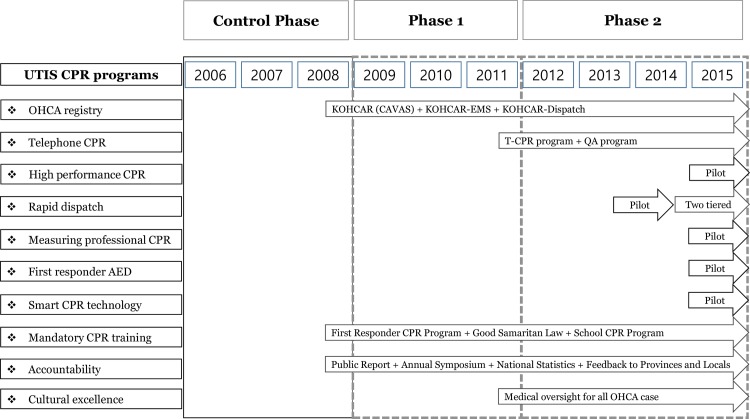
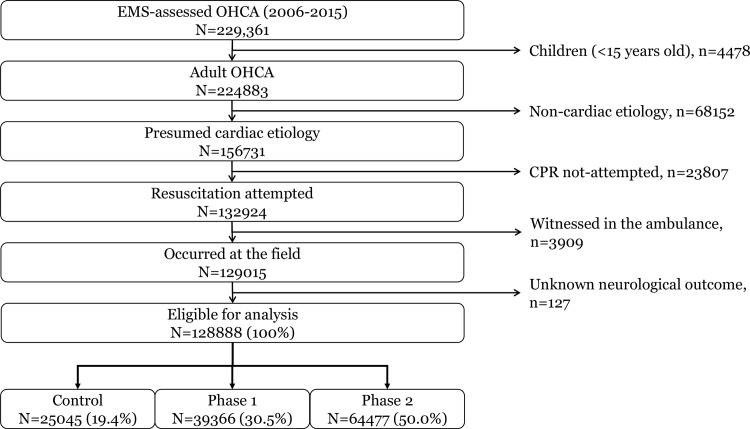
The study was a before- and after-intervention study. Adults OHCAs treated by emergency medical service (EMS) from 2006 to 2015 in Korea were collected, excluding patients witnessed by ambulance personnel and without outcomes. Phase 1 (2009-2011) after implementing three programs (national OHCA registry, obligatory CPR education, and public report of OHCA outcomes), and phase 2 (2012-2015) after implementing two programs (telephone-assisted CPR and EMS quality assurance programme) were compared with the control period (2006-2008) when no UTIS programme were implemented. The primary outcome was good neurological recovery (cerebral performance scale 1 or 2). We tested the association between the phases and outcomes, adjusting for confounders using a multivariate logistic regression model to calculate adjusted odds ratios (AORs) with 95% confidence intervals (CIs).
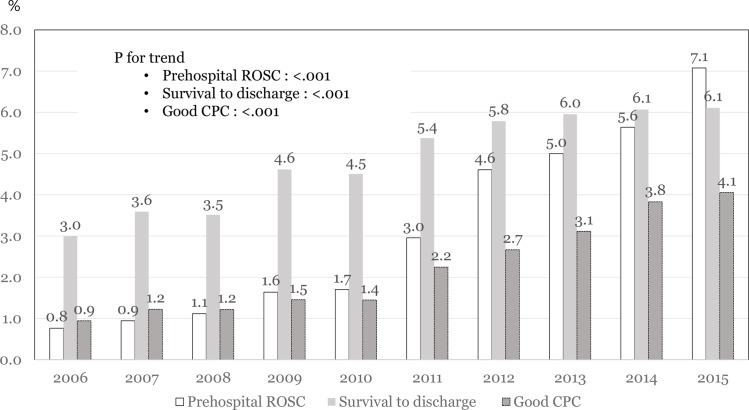
A total of 1 28 888 eligible patients were analysed. The control, phase 1, and phase two study groups were 19.4%, 30.5%, and 50.0% of the whole, respectively. There were significant changes in pre-hospital ROSC (0.8% in 2006 and 7.1% in 2015), survival to discharge (3.0% in 2006 and 6.1% in 2015), and good neurological recovery (1.2% in 2006 and 4.1% in 2015). The AORs (95% CIs) for good neurological recovery were 1.82 (1.53-2.15) or phase 1 and 2.21 (1.78-2.75) for phase two compared with control phase.
The national implementation of the five UTIS programs was significantly associated with better OHCA outcomes in Korea.
全球复苏联盟提出的乌斯丁十步实施策略(UTIS)是一套社区心肺复苏(CPR)项目,旨在改善院外心脏骤停(OHCA)后的结局。然而,目前尚不清楚 UTIS 项目是否与更好的结局相关。本研究旨在检验 UTIS 项目与 OHCA 后更好结局之间的关联。
本研究为干预前后研究。纳入韩国 2006 年至 2015 年接受急救医疗服务(EMS)治疗的成年人 OHCA 患者,排除由救护人员目击且无结局的患者。第一阶段(2009 年至 2011 年)实施了三项计划(国家 OHCA 登记处、强制性 CPR 教育和 OHCA 结局的公开报告),第二阶段(2012 年至 2015 年)实施了两项计划(电话辅助 CPR 和 EMS 质量保证计划),与未实施 UTIS 计划的对照期(2006 年至 2008 年)进行比较。主要结局为良好的神经功能恢复(脑功能量表 1 或 2 级)。我们使用多变量逻辑回归模型调整混杂因素后,测试了各阶段与结局之间的关联,计算调整后的比值比(AOR)及其 95%置信区间(CI)。
共纳入 12888 例符合条件的患者。对照组、第一阶段和第二阶段研究组分别占总数的 19.4%、30.5%和 50.0%。院外 ROSC(2006 年为 0.8%,2015 年为 7.1%)、存活出院(2006 年为 3.0%,2015 年为 6.1%)和良好的神经功能恢复(2006 年为 1.2%,2015 年为 4.1%)均有显著变化。与对照组相比,第一阶段和第二阶段良好神经功能恢复的 AOR(95%CI)分别为 1.82(1.53-2.15)或 2.21(1.78-2.75)。
韩国实施五项 UTIS 计划与 OHCA 结局的改善显著相关。