Movement Disorders Unit Neurology Department Vall d'Hebron University Hospital Neurodegenerative Diseases Research Group-Vall d'Hebron Research Institute Autonomous University of Barcelona Barcelona Spain.
Digestive Endoscopy Department Vall d'Hebron University Hospital Barcelona Spain.
Brain Behav. 2017 Jul 7;7(8):e00758. doi: 10.1002/brb3.758. eCollection 2017 Aug.
Levodopa-carbidopa intestinal gel (LCIG) infusion has demonstrated to improve motor fluctuations. The aim of this study is to assess the long-term safety and effectiveness of LCIG infusion in advanced Parkinson's disease (PD) patients with motor fluctuations and its effect in nonmotor symptoms.
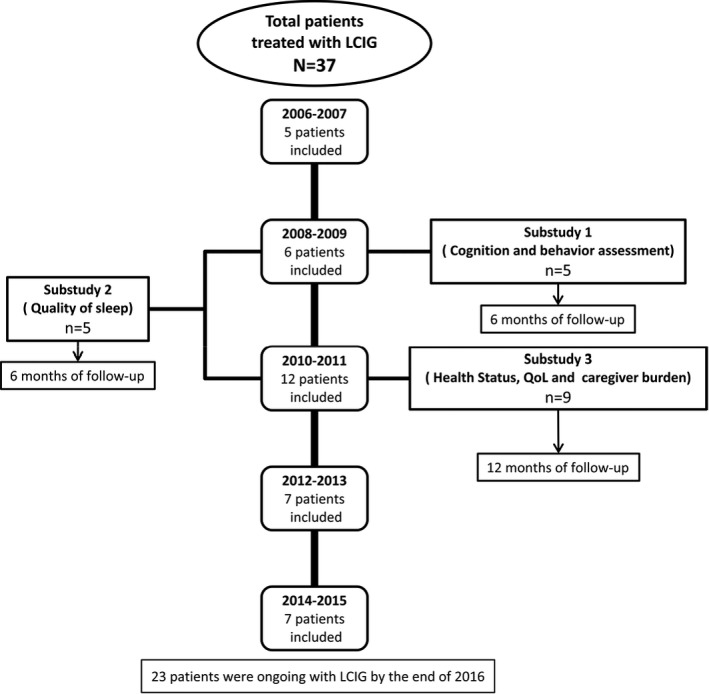
Adverse events (AE) and their management, clinical motor, and nonmotor aspects were assessed up to 10 years. Thirty-seven patients were treated with LGIC; in three subsets of patients, specific batteries of tests were used to assess cognitive and behavior assessment for 6 months, quality of sleep for 6 months, and quality of life and caregiver burden for 1 year.
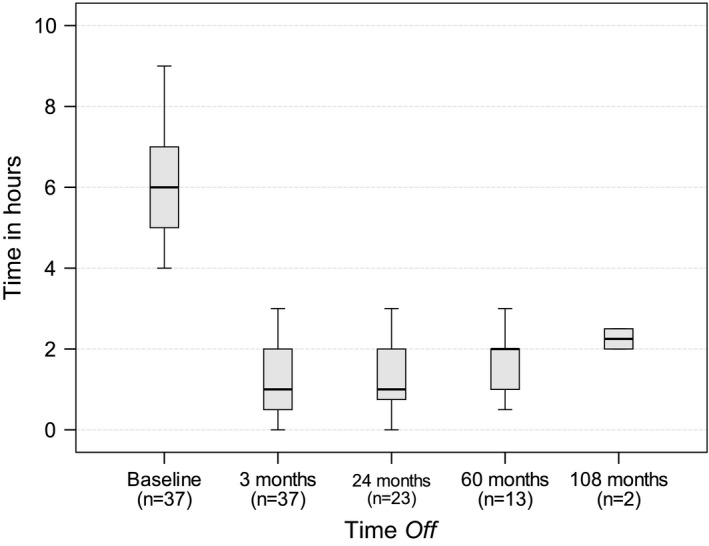
There was a high number of AE, but manageable, most of mild and moderate severity. All patients experienced significant improvement in motor fluctuations with a reduction in mean daily time of 4.87 hr after 3 months ( = 37) to 6.25 hr after 9 years ( = 2). Diskynesias remained stables in 28 patients (75.7%) and improved in 5 patients (13.5%). There was no neuropsychological deterioration, but an improvement in attentional functions, voluntary motor control, and semantic fluency. Quality of sleep did not worsen, and there was an improvement in the subjective parameters, although overnight polysomnography did not change. There was a significant sustained improvement of 37% in PD-Q39 after 3 months and to 1 year, and a significant reduction in caregiver burden of 10% after 3 months.
LCIG infusion is a safe and efficacious treatment for the control of motor fluctuations, and for improvement or nonworsening of nonmotor aspects, long-term sustained, and feasible for use in routine care.
左旋多巴-卡比多巴肠凝胶(LCIG)输注已被证明可改善运动波动。本研究旨在评估 LCIG 输注在有运动波动的晚期帕金森病(PD)患者中的长期安全性和有效性,及其对非运动症状的影响。
评估了不良事件(AE)及其管理、临床运动和非运动方面,最长可达 10 年。37 例患者接受了 LGIC 治疗;在三组患者中,使用特定的电池测试评估认知和行为评估 6 个月、睡眠质量 6 个月和生活质量和照顾者负担 1 年。
AE 数量较高,但可管理,大多数为轻度和中度。所有患者的运动波动均有显著改善,3 个月后(n=37)平均每日时间减少 4.87 小时,9 年后(n=2)减少 6.25 小时。28 例患者(75.7%)的舞蹈病保持稳定,5 例患者(13.5%)有所改善。认知功能没有恶化,但注意力、自主运动控制和语义流畅性有所改善。睡眠质量没有恶化,主观参数有所改善,尽管整夜多导睡眠图没有改变。PD-Q39 在 3 个月后和 1 年时分别有 37%和 1 年的显著持续改善,3 个月后照顾者负担减轻 10%。
LCIG 输注是一种安全有效的治疗方法,可控制运动波动,并改善或不恶化非运动方面,长期持续,可在常规护理中使用。