Uršič Katja, Ogrizović Mojca, Kordiš Dušan, Natter Klaus, Petrovič Uroš
Jožef Stefan Institute, Department of Molecular and Biomedical Sciences, Jamova cesta 39, 1000, Ljubljana, Slovenia.
Present address: Institute of Oncology Ljubljana, Zaloška cesta 2, 1000, Ljubljana, Slovenia.
BMC Microbiol. 2017 Aug 22;17(1):181. doi: 10.1186/s12866-017-1088-1.
The only hitherto known biological role of yeast Saccharomyces cerevisiae Tum1 protein is in the tRNA thiolation pathway. The mammalian homologue of the yeast TUM1 gene, the thiosulfate sulfurtransferase (a.k.a. rhodanese) Tst, has been proposed as an obesity-resistance and antidiabetic gene. To assess the role of Tum1 in cell metabolism and the putative functional connection between lipid metabolism and tRNA modification, we analysed evolutionary conservation of the rhodanese protein superfamily, investigated the role of Tum1 in lipid metabolism, and examined the phenotype of yeast strains expressing the mouse homologue of Tum1, TST.
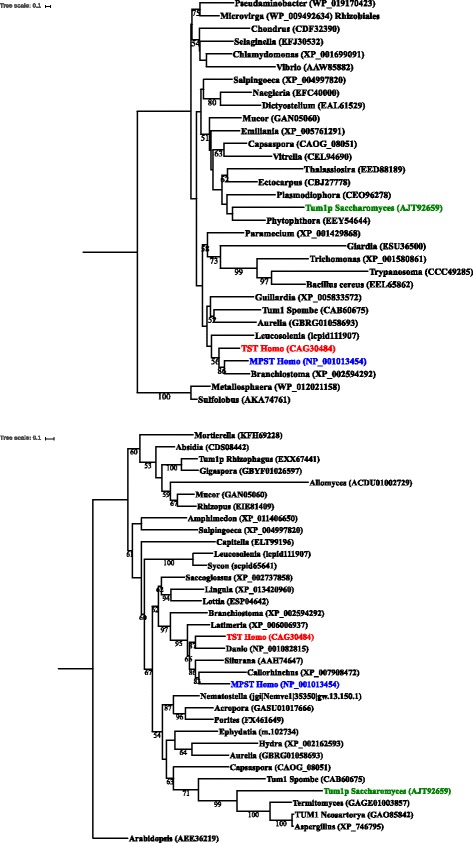
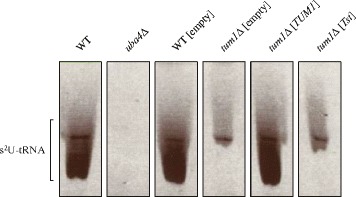
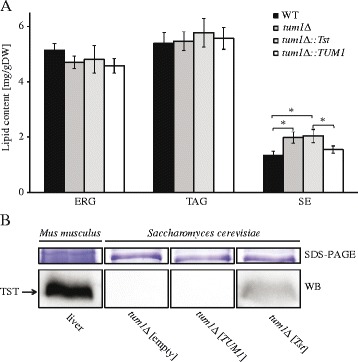
We analysed evolutionary relationships in the rhodanese superfamily and established that its members are widespread in bacteria, archaea and in all major eukaryotic groups. We found that the amount of sterol esters was significantly higher in the deletion strain tum1Δ than in the wild-type strain. Expression of the mouse TST protein in the deletion strain did not rescue this phenotype. Moreover, although Tum1 deficiency in the thiolation pathway was complemented by re-introducing TUM1, it was not complemented by the introduction of the mouse homologue Tst. We further showed that the tRNA thiolation pathway is not involved in the regulation of sterol ester content in S. cerevisiae, as overexpression of the tE, tK and tQ tRNAs did not rescue the lipid phenotype in the tum1Δ deletion strain, and, additionally, deletion of the key gene for the tRNA thiolation pathway, UBA4, did not affect sterol ester content.
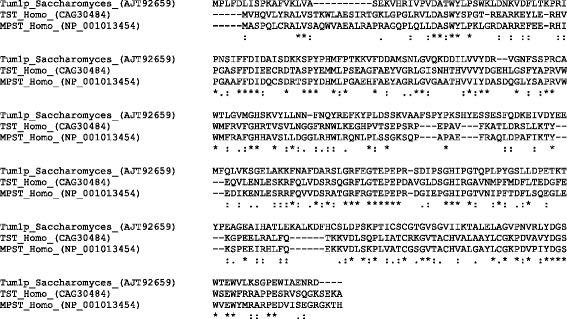
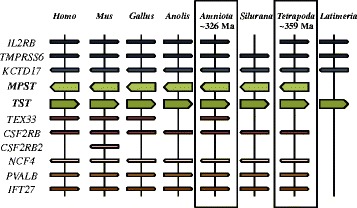
The rhodanese superfamily of proteins is widespread in all organisms, and yeast TUM1 is a bona fide orthologue of mammalian Tst thiosulfate sulfurtransferase gene. However, the mouse TST protein cannot functionally replace yeast Tum1 protein, neither in its lipid metabolism-related function, nor in the tRNA thiolation pathway. We show here that Tum1 protein is involved in lipid metabolism by decreasing the sterol ester content in yeast cells, and that this function of Tum1 is not exerted through the tRNA thiolation pathway, but through another, currently unknown pathway.
迄今为止,已知酵母酿酒酵母Tum1蛋白唯一的生物学作用是参与tRNA硫醇化途径。酵母TUM1基因的哺乳动物同源物,硫代硫酸盐硫转移酶(又称硫氰酸酶)Tst,已被认为是一种抗肥胖和抗糖尿病基因。为了评估Tum1在细胞代谢中的作用以及脂质代谢与tRNA修饰之间的假定功能联系,我们分析了硫氰酸酶蛋白超家族的进化保守性,研究了Tum1在脂质代谢中的作用,并检测了表达Tum1小鼠同源物TST的酵母菌株的表型。
我们分析了硫氰酸酶超家族中的进化关系,确定其成员广泛存在于细菌、古细菌和所有主要真核生物类群中。我们发现,缺失菌株tum1Δ中的甾醇酯含量显著高于野生型菌株。在缺失菌株中表达小鼠TST蛋白并不能挽救这种表型。此外,虽然通过重新引入TUM1可以弥补硫醇化途径中的Tum1缺陷,但引入小鼠同源物Tst并不能弥补这一缺陷。我们进一步表明,tRNA硫醇化途径不参与酿酒酵母中甾醇酯含量的调节,因为tE、tK和tQ tRNA的过表达并不能挽救tum1Δ缺失菌株中的脂质表型,此外,tRNA硫醇化途径的关键基因UBA4的缺失并不影响甾醇酯含量。
硫氰酸酶蛋白超家族在所有生物中广泛存在,酵母TUM1是哺乳动物Tst硫代硫酸盐硫转移酶基因的真正直系同源物。然而,小鼠TST蛋白在其脂质代谢相关功能或tRNA硫醇化途径中均不能在功能上替代酵母Tum1蛋白。我们在此表明,Tum1蛋白通过降低酵母细胞中的甾醇酯含量参与脂质代谢,并且Tum1的这一功能不是通过tRNA硫醇化途径发挥的,而是通过另一条目前未知的途径。