Taylor Nicholas J, Mitra Nandita, Goldstein Alisa M, Tucker Margaret A, Avril Marie-Françoise, Azizi Esther, Bergman Wilma, Bishop D Timothy, Bressac-de Paillerets Brigitte, Bruno William, Calista Donato, Cannon-Albright Lisa A, Cuellar Francisco, Cust Anne E, Demenais Florence, Elder David E, Gerdes Anne-Marie, Ghiorzo Paola, Grazziotin Thais C, Hansson Johan, Harland Mark, Hayward Nicholas K, Hocevar Marko, Höiom Veronica, Ingvar Christian, Landi Maria Teresa, Landman Gilles, Larre-Borges Alejandra, Leachman Sancy A, Mann Graham J, Nagore Eduardo, Olsson Håkan, Palmer Jane M, Perić Barbara, Pjanova Dace, Pritchard Antonia, Puig Susana, van der Stoep Nienke, Wadt Karin A W, Whitaker Linda, Yang Xiaohong R, Newton Bishop Julia A, Gruis Nelleke A, Kanetsky Peter A
Department of Epidemiology and Biostatistics, Texas A&M Health Science Center, College Station, Texas, USA.
Department of Biostatistics and Epidemiology, University of Pennsylvania, Philadelphia, Pennsylvania, USA.
J Invest Dermatol. 2017 Dec;137(12):2606-2612. doi: 10.1016/j.jid.2017.07.829. Epub 2017 Aug 19.
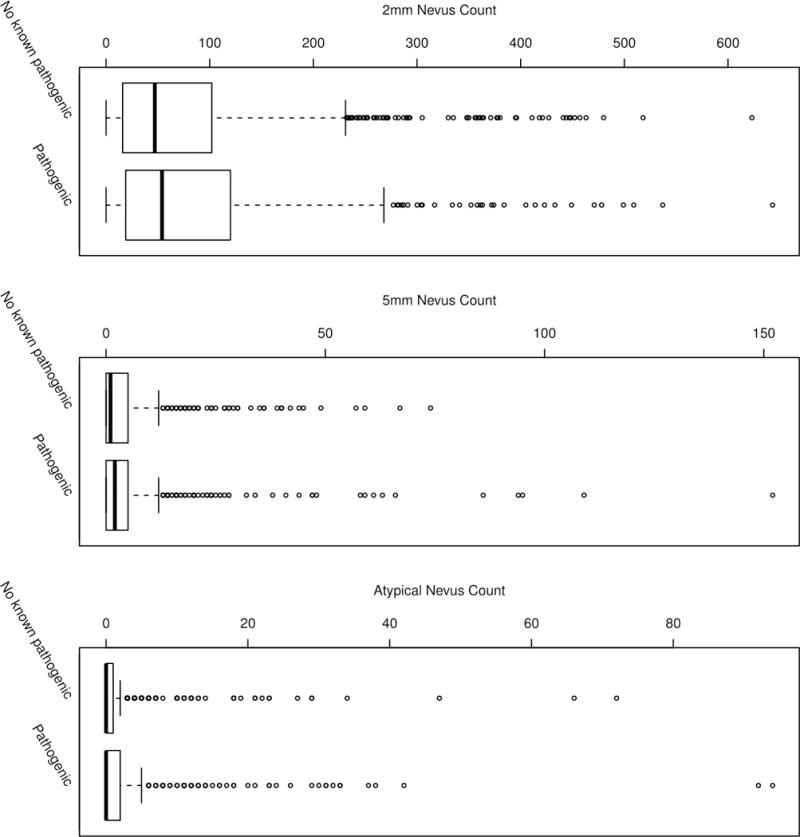
Germline mutations in CDKN2A are frequently identified among melanoma kindreds and are associated with increased atypical nevus counts. However, a clear relationship between pathogenic CDKN2A mutation carriage and other nevus phenotypes including counts of common acquired nevi has not yet been established. Using data from GenoMEL, we investigated the relationships between CDKN2A mutation carriage and 2-mm, 5-mm, and atypical nevus counts among blood-related members of melanoma families. Compared with individuals without a pathogenic mutation, those who carried one had an overall higher prevalence of atypical (odds ratio = 1.64; 95% confidence interval = 1.18-2.28) nevi but not 2-mm nevi (odds ratio = 1.06; 95% confidence interval = 0.92-1.21) or 5-mm nevi (odds ratio = 1.26; 95% confidence interval = 0.94-1.70). Stratification by case status showed more pronounced positive associations among non-case family members, who were nearly three times (odds ratio = 2.91; 95% confidence interval = 1.75-4.82) as likely to exhibit nevus counts at or above the median in all three nevus categories simultaneously when harboring a pathogenic mutation (vs. not harboring one). Our results support the hypothesis that unidentified nevogenic genes are co-inherited with CDKN2A and may influence carcinogenesis.
CDKN2A基因的种系突变在黑色素瘤家族中经常被发现,并且与非典型痣数量增加有关。然而,致病性CDKN2A基因突变携带与其他痣表型(包括常见后天痣的数量)之间的明确关系尚未确立。利用GenoMEL的数据,我们研究了黑色素瘤家族有血缘关系的成员中CDKN2A基因突变携带与2毫米、5毫米及非典型痣数量之间的关系。与没有致病性突变的个体相比,携带致病性突变的个体非典型痣的总体患病率更高(优势比=1.64;95%置信区间=1.18-2.28),但2毫米痣(优势比=1.06;95%置信区间=0.92-1.21)或5毫米痣(优势比=1.26;95%置信区间=0.94-1.70)的患病率没有更高。按病例状态分层显示,在非病例家庭成员中,这种正相关更为明显,当携带致病性突变时,他们在所有三种痣类别中同时出现痣数量等于或高于中位数的可能性几乎是非携带者的三倍(优势比=2.91;95%置信区间=1.75-4.82)。我们的结果支持这样一种假设,即未识别的致痣基因与CDKN2A共同遗传,并可能影响致癌作用。